On this page
Your teenager wants to pay for the canteen, the auto home from tuition and a friend's birthday gift without asking you for cash each time. UPI can do that. The real questions are which setup, how much money, and which rules to agree on first.
Can a teenager in India use UPI at all?
There are two routes.
The first is your teen's own bank account. Under the RBI's April 2025 directions on deposit accounts of minors, banks may let minors open and operate savings accounts independently from an age the bank sets, which cannot be lower than 10, up to amounts and on terms the bank fixes. The same directions say banks are free to offer extras such as internet banking and debit cards based on their own risk management policy, and that a minor's account must never be overdrawn. So whether your teen can link UPI to their own account depends on the bank: ask at the branch. Our guide to opening a bank account for a minor child covers the paperwork.
The second route is UPI Circle, where your teen pays from your account with limits you set.
What is UPI Circle, and what are its limits?
UPI Circle lets a primary user (you) authorise a secondary user (your teen) to make UPI payments from your bank account. There are two modes, as Paytm's guide to UPI Circle explains:
Partial delegation: your teen starts a payment, and it goes through only after you approve it with your UPI PIN.
Full delegation: your teen pays on their own, within a limit you choose.
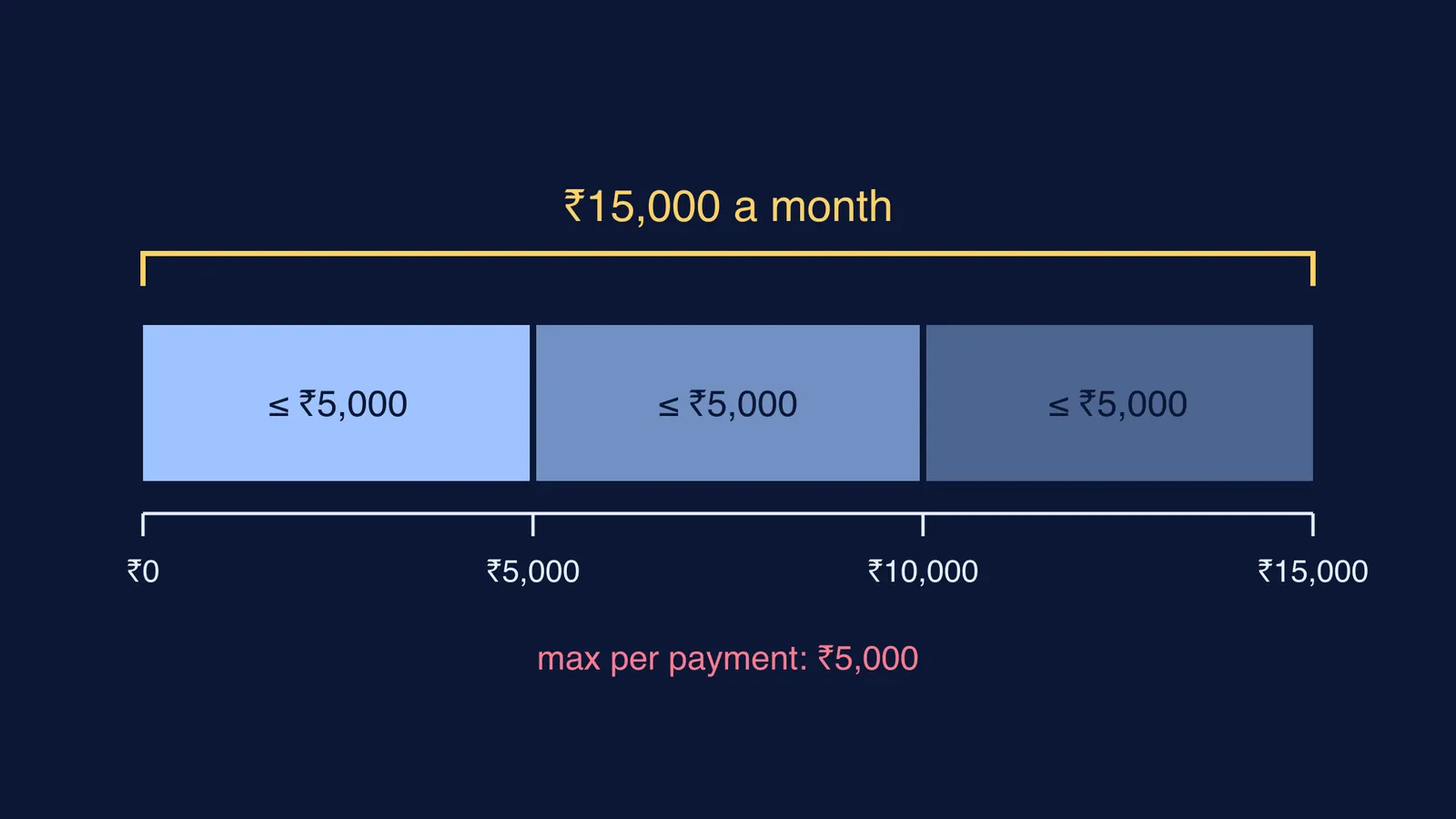
Under full delegation, a secondary user can spend at most ₹15,000 a month and ₹5,000 per payment, according to Ujjivan Small Finance Bank's UPI Circle explainer. The same page says one primary user can add up to 5 secondary users. Set a lower limit than the maximum.
How much should a teenager be allowed to spend?
Start with partial delegation, then widen access in stages once your teen shows they can manage it. One staged plan:
Weeks 1 to 4, approve everything. Use partial delegation. Each request reaches your phone, which gives you a natural moment to ask what it was for.
Months 2 to 3, a small monthly limit. Switch to full delegation with a limit close to their usual pocket money. Review the history together once a week.
After that, a limit tied to a budget. Raise the limit only when the weekly reviews have been dull for a month.
Worked example: Ananya, 15, gets ₹1,200 a month. Her parents set a ₹1,200 full-delegation limit: ₹600 for snacks, ₹400 for travel, ₹200 saved. By the end of week two she has spent ₹500 of her ₹600 snack budget. The weekly review shows the gap, and she decides what to cut. If you are unsure what figure to start from, see how much pocket money a teenager in India needs.
Tracking spending is good percentage practice. If the maths underneath is shaky, the Fermi Concept Library has a lesson for each concept in mathematics.
What scam rules should a teen agree to first?
Fraud is harder to spot and undo than overspending. A PIB backgrounder from October 2025 reports that cybersecurity incidents in India rose from 10.29 lakh in 2022 to 22.68 lakh in 2024.
Agree on these four rules out loud, before the first payment:
The PIN is only for sending. The RBI's consumer awareness notice on cyber frauds states that receiving money does not require scanning a QR code or entering a PIN.
Nobody gets the PIN or OTP. The same notice says never to share your UPI PIN or OTP with anyone, not even bank officials.
No app installs on a stranger's instructions. The RBI warns that fraudsters persuade people to download apps that can access the data on their phone.
A request for money from a person is a stop sign. NPCI stopped person-to-person collect requests on UPI from 1 October 2025 because fraudsters misused them, Business Today reported. Collect requests from merchants still exist.
For a longer conversation on OTPs and fake callers, read how to teach your child about scams and OTPs.
What should you do if money goes to a scammer?
Act within minutes, not days.
Call 1930, the national cybercrime helpline, or file at cybercrime.gov.in. The PIB backgrounder says 1930 helps victims of online financial fraud report promptly and, where possible, freeze fraudulent transactions.
Report it to your bank the same day. Under the RBI's 2017 circular on customer liability, when an unauthorised transaction happens because a customer shared their payment credentials, the customer bears the entire loss until they report it to the bank; losses after reporting fall on the bank.
Remove your teen's delegation in the UPI app until you have talked it through.