On this page
If you know the four corners of a tetrahedron as coordinates, you do not need a separate base area and height. Three subtractions, one 3×3 determinant, divide by six. Here is where the six comes from, one example checked two ways, and the slips that cost marks.
What is the scalar triple product formula for tetrahedron volume?
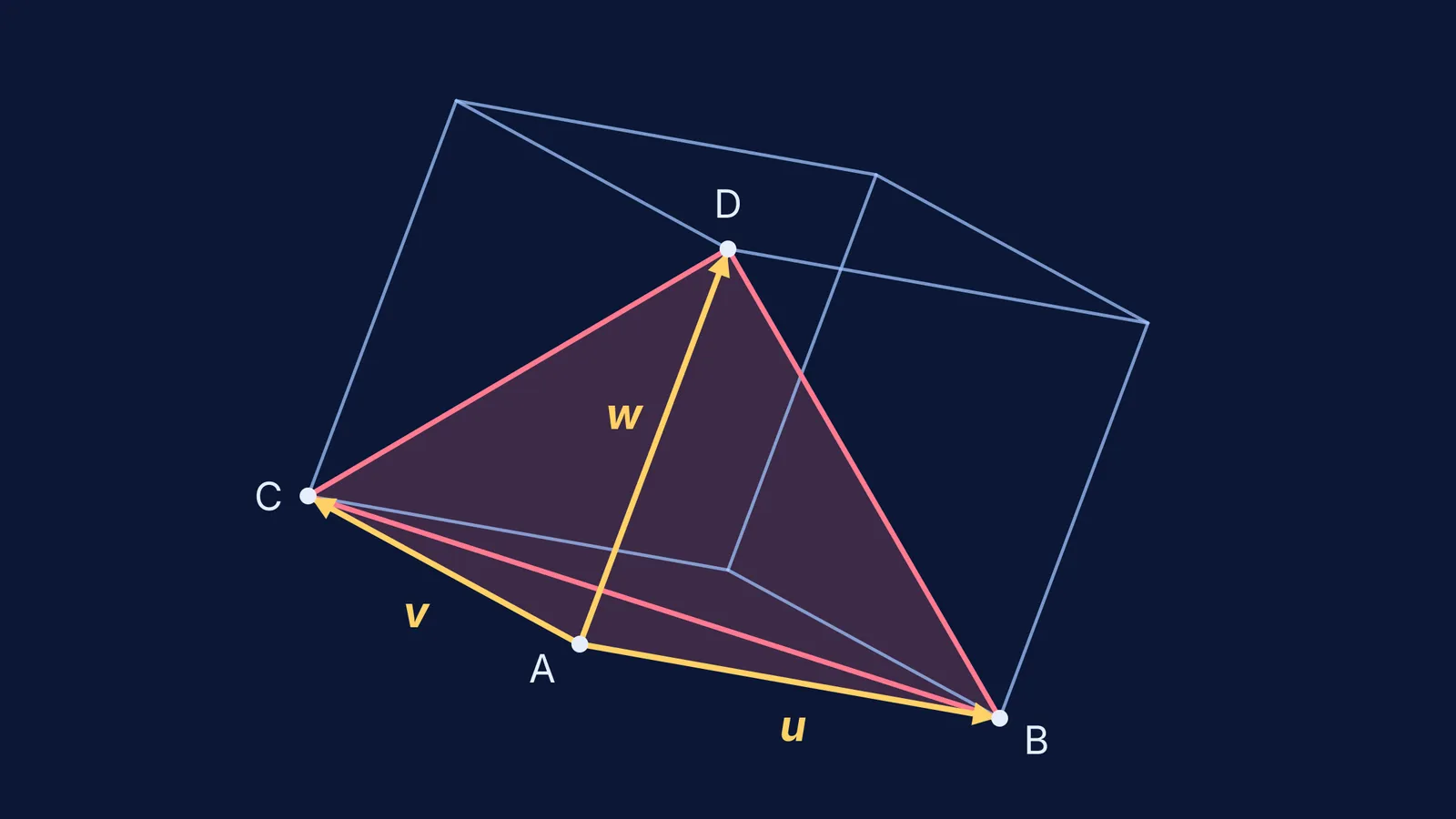
Pick one vertex, say A, and take edges to the other three: u = AB = B − A, v = AC and w = AD.
The scalar triple product u · (v × w) equals the determinant of the 3×3 matrix whose rows are the components of u, v and w (Wikipedia: Triple product).
The volume of the parallelepiped with adjacent edges u, v and w is the absolute value of that triple product, |u · (v × w)| (OpenStax Calculus Volume 3, section 2.4).
The volume of the tetrahedron on the same three edges is one-sixth of the parallelepiped's: V = (1/6)|u · (v × w)| (Wikipedia: Tetrahedron).
If the cross product inside the formula still trips you up, read how to expand a cross product by determinant without sign errors first.
Why is a tetrahedron one-sixth of the parallelepiped?
Start from the pyramid formula. The volume of any tetrahedron is V = (1/3)Ah, where A is the base area and h is the perpendicular distance from the base to the opposite vertex (Wikipedia: Tetrahedron). Now compare it with the parallelepiped on the same three edges.
Base. The parallelepiped stands on the parallelogram spanned by v and w, area |v × w|. The tetrahedron stands on triangle ACD, exactly half of it: |v × w|/2.
Height. Both solids are lifted by the same edge u, so both have the same height: the component of u along the normal to the base.
Combine. The parallelepiped is a prism, so its volume is base × height. The tetrahedron is (1/3) × (half the base) × (the same height), which is 1/3 × 1/2 = 1/6 of the parallelepiped.
In the diagram at the top, the shaded tetrahedron ABCD sits in one corner of the parallelepiped on u, v and w.
Worked example: volume from four vertices in coordinates
Find the volume of the tetrahedron with A(1, 0, 1), B(3, 1, 1), C(1, 2, 2) and D(2, 1, 4), using V = (1/6)|u · (v × w)| (OpenStax Calculus Volume 3).
Step 1: edge vectors from A.
u = B − A = (2, 1, 0)
v = C − A = (0, 2, 1)
w = D − A = (1, 1, 3)
Step 2: the determinant with rows u, v and w, expanded along the first row:
2(2·3 − 1·1) − 1(0·3 − 1·1) + 0(0·1 − 2·1) = 2(5) − 1(−1) + 0 = 11.
Step 3: divide by six. V = 11/6 cubic units, about 1.83. The parallelepiped on the same edges has volume 11.
Check 1, a different starting vertex. From B, the edges are BA = (−2, −1, 0), BC = (−2, 1, 1) and BD = (−1, 0, 3), and the determinant is −11. The sign records orientation; the absolute value, and so the volume 11/6, is unchanged.
Check 2, base and height. AB × AC = (1, −2, 4), with magnitude √21, so triangle ABC has area √21/2. The height of D above that plane is (1, −2, 4) · AD / √21 = 11/√21. Then V = (1/3)(√21/2)(11/√21) = 11/6.
For a faster Step 2 on paper, the rule of Sarrus for 3×3 determinants gives the same 11.
What mistakes cost marks on this question?
Forgetting the 1/6 and writing 11, the parallelepiped's volume.
Using position vectors of the points instead of edge vectors such as B − A.
Taking edges from different vertices. All three must start at one corner.
Reporting a negative volume. The triple product is signed, and the sign only records orientation (Wikipedia: Triple product), so take the absolute value.
Panicking at zero. A zero triple product means the edges are coplanar and the parallelepiped is flat (Wikipedia: Triple product), so the four points lie in one plane. The same idea drives the condition for two lines to be coplanar.
How should you practise this?
Do three problems in one sitting, and check at least one by base and height:
One vertex at the origin, so the edges are the other three position vectors.
Four general points, starting from a vertex other than A.
A point with an unknown k: set the triple product to a given volume, or to zero for coplanar points, and solve for k.
If your determinant keeps disagreeing with the answer key, the Fermi Problem Library has worked problems with a step-by-step solver that explains the reasoning rather than printing an answer, so you can see which row went wrong. If the cross product itself feels shaky, the Fermi Concept Library gives every concept in mathematics its own lesson.
Next time you see four vertices, write three edges from one corner first.