On this page
The van is honking, the geometry box is under the sofa and the signed permission slip is still on the fridge. Packing the night before moves that job to a calmer hour, and a child can learn to do it alone with three things: a checklist that comes from the timetable, a fixed packing time, and parent checks that step back week by week.
Why pack the school bag the night before?
Evenings leave time to fix what mornings cannot, like a form to sign or a PE uniform to wash. They also keep the bag light. India's Policy on School Bag 2020, released by NCERT for the Ministry of Education, recommends a school bag weight of 10 per cent of the child's body weight for Classes I to X.
The same policy's survey found that where schools prescribe more than one textbook per subject, students often carry all of them "without knowing which book will be used in the class on which day". Packing by timetable each night is the home version of the fix: only what tomorrow needs goes in. If the bag is still too heavy, our guide on how to reduce a heavy school bag covers weighing it and what to ask the school.
How do you make a packing checklist from the timetable?
The Policy on School Bag 2020 says the class timetable should indicate which book will be used on which day. Turn it into a checklist your child can read without you.
Stick the weekly timetable at eye level near the place the bag lives.
Under it, pin a short list of things that go in every day.
Each night, your child reads tomorrow's column and packs one period at a time.
Last step: take out anything for a subject that is not on tomorrow's timetable.
Here is a worked example for a Class 6 Tuesday with English, Maths, Science, Hindi, Social Science and PE:
Every day: pencil pouch, school diary, ID card, water bottle and tiffin box (the last two filled in the morning)
English: textbook and notebook
Maths: textbook, notebook and geometry box
Science: textbook and notebook
Hindi: textbook and notebook
Social Science: textbook and notebook
PE: sports shoes or house T-shirt, if the school asks for them
Tonight's extras: finished homework in the right notebook, anything that needs a parent's signature
Out of the bag: Wednesday-only books, last week's art material
What time should a child pack the school bag?
Pick one time and tie it to something that already happens every night, such as "straight after homework, at my desk". Psychologists call this kind of if-then plan an implementation intention.
In a meta-analysis by Peter Gollwitzer and Paschal Sheeran38002-1), plans that spell out when, where and how to act had a medium-to-large effect on reaching goals across 94 independent tests (d = .65). Let your child say their own plan out loud: "When I finish homework, I pack my bag at my desk."
Expect it to take a while. In a study of 96 volunteers by Phillippa Lally and colleagues, the time for a daily behaviour in a fixed context to reach 95 per cent of its peak automaticity ranged from 18 to 254 days. The same study found that missing one opportunity did not materially affect habit formation, so a skipped night is not a reason to start over. If tuition crowds the evening, our evening routine time plan for a child with tuition shows where the slot can fit.
How do you stop checking without the bag falling apart?
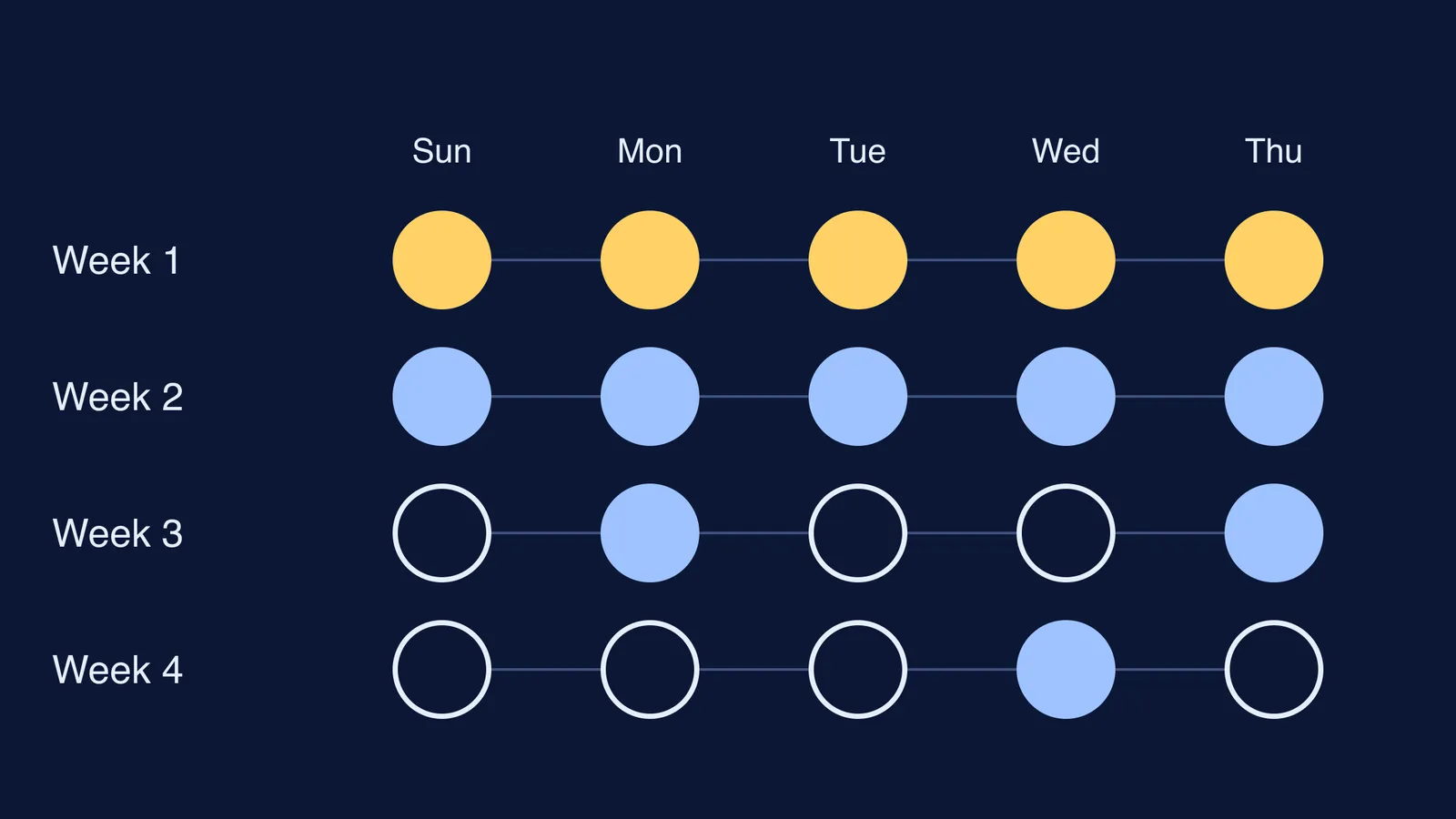
Fade your checks on a schedule, so your child takes over one step at a time. This is our suggested four-week plan:
Week 1, pack together: you sit beside them, they read the timetable aloud and put each item in.
Week 2, they pack and you check every night: they show you the bag against the list; you point, they fix.
Week 3, two spot checks: they pack alone every night and you check on two nights of your choosing.
Week 4, one spot check: a single check on a night they do not know in advance.
After that, the list does the checking. If items keep going missing, go back one week for a few nights, not back to the start. A forgotten notebook that costs a teacher's remark is a small, safe lesson; for things with bigger stakes, such as an admit card or a fee receipt, keep a parent check in place.
For other jobs a child can own, see our list of age-appropriate chores for kids in India.
What if the nightly check turns up unfinished homework?
That is the routine doing its job. If the problem is a maths or science question your child is stuck on, the Fermi Problem Library has worked problems with a step-by-step solver that explains the reasoning rather than printing an answer.
Start tonight: print tomorrow's timetable, write the every-day list under it, and pack the first bag together.