

On this page
If your child's bag feels like a sack of rice, you are not imagining it. For the Policy on School Bag 2020, an expert group convened by the Ministry of Education surveyed 352 schools, 2,992 parents and 3,624 students. School heads generally found primary-class bags of 2 to 3.5 kg, rising to 3 to 6 kg from Class VI. Textbooks alone weighed 500 g to 3.5 kg, and the empty bag itself weighed 150 g to 1 kg.
Much of that weight comes from packing habits and the timetable, which you and the school can change.
How heavy should a school bag be?
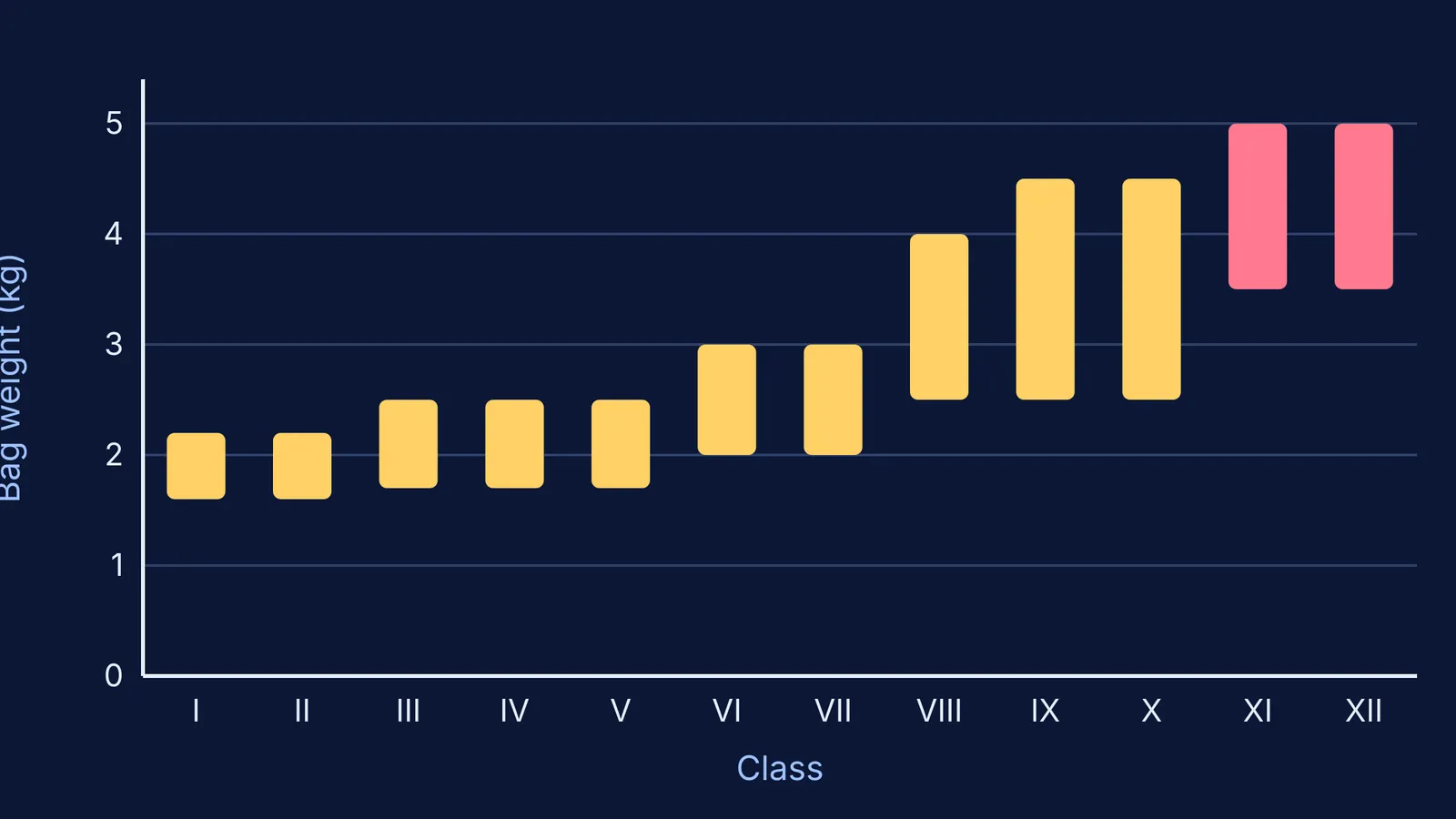
The Policy on School Bag 2020 recommends that a school bag weigh no more than 10 per cent of the student's body weight across Classes I to X. It recommends no bag at all in pre-primary, and gives these suggested ranges:
Classes I and II: 1.6 to 2.2 kg
Classes III to V: 1.7 to 2.5 kg
Classes VI and VII: 2 to 3 kg
Class VIII: 2.5 to 4 kg
Classes IX and X: 2.5 to 4.5 kg
Classes XI and XII: 3.5 to 5 kg
The 10 per cent figure is a guideline, not a medical cut-off. A 2018 systematic review in the British Journal of Sports Medicine of 69 studies with 72,627 children and adolescents found no convincing evidence that bag weight, design or carrying method raises the risk of back pain. If your child has back or shoulder pain that lasts or gets worse, see a doctor or physiotherapist.
How do you check your child's bag weight at home?
Use a bathroom scale on the heaviest day of the week. A worked example for a Class 7 child:
Your child stands on the scale alone: 32 kg.
Your child stands on it again holding the packed bag: 35.5 kg.
The bag weighs 35.5 minus 32, which is 3.5 kg.
Ten per cent of 32 kg is 3.2 kg, so the bag is about 300 g over.
Weigh the bottle, lunch box and each textbook on a kitchen scale to see which item to drop first.
How can you reduce a heavy school bag for your child?
Do this the night before. From about Class 6, children can do it themselves while you check weekly. It fits into a two-part plan for calmer school mornings.
Pack from the timetable, not from habit. The national policy says the class timetable should show which book is used on which day, including which of two textbooks for the same subject.
Ask which books will not be needed. The policy asks subject teachers to give advance notice so students can leave textbooks at home on days they won't be used.
Leave notebooks at school where you can. For Classes III to V, the policy suggests two notebooks with only one in the bag at a time. For Classes VI to VIII it suggests one file of loose sheets for classwork and homework.
Drop the extras. Leave guidebooks and reference books at home unless the teacher asked for them. The policy makes schools responsible for safe drinking water, so a smaller bottle may be enough.
Share with a seatmate. The policy encourages children who sit together to share textbooks so that each one carries fewer.
Check the bag itself. The policy recommends a light bag with compartments and two padded, adjustable straps worn on both shoulders, and no wheels, which can hurt children on stairs. Here is why thin bag straps hurt your shoulders.
The survey found reference books adding weight from Class IX. If your teenager carries a guidebook for its worked examples, the Fermi Problem Library has worked problems with a step-by-step solver that explains the reasoning, so the guide can stay at home.
What should you say to the school about bag weight?
You are asking the school to do what the national policy already asks. The Policy on School Bag 2020 says every school should keep a digital weighing machine, and teachers in Classes I to V should check bags at random every three months. The head of school should spread textbook weight fairly across the week. Education departments still act on it: a May 2026 circular from Chandigarh's Directorate of School Education told schools to limit the textbooks students carry, with books brought only according to the timetable.
At a parent-teacher meeting, bring the numbers and one or two specific requests:
"We weighed my child's bag on Tuesday: 3.5 kg, against a body weight of 32 kg. That is above the 10 per cent in the School Bag Policy."
"Could the timetable show which books are needed each day?"
"Is there a place in class to keep notebooks overnight, or could seatmates share a textbook?"
"Tuesday has the most heavy subjects. Could some move to other days?"
If your teenager wants to argue the physics, here is when a school bag does zero work even though it still tires you out. Tonight, put the bag on the scale and do the subtraction together.


