

On this page
If you have ever carried a heavy school bag by just one strap or noticed red marks on your child's shoulders after a long day at school, you know the discomfort of a heavy backpack. But the weight of the books is only half the story. The pain often comes down to a basic law of physics.
Why do narrow straps increase pressure?
In physics, pressure is defined as the force applied perpendicular to a surface divided by the area over which it is distributed (Pressure = Force ÷ Area).
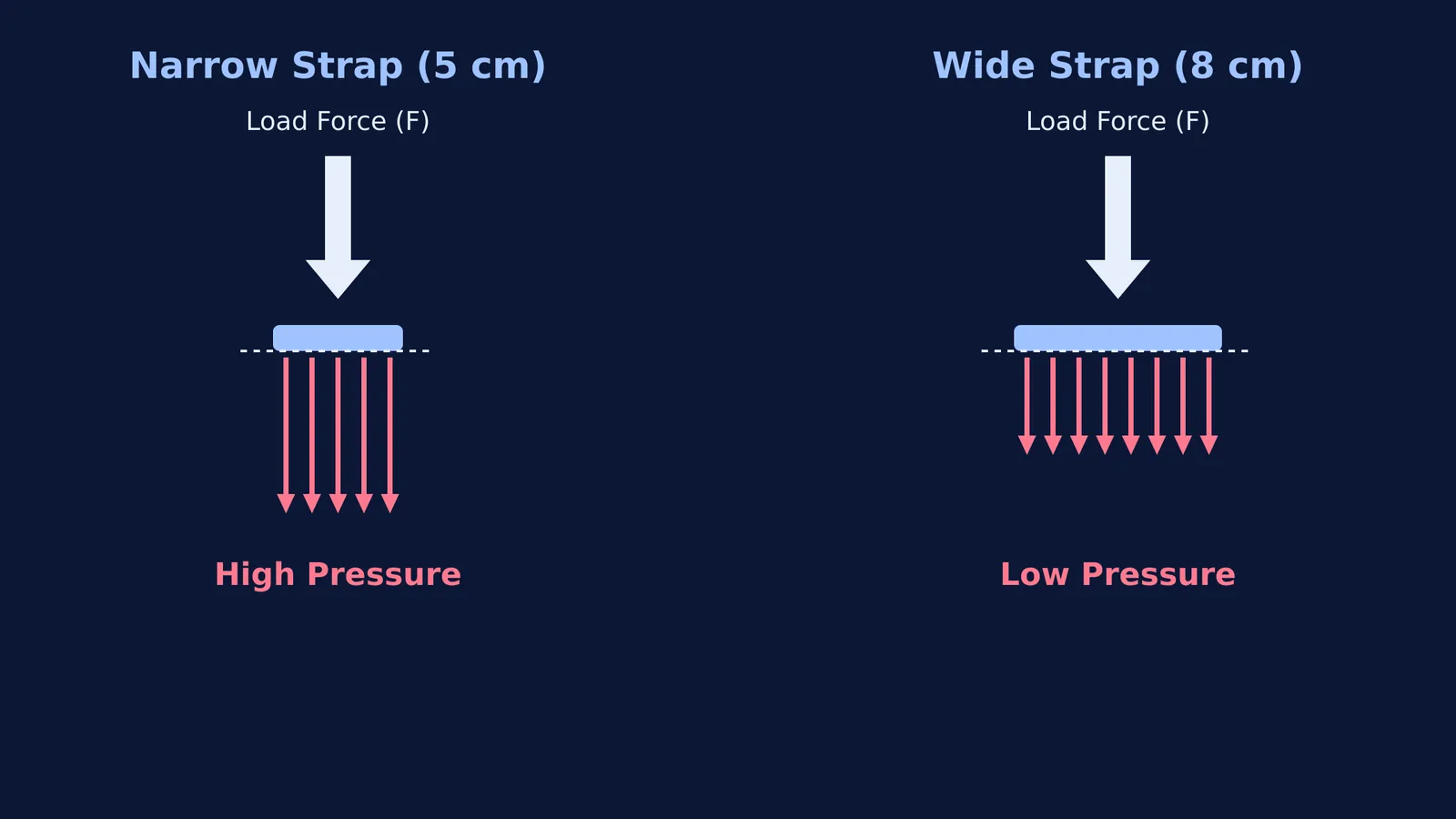
When a student wears a backpack, gravity pulls the bag down towards the Earth, creating a downward force equal to the bag's weight. If the bag is carried on thin, narrow straps, all of that weight is concentrated into a very small area on the shoulders.
Because the area is in the denominator of the equation, dividing a constant force by a smaller area results in a mathematically much higher pressure. This concentrated high pressure can dig into the shoulders and cause discomfort.
By contrast, a wider strap spreads the exact same weight over a much larger surface area. The total downward force remains unchanged, but the resulting pressure on the shoulder drops significantly.
If your child finds concepts like force and pressure hard to picture in their textbooks, the Fermi Simulation Lab lets them interact with these variables directly. They can visually explore how changing an area alters the pressure in real time, turning an abstract equation into a concrete experience. We also cover more on contact and non-contact forces in Class 8.
What does research say about strap width?
Researchers have tested exactly how strap design affects the human body. In a 2017 study published in the journal *Work*, scientists placed a 20 kg backpack on a manikin and carefully measured the interface pressure on the shoulders and underarms using different strap widths: 5 cm, 6 cm, 7 cm, and 8 cm (Work, 2017).
The results matched the physics equation perfectly. The study demonstrated an inverse relationship: as the shoulder strap width increased, the interface pressure decreased significantly. The researchers found that the 8 cm straps—the widest ones tested in the experiment—resulted in the least amount of interface pressure on the shoulder.
The study also found that where the weight sits inside the bag matters just as much as the straps. When narrow straps were used, placing the heavy load lower in the bag caused a huge spike in shoulder pressure. Wider straps made the bag far less sensitive to how it was packed, though the absolute best configuration for the body was an 8 cm strap with the heavy load packed high up.
How should you pack a school bag for comfort?
To minimise the strain on your child's shoulders, you can apply both the physics of pressure and the ergonomics of load placement to their everyday routine:
Choose wide, padded straps: When buying a school bag, look for shoulder straps that are close to 8 cm in width to distribute the pressure as evenly as possible.
Pack heavy items high and close: Place the heaviest textbooks at the very back of the main compartment (closest to the spine) and ensure they sit as high up as possible.
Always use both straps: Carrying a bag on one shoulder halves the contact area again, instantly doubling the pressure and pulling the spine out of alignment.
Lighten the load: Routinely check your child's packed bag. If they are carrying unnecessary items, talk to them about leaving non-essential books at school.
Balancing high expectations against pressure is a constant challenge for parents in education, but the physical pressure from a heavy school bag is one strain we can easily fix.


