

On this page
Most rushed mornings are not lost at 7 a.m. They are lost the night before. The fix is two short written lists, one for the evening and one for the morning, so nobody argues about what comes next.
Why are school mornings so rushed?
Mostly because we guess how long things take, and we guess short. In a classic study, final-year university students predicted they would finish their thesis in 33.9 days on average and actually took 55.5 days (Buehler, Griffin and Ross, 1994). In the same study, fewer than one in three finished by the date they gave as their most realistic guess.
The second cause is decisions. Every "Where is my diary?" at 6:45 is a small negotiation, and negotiations become arguments when time is short. A checklist moves those decisions to the evening.
What should you do the night before school?
Do these in one 15-minute slot after dinner; your child does the work, you check. A picture routine chart for younger children helps those who cannot read a list yet.
Check the school diary or app for notes to sign and forms due.
Pack the bag by timetable, homework included, and put it by the door.
Lay out the full uniform down to socks, belt and ID card. Check for PT or house-colour day.
Fill the water bottle, decide the tiffin and prep what you can (see lunchbox ideas and a routine that holds up).
Decide breakfast and set out what does not need the fridge: plates, spoons, the poha already measured.
Charge phones outside the bedroom and set the alarm.
Lights out at a time that allows enough sleep.
On that last point, the American Academy of Sleep Medicine says children aged 6 to 12 should sleep 9 to 12 hours per 24 hours, and teenagers aged 13 to 18 should sleep 8 to 10 hours (Paruthi et al., 2016). Count back from the alarm: a 6:05 wake-up means lights out by 9 p.m. at the latest for a Class 4 child and by 10 p.m. at the latest for a Class 10 student. Keeping that time steady matters too; see how to handle bedtime on weekends and holidays.
If homework pushes bedtime late and a teenager is stuck on a maths or science chapter, Fermi's AI tutor can work out what they already know and build a plan for the session, so the evening starts with a clear next step instead of a blank page.
What is a good morning routine for school?
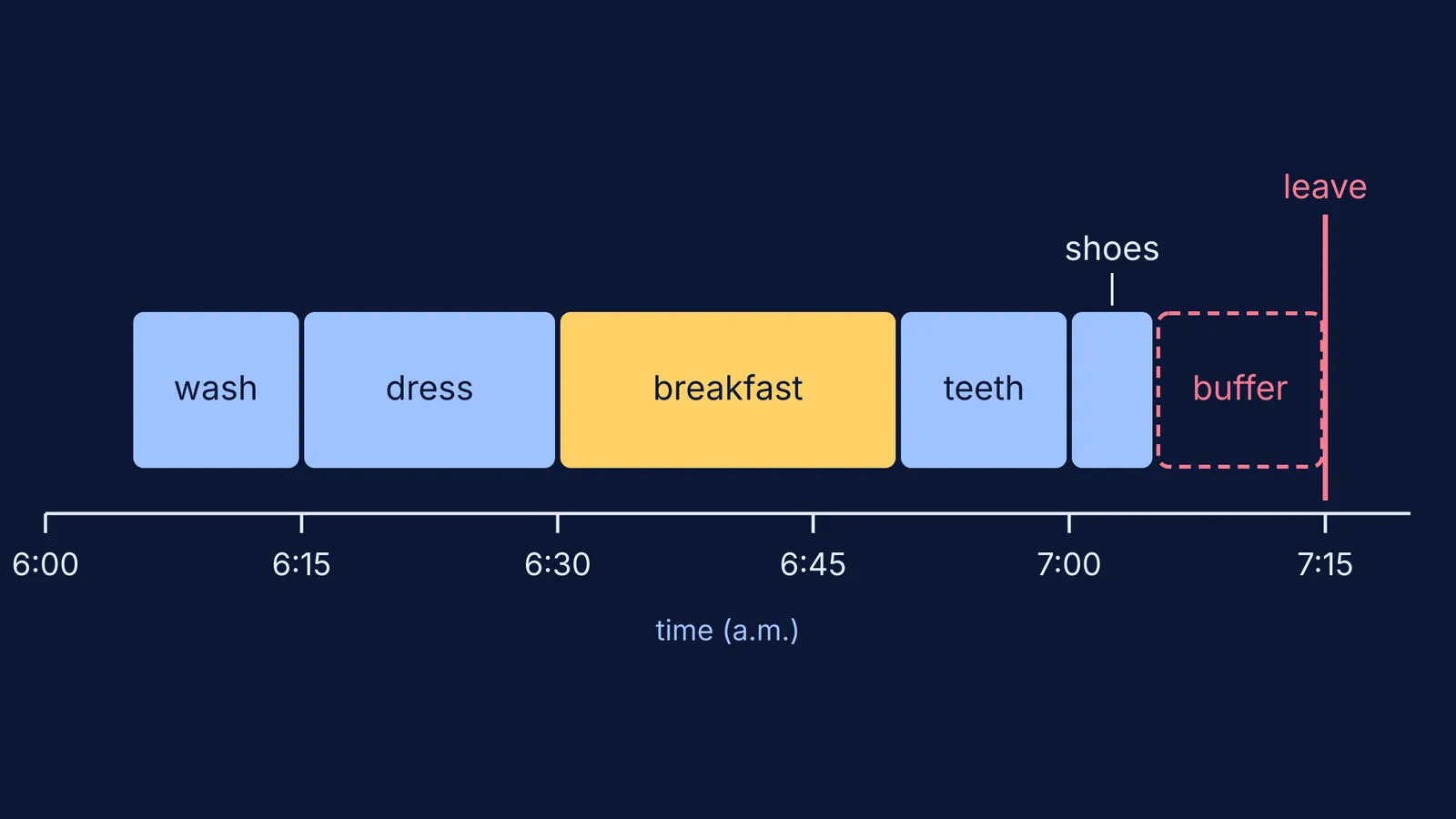
Work backwards from the time you must leave. Here is a worked plan for a school bus at 7:15 a.m.:
6:05 wake up, toilet, wash face (10 minutes)
6:15 dress in the uniform laid out last night (15 minutes)
6:30 breakfast at the table, no screens (20 minutes)
6:50 brush teeth, comb hair (10 minutes)
7:00 shoes on, bag and bottle in hand (5 minutes)
7:05 buffer (10 minutes)
7:15 leave for the bus
Dressing before breakfast means a slow eater eats into the buffer, not into a half-buttoned shirt at the gate. Keep the same order daily so it becomes "what we do" rather than "what Amma keeps saying". For an earlier bus, shift every time, bedtime included.
How do you get a child to eat breakfast before school?
Give breakfast a protected 20-minute slot, sit with your child if you can, and limit the choice to two options agreed the night before. A review of 36 studies found a mainly positive effect of breakfast on on-task behaviour in the classroom, and eating breakfast more often was consistently linked with better school performance (Adolphus, Lawton and Dye, 2013). The authors note that socio-economic status and weak study methods may explain part of that link.
If your child is not hungry at 6:30, go small: a banana and milk, or a rolled-up paratha, plus a little extra in the tiffin. If a child regularly refuses food, or mornings bring stomach aches or fear about going to school, talk to your paediatrician or the school counsellor. For emotional distress, Tele MANAS is free on 14416.
What should you say when the morning still goes wrong?
Plan the trouble spots as if-then rules. A meta-analysis of 94 independent tests found that if-then plans ("If situation X happens, I will do Y") had a medium-to-large effect on reaching goals (Gollwitzer and Sheeran, 2006). Agree a few with your child at a calm moment, then use the same words in the morning:
"If you are not at the table by 6:35, breakfast goes into a box and you eat it at the bus stop."
"If something is missing at 7:00, we do not hunt for it. We add it to tonight's list."
"If you are still in bed after the alarm, I will come once, open the curtains and tell you the time."
"If we start arguing, I will stop talking and point at the chart."
Each evening, ask "What slowed us down today?" and add the answer to the night-before list. Start tonight with the seven points above.


