

On this page
It is a Friday night, and the natural temptation is to let your child stay up late. After a week of early alarms, homework, and strict schedules, weekends feel like a time to catch up on sleep and relax the rules.
But pediatric sleep science paints a different picture. Shifting a child's bedtime and wake time by several hours on weekends creates a stark mismatch between their biological clock and their social schedule—a phenomenon known in chronobiology as "social jetlag."
What is social jetlag?
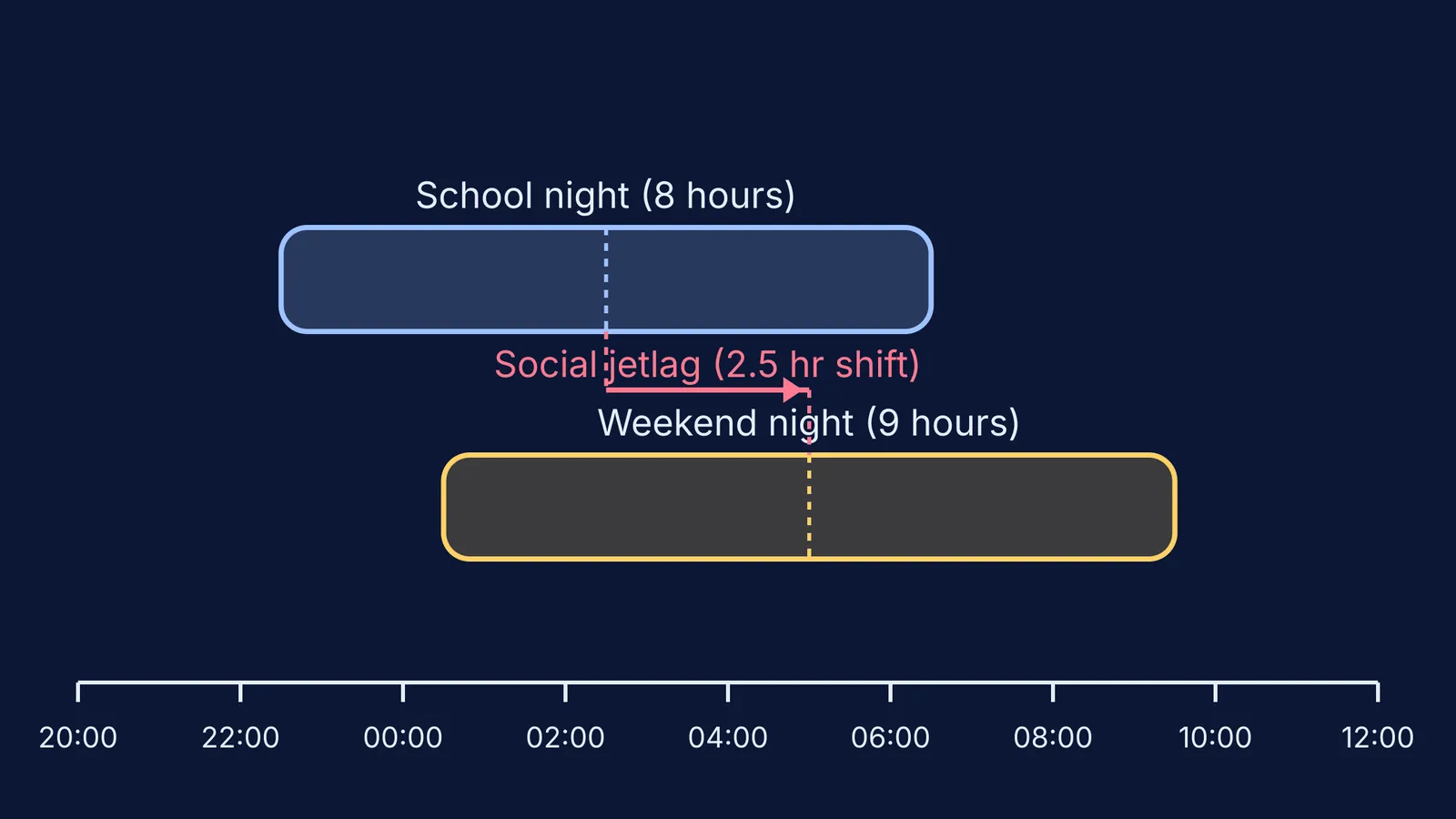
When a student sleeps from 22:30 to 06:30 on a school night (a midpoint of 02:30) but stays up until 00:30 on Saturday and sleeps until 09:30 (a midpoint of 05:00), their internal clock shifts by two and a half hours. By Monday morning, their body feels exactly as if they have flown across three time zones.
A 2025 study of 19,760 students across England found that the average social jetlag is 1 hour 53 minutes, peaking around age 15 (Chronobiology International). This shifting schedule does not just cause groggy Monday mornings. A 2026 meta-analysis of over 235,000 teenagers found a consistent link between greater social jetlag and higher levels of anxiety (Sleep Medicine Reviews).
Ever since the first recordings of human brain waves, scientists have seen how sleep architecture changes when the timing shifts. The disruption affects the forebrain, midbrain and hindbrain roles responsible for executive function, emotional regulation, and processing new information.
Can sleep debt be repaid in one morning?
During puberty, a teenager's circadian rhythm naturally shifts later into the evening. This biological change makes them feel alert late at night and deeply tired when the 06:30 school alarm rings, leading to an accumulated sleep debt by Friday.
You might think that sleeping 10 hours on a Sunday makes up for the lost sleep. While some catch-up sleep helps the body recover, pushing the wake-up time past the one-hour mark confuses the brain's natural rhythms. The body relies on consistent light exposure to release hormones like cortisol to wake up and melatonin to sleep.
If a student is stuck on a difficult concept late at night, they are fighting their biology. The Fermi Problem Library has worked problems with a step-by-step solver that explains the reasoning rather than printing an answer, so a student can resolve their confusion quickly and get to bed rather than staring at a blank page for another hour.
What is the one-hour rule?
To protect your child's cognitive health and mood, the goal is to anchor their circadian rhythm so Monday mornings do not feel like an uphill battle.
Limit the shift to 60 minutes: If the weekday bedtime is 21:30 and the alarm is 06:30, the weekend bedtime should be no later than 22:30, with a wake-up time of 07:30.
Anchor the morning: Waking up at the same time is far more powerful than going to sleep at the same time. Exposure to morning light resets the clock for the day and makes it easier to fall asleep that night.
Set a digital curfew: The 2025 study noted that electronic media use before sleep was one of the strongest predictors of severe social jetlag. A screen-off rule 45 minutes before bed allows natural melatonin to rise and signals to the brain that it is time to wind down.
How to plan for special occasions?
A rigid sleep schedule should not ruin family celebrations or special milestones. You can plan for late nights using a simple decision framework:
Is it a one-off event? For a family wedding, a major festival like Diwali, or a special holiday trip, let them stay up. However, wake them no more than 90 minutes past their usual time the next morning to prevent their internal clock from drifting too far.
Is it a regular weekend? Stick strictly to the one-hour rule. Routine is what builds the biological foundation.
Is an exam coming up? Maintain the weekday schedule strictly to ensure their memory consolidation works perfectly leading up to the test.
When we understand the science of sleep, we see that consistency is not about being strict. It is about giving the developing brain the biological stability it needs to learn, grow, and thrive throughout the school week.


