On this page
If your child goes to tuition, the evening has a fixed block in the middle of it, and everything else has to fit around that block. You are not alone in this: in the government's Comprehensive Modular Survey on Education, run from April to June 2025, 27.0% of school students were taking or had taken private coaching during the academic year, and the share was 37.8% at the secondary level (PIB, Ministry of Statistics and Programme Implementation).
The usual mistake is to plan forwards from the school bell and let bedtime be whatever is left. This guide does it the other way round.
How much time does an evening with tuition actually have?
Start with sleep, because it is the one block that cannot shrink without a cost the next day. The American Academy of Sleep Medicine recommends 9 to 12 hours of sleep in every 24 hours for children aged 6 to 12, and 8 to 10 hours for teenagers aged 13 to 18 (Paruthi et al., Journal of Clinical Sleep Medicine, 2016). That consensus came from a panel that reviewed 864 published articles on sleep and health in children.
Homework also has a ceiling. India's School Bag Policy 2020 recommends no homework up to Class 2, at most two hours a week for Classes 3 to 5, up to one hour a day for Classes 6 to 8, and up to two hours a day for Classes 9 to 12 (The Swaddle's report on the Education Ministry's policy). Tuition worksheets come on top of that, which is why evenings overflow.
How do you plan the evening, step by step?
Take a sheet of paper and work backwards.
Fix the wake-up time, then count back the sleep your child's age needs. That gives lights-out.
Put a 30-minute wind-down before lights-out: bath, bag packed, screens away.
Block tuition, plus travel both ways, plus 10 minutes to leave the house. These are fixed.
Block dinner. Thirty minutes at the table is a fair default.
Put a snack within half an hour of getting home from school, so nobody does homework hungry.
Fill homework into what is left, up to the class limit above.
Whatever minutes remain are free time. If the number is negative, go to the drop list below.
What does a real evening with tuition look like?
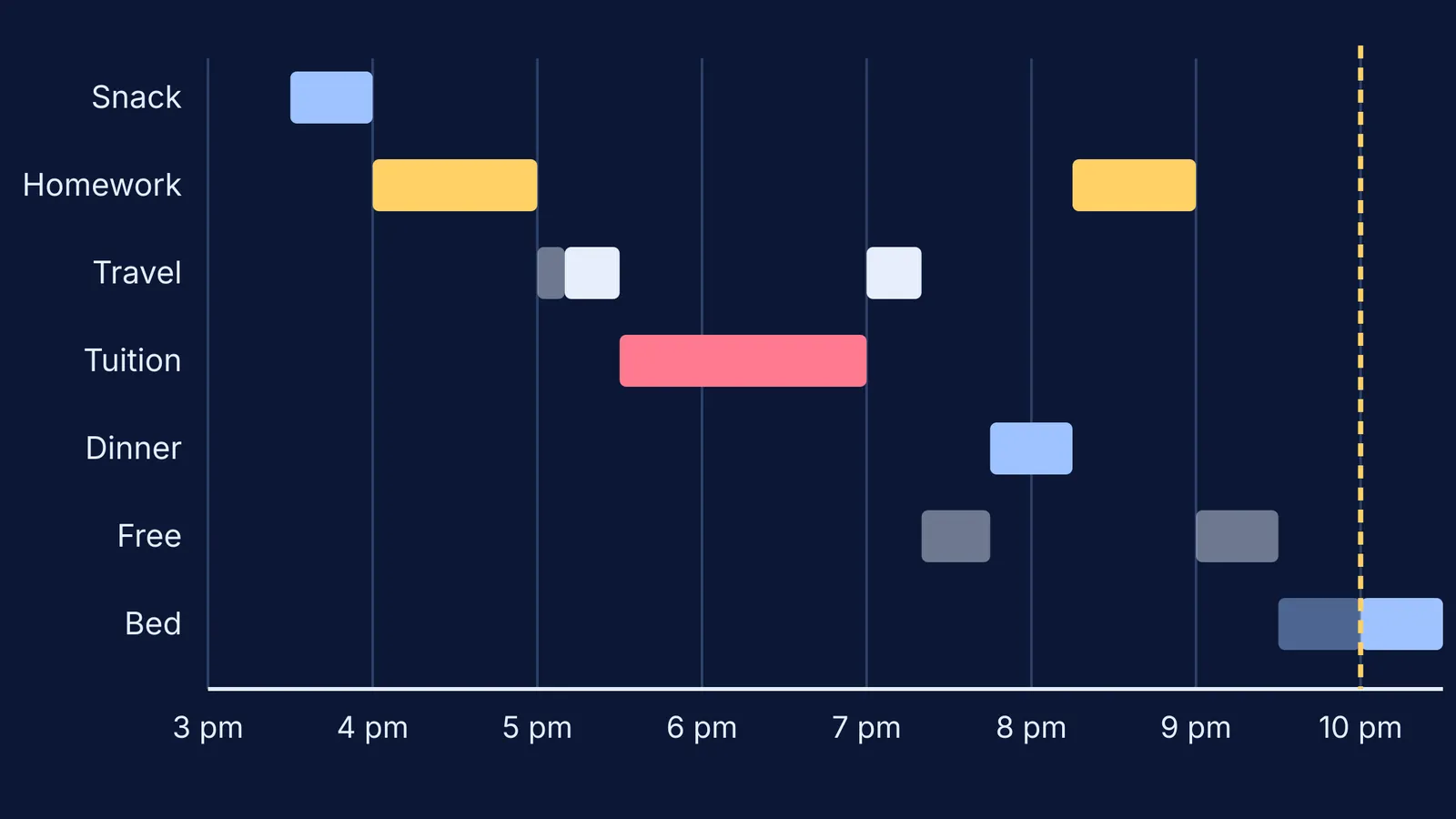
Here is a worked example for a Class 9 student who wakes at 6:00 am, gets home at 3:30 pm and has tuition from 5:30 to 7:00 pm, 20 minutes away.
3:30 to 4:00: change, wash, snack
4:00 to 5:00: homework block one, only what is due tomorrow
5:00 to 5:10: pack the tuition bag, leave
5:10 to 5:30: travel
5:30 to 7:00: tuition
7:00 to 7:20: travel back
7:20 to 7:45: free time
7:45 to 8:15: family dinner
8:15 to 9:00: homework block two, tuition work or revision
9:00 to 9:30: free time
9:30 to 10:00: wind-down
10:00: lights out
That gives 1 hour 45 minutes of homework, inside the School Bag Policy's two-hour limit, and 8 hours of sleep, which is the bottom of the AASM's teenage range. There is no slack, so the plan only works if homework block one starts on time.
What should you drop when it does not fit?
When the sum comes out negative, drop in this order, and never from sleep or dinner:
Extra practice beyond what is due. Move it to a weekend slot.
Tuition worksheets that repeat today's school homework on the same chapter.
A second activity on tuition days. A weekly time audit of after-school activities shows which day is carrying too much.
One tuition day a week, if the first three are not enough.
For step 2, a short message to the tutor usually works. You might say: "On tuition days, Riya has about 45 minutes for homework after dinner. Could the worksheet be the ten most important questions, with the rest for Sunday?" Ten careful answers can show a tutor more than thirty rushed ones.
What if homework keeps spilling past bedtime?
If block two keeps running long, time each subject for a week before changing anything. Our guide to shorter homework evenings with a timer walks through that. If your teenager says they are not sleepy at 10 pm, that is common too; here is why teenagers feel sleepy later at night.
A lot of lost time is one problem nobody at home can explain. When that happens in block two, the Fermi Problem Library has worked problems with a step-by-step solver that explains the reasoning rather than printing an answer, so your child can see where the method went wrong.
Tonight, write down the wake-up time and count back. The rest of the evening follows from that one number.