

On this page
Many children in India go from school to tuition, then to swimming, dance or abacus, with homework squeezed in after dinner. Whether that is too much depends less on the number of classes than on what is left over: sleep, play and time with you. To find out, add up one ordinary week in hours, with your child beside you.
Is my child doing too many after-school activities?
Two things a timetable must protect come first. The American Academy of Sleep Medicine recommends 9 to 12 hours of sleep per 24 hours for children aged 6 to 12, and 8 to 10 hours for teenagers (CDC summary of the AASM consensus; Paruthi and colleagues, 2016). The World Health Organization advises at least 60 minutes of moderate to vigorous physical activity daily for ages 5 to 17 (WHO).
The number of activities on its own is a weak signal. In a study of suburban 8th graders from well-off families, Suniya Luthar and colleagues found negligible evidence that high extracurricular involvement by itself was harmful; perceived parent criticism and a lack of after-school supervision were far more strongly linked to distress (Luthar, Shoum and Brown, 2006). That was one group of American students, so treat it as a clue: four classes a child loves may be fine, two that come with pressure may not.
What often gets squeezed out is unstructured play. A clinical report from the American Academy of Pediatrics noted that time for free play has been markedly reduced for some children, partly because of more attention to academics and enrichment activities (Ginsburg, 2007).
What are the signs a child is overscheduled?
Look for patterns over two or three weeks, not one bad day:
Sleep regularly falls below the range for their age because classes or homework run late.
Homework gets done in the car, at 10 pm, or not at all.
No weekday has an hour that belongs only to the child.
They dread, or keep forgetting, a class they once begged to join.
Headaches, stomach aches or tears show up before one particular class.
Weekends are booked as tightly as weekdays.
If your child seems persistently low, anxious or withdrawn, talk to their paediatrician or school counsellor; Tele MANAS, the government's free 24/7 mental health helpline, is on 14416 or 1800-89-14416 (PIB Research Unit).
How do you do a weekly time audit?
A week has 168 hours. Sit down together on a Sunday and fill in one typical week:
Write sleep first, at the bottom of the recommended range for their age.
Add school, including the bus or auto ride.
Add meals, bathing and getting ready.
Add homework and revision.
Add every class and practice, door to door.
Whatever is left is free time. Split it by day, not just weekly.
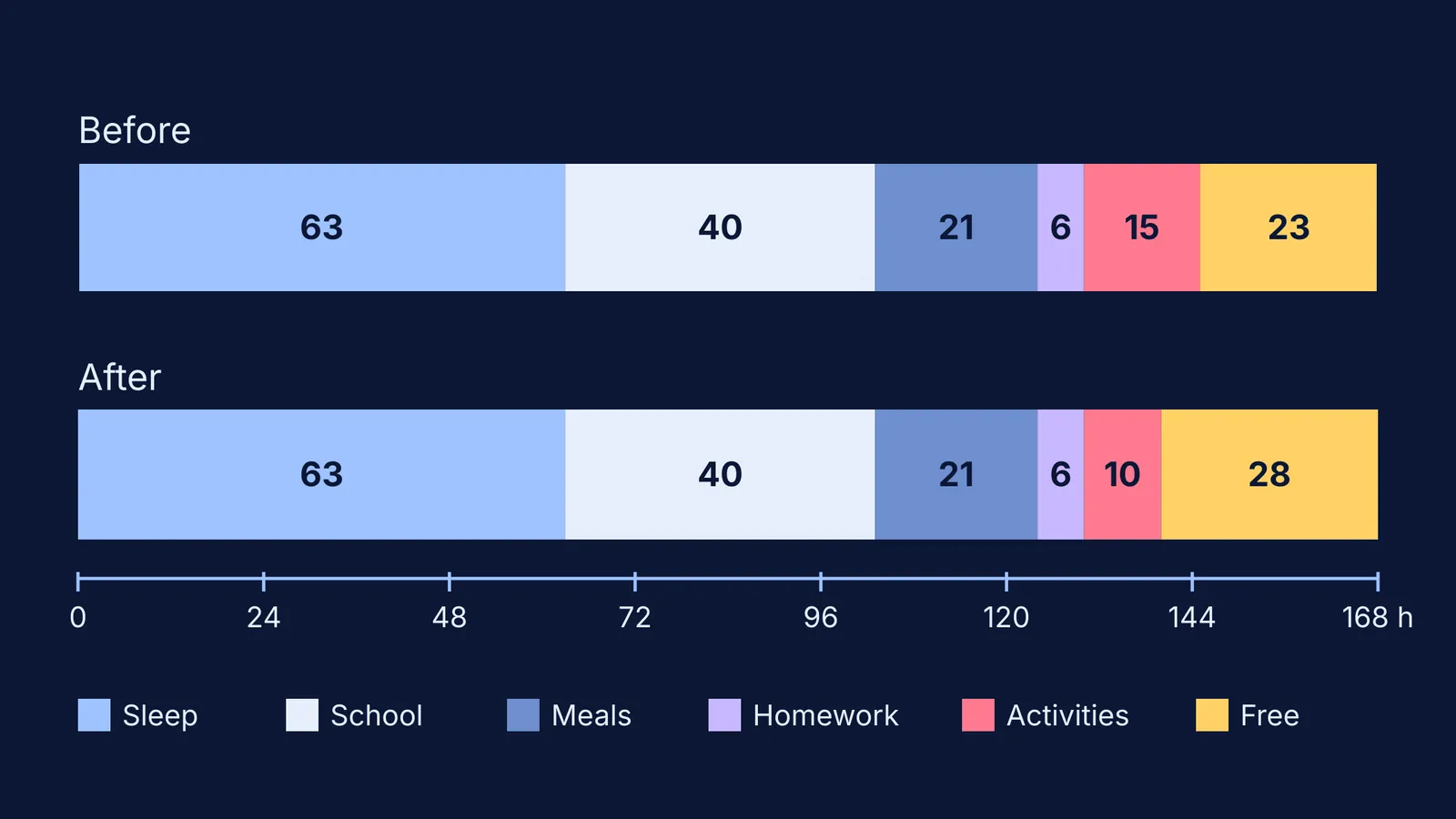
An illustrative example: Riya is 11 and in Class 6. Her week:
Sleep: 9 hours a night, 63 hours
School with travel: 8 hours on 5 days, 40 hours
Meals and getting ready: 3 hours a day, 21 hours
Homework: 6 hours
Activities: swimming 3, Bharatanatyam 3, abacus 3, maths tuition 4, online chess 2, so 15 hours
Free time: 23 hours
Twenty-three free hours sounds generous, but about 19 fall on the weekend. On weekdays Riya has roughly 4 free hours in total, under an hour a day, and any class that runs late comes out of her sleep.
How do you decide which activity to drop together?
Go through each activity and let your child answer first:
Who chose it, and would you choose it again today?
What does it give you that nothing else does: exercise, friends, a skill you are proud of?
How many hours a week does it cost, door to door?
If it stopped tomorrow, would you feel relief or loss?
Keep what brings loss and something unique. Shrink what they like but cannot fit, say two sessions a week instead of three. Pause or drop what brings relief or overlaps.
For Riya, swimming stays because it is most of her daily movement, and dance stays because she asked for it. Abacus now feels like a chore, so it goes, and chess becomes something she plays when she likes. Activities fall to 10 hours, free time rises to 28, and weekdays gain 3 hours.
A script that keeps it a joint decision:
We added up your week and you have less than an hour to yourself most evenings. That is our planning, not your fault.
Which class would you miss most? Which one would you not miss at all?
Let us try one change for a month, then do the audit again.
If maths tuition is staying only to patch one shaky topic, the Fermi Concept Library has a lesson for every concept in physics, chemistry, biology, mathematics and computing, so your child can revisit it at home. See also how to decide together when a child wants to quit tuition and summer camp or a free summer.
Timetables creep back up, so book the next audit for the start of next term.


