

On this page
The end of the school year brings a familiar question for many families: should you schedule your child's summer with academic camps and structured activities, or should you leave the holiday entirely open for free play?
Summer break is a chance to recharge after a demanding academic year, but unstructured time and structured learning camps both have unique developmental benefits. Finding the right mix can prevent the summer slide while still giving your child the mental break they need.
Does the summer slide really happen?
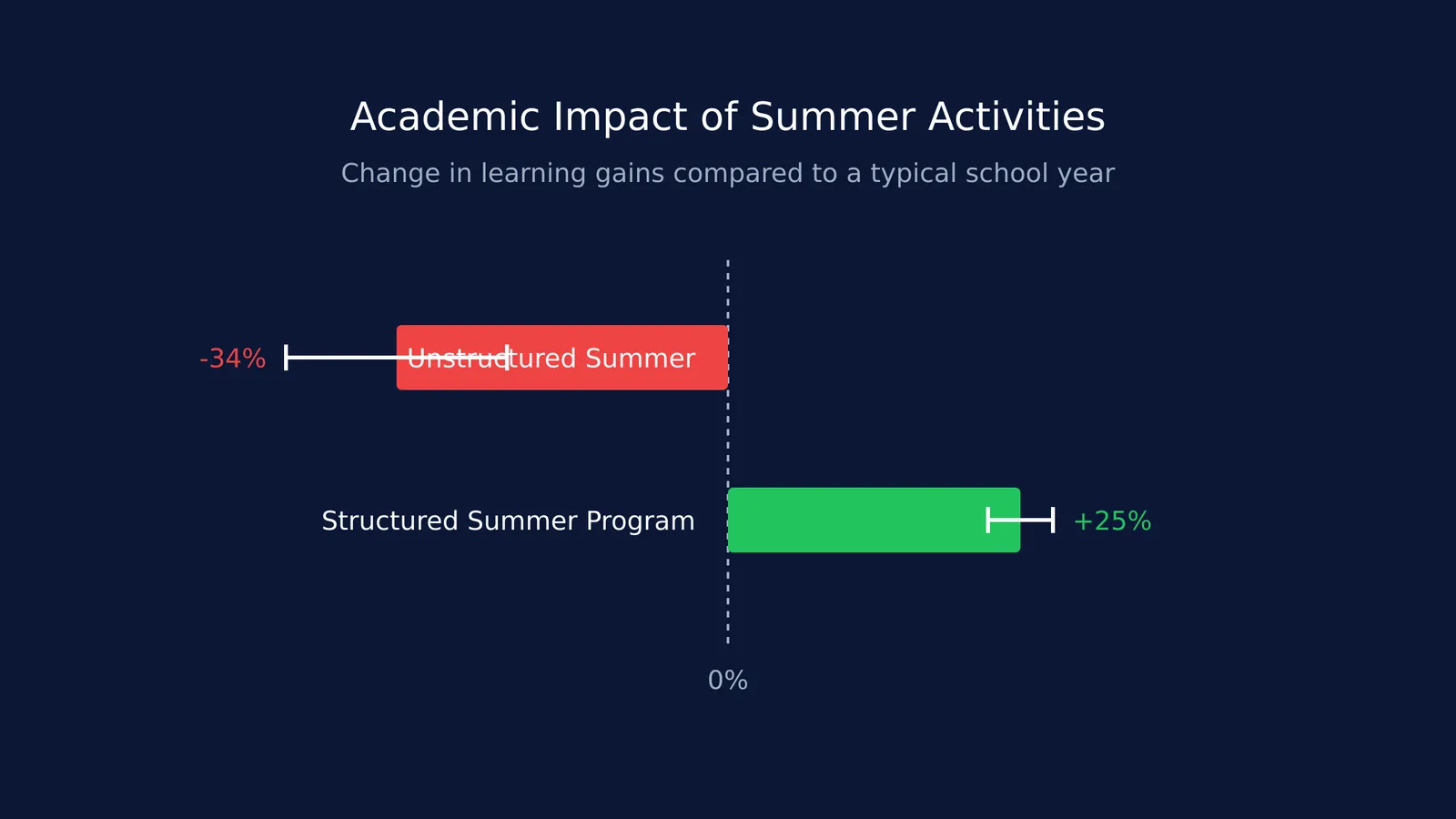
The "summer slide" is the measurable loss of academic skills that happens when students spend months away from a structured learning environment. Without regular practice, the knowledge gained during the school year begins to fade. According to the NWEA, children can lose between 17% and 34% of the previous year's learning gains over a summer without any academic intervention. Mathematics skills, which rely heavily on procedural practice and repetition, tend to slip much more sharply than reading skills.
Structured summer programs and academic camps act as a reliable buffer against this decline. Research published by the Wallace Foundation found that students who frequently attended five-to-six-week summer programs outperformed their peers in both mathematics and English. The frequent attendees gained the equivalent of 20 to 25% of a year's learning in those subjects compared to students who did not attend.
If a student struggles with procedural knowledge or needs to keep their problem-solving sharp, a structured camp or a dedicated study routine is highly effective. However, booking a child into full-time academic camps back-to-back can also lead to burnout if they never get a chance to truly switch off.
Why is unstructured time important for a child?
While structured camps are excellent for maintaining academic skills, unstructured free time builds an entirely different, but equally vital, set of mental muscles. A 2014 study by psychologists at the University of Colorado Boulder found that the more time six-year-olds spent in less-structured activities, the better their self-directed executive functioning became.
Executive function is the cognitive ability to set goals, plan, switch between tasks, and manage time without an adult providing a schedule or prompting them. Children who had more free time—which included imaginative play, reading for pleasure, or visiting a museum—practiced deciding what to do and how to do it. Conversely, the study found that high amounts of structured, adult-led time actually predicted poorer self-directed executive function.
Boredom itself can be a powerful catalyst for creativity. When left without a script or a schedule, children are forced to invent their own games, negotiate rules with their peers, and discover new personal interests.
What counts as unstructured free time?
It is easy to confuse unstructured time with simply doing nothing, but the two are very different. The researchers in the 2014 study defined structured activities as anything adult-led and formal. This includes homework, scheduled sports practices, and music lessons. While these teach valuable skills, they rely heavily on externally driven executive function, where an adult provides the instructions and manages the clock.
Less-structured activities are child-initiated. They allow the student to navigate social dynamics and resolve conflicts independently. When children build a fort or organise a game of backyard cricket, they must collaborate and negotiate rules to keep the play going, which builds social-emotional resilience and self-confidence.
How do you balance summer camps with free time?
The most effective summers balance the benefits of both approaches. Here is a practical framework you can use to find that mix for your family.
Block out the "must-do" learning: Choose a structured camp or build a daily routine that focuses on the specific areas where your child needs the most support, such as a morning maths programme. If a physical camp feels too rigid or takes up too much of the day, Fermi's AI tutor can help build a plan for a short, targeted daily study session. The tutor works out what the student already knows and teaches through it, leaving the rest of the day completely free.
Protect the free hours: Treat unstructured time as an important, non-negotiable activity. Resist the urge to fill every afternoon with supervised sports, coding classes, or lessons. Let them experience the kind of open-ended, unscheduled time that builds true independence.
Bring learning into daily life: You can keep a child's curiosity alive without putting them in a classroom. Practical projects, cooking, or discussing science in the real world can bridge the gap between academic learning and play. If you want to know how to start those conversations effectively, look at our breakdown of a trial that helped parents explain why maths and science matter.
A good summer schedule leaves room for a child to simply be a child. By combining targeted, structured practice with plenty of genuine free time, you help them return to school rested, sharp, and ready to learn. If you are looking for ways to make their active learning time more effective during those structured hours, read our guide to the ten study techniques rated in the 2013 Dunlosky review.


