On this page
In many Indian homes the daughter is called to the kitchen while the son is told to go and study. Nobody says it out loud as a rule, but children notice. By the time they leave home, one of them may be able to run a household while the other cannot boil rice.
Here is what the numbers say, why parents matter, and a plan you can begin this week.
How unequal is housework in India today?
The gap is very large. India's second national Time Use Survey, released by MoSPI in February 2025, surveyed 4,54,192 people aged 6 and above in 2024.
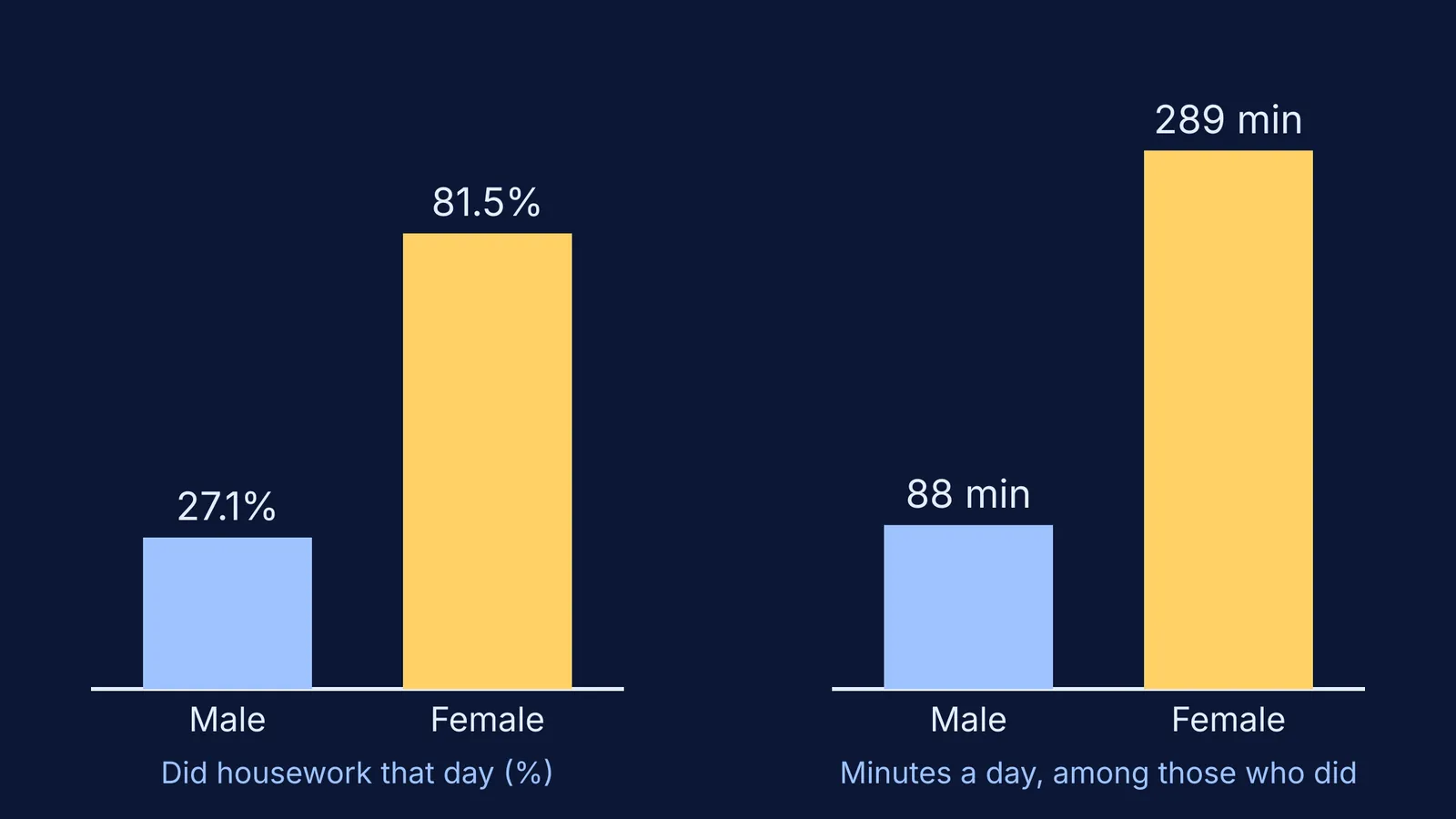
81.5% of females did unpaid domestic work for their household, such as cooking and cleaning, on a given day, against 27.1% of males.
Females who did it spent 289 minutes a day on it, against 88 minutes for males.
Women aged 15-59 who did housework spent about 305 minutes a day on it, down only slightly from 315 minutes in 2019.
That is roughly five hours a day for the women and girls who do it, and about an hour and a half for the men and boys who do it at all.
Does the gap start in childhood?
Yes. A UNICEF report from October 2016 estimated that, worldwide, girls aged 5-14 spend 40% more time on unpaid household chores than boys their age. The gap widens with age: girls aged 10-14 spend 50% more time on chores than boys, against 30% more at ages 5-9.
UNICEF notes that this load limits a girl's time to play, see friends and study. A boy who is never asked to help also misses out. He reaches a hostel, a first job or a marriage without basic skills he will need every day.
Why do parents' own habits matter?
Children notice what their parents do, not just what they say. In a study of 326 children aged 7 to 13, psychologists at the University of British Columbia found that mothers' beliefs about who should do housework predicted their children's beliefs (Croft and colleagues, Psychological Science, 2014). When fathers did or backed a more equal split of housework, their daughters in particular were more interested in working outside the home and in less stereotyped jobs.
So one useful thing a father can do is pick up a broom or roll rotis where his children can see him. Telling a son "help your mother" makes housework sound like her job that he sometimes assists with. "This is our home, so we all run it" says something different.
How do you share chores equally between sons and daughters?
Use this four-week plan. It works for a 7-year-old and a 16-year-old alike; only the jobs change.
Week 1: list every job. Sit together and write down everything that keeps the house running: cooking, washing up, sweeping, laundry, buying vegetables, paying the bill, looking after a grandparent. Children are often surprised by how long the list is.
Week 2: same list, same rota. Give every child jobs from the same list, rotated weekly so nobody owns the kitchen or the dustbin. Our guide to settling sibling fights with a rotating chore rota shows how to set one up.
Week 3: teach, don't rescue. Show the job once, do it together once, then let them do it alone. Accept a lumpy roti and a slow sweep. Redoing it yourself tells them they can't.
Week 4: one meal each. Each child, son and daughter, plans and cooks one simple meal with you watching, not doing.
For jobs suited to each age, see age-appropriate chores for kids in India. For older teens, our weekend cooking plan for Class 11 students builds up to real independence.
What should you say when someone objects?
Objections often come from grandparents, relatives or the boy himself. Short, calm replies work better than a debate.
"Boys don't need to cook." Try: "He will need to eat when he lives alone. I'd rather he learns here."
"He has board exams." Try: "So does his sister. Fifteen minutes of washing up is a break, not a burden."
From your son, "Why me? Didi does it better." Try: "She does it better because she has practised. Now it's your turn."
The exam worry is real, and it is the same for both children. Keep chores short and fixed, such as after dinner, so they don't eat into study blocks. If what eats the evening is not knowing where to start studying, Fermi's AI tutor can work out what your child already knows and build a plan for the session, so the time they do have counts.
Housework is a life skill, not a girls' subject. Start with one job this week, and give it to every child.