On this page
"It's not fair, I did it yesterday!" Most chore fights between siblings are not about the dishes. They are about whether the system is fair, and whether anyone can check. You can stop playing judge every evening by fixing the system: a rota everyone can see, jobs that rotate weekly, and a fair way to trade.
Why do siblings argue that chores are not fair?
Arguments about turns and fairness are a distinct kind of sibling conflict, and they matter. In a 2013 study in Child Development, Nicole Campione-Barr and colleagues followed 145 pairs of siblings, with average ages of about 15 and 12, for one year. Conflicts about equality and fairness, such as whose turn it is to empty the dishwasher, were associated with greater depressed mood one year later. That is a link, not proof of cause, and the families were mostly European American and middle class. In the Society for Research in Child Development's summary, Campione-Barr, the study's lead author at the University of Missouri, said "structured tradeoffs in chore duties and equal time with shared household items (like computer/video games) give siblings fewer opportunities to compare themselves unfavorably to one another."
Children also care more about whether something feels fair than whether it is exactly equal. In a study of 385 families in Social Development, Susan McHale and colleagues found that children's perceptions of fairness were more strongly linked to their self-esteem and to positivity between siblings than the actual differences in how parents treated them, including in household tasks. That suggests a 14-year-old can do more than a 9-year-old without it feeling unfair, especially if the reason is said out loud and written down.
Indian homes add another layer. In the Time Use Survey 2024, 81.5% of females aged 6 and above did unpaid domestic work on a given day, compared with 27.1% of males. Female participants spent 289 minutes a day on it, against 88 for male participants. When a daughter notices she is called to the kitchen and her brother is not, she may be seeing something real. A rota that rotates jobs regardless of gender answers her directly.
How do you make a chore rota children see as fair?
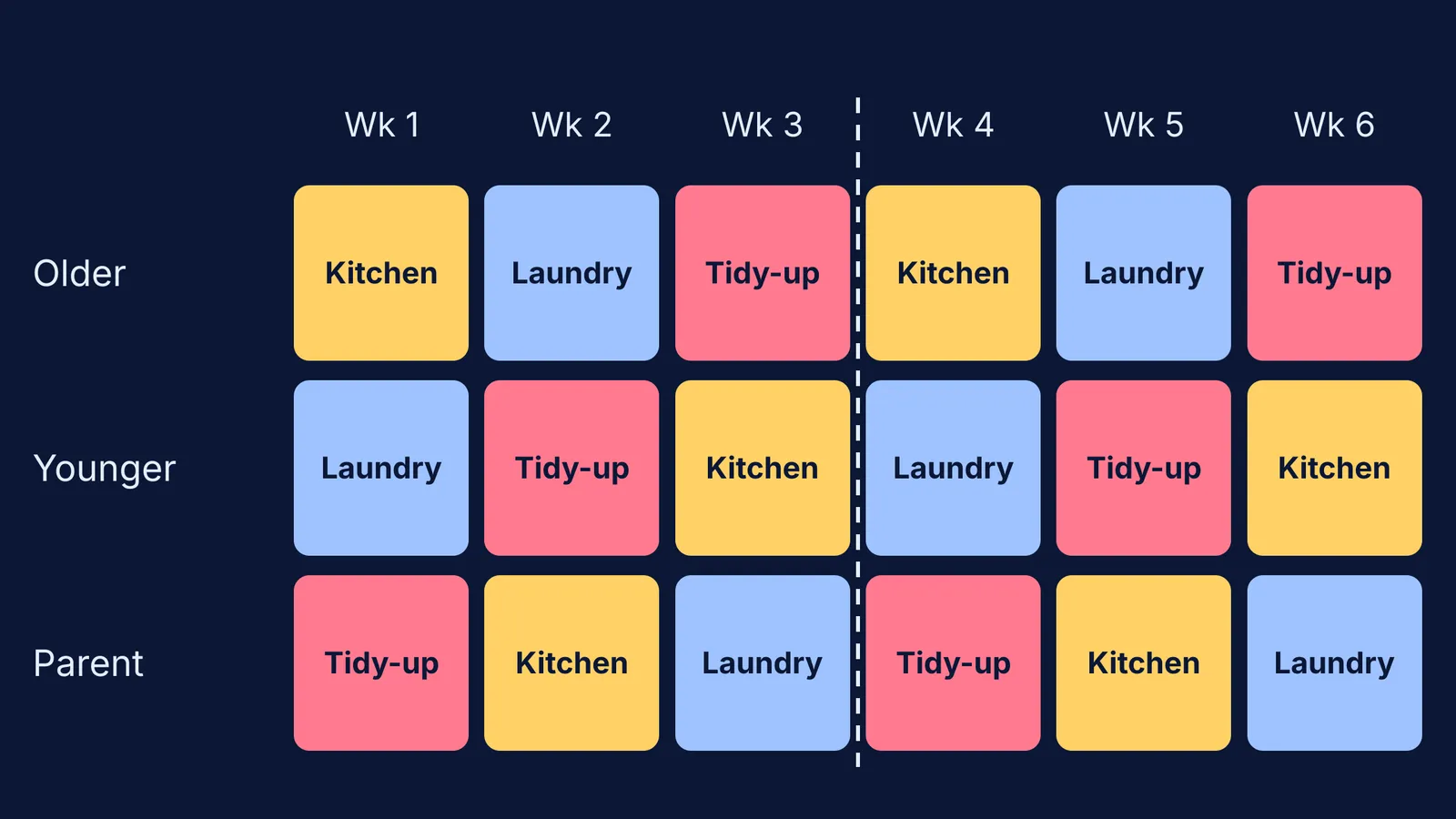
Bundle the jobs. Group daily jobs into three bundles that take roughly the same time, for example Kitchen (clear plates, wipe the table), Laundry (fold and put away dry clothes, set out uniforms) and Tidy-up (shoes, plants, bins).
Put it where everyone can see it. The fridge door or a pinned message in the family WhatsApp group, so nobody has to ask you whose turn it is.
Rotate every week on a fixed day. Nobody owns the worst job forever.
Put a parent on the rota. It shows that housework is family work, not a punishment for being younger.
Size by age, never by gender. A younger child does the same bundle in a smaller version, and you say why.
Review monthly. Re-balance any bundle that always causes complaints.
For what each age can realistically manage, see our guide to age-appropriate chores for kids in India.
A worked example: a three-week cycle
Riya is 14, Arjun is 10, and one parent joins the rota.
Week 1: Riya does Kitchen, Arjun does Laundry, the parent does Tidy-up.
Week 2: Riya does Laundry, Arjun does Tidy-up, the parent does Kitchen.
Week 3: Riya does Tidy-up, Arjun does Kitchen, the parent does Laundry.
Week 4: back to Week 1.
Every three weeks, each person does each bundle once. The chart also says "Kitchen, age 12 and up: also load the dishes." Riya does that step now; when Arjun turns 12, so will he.
How should children trade chores fairly?
Trading teaches negotiation, but an older sibling can quietly take advantage. Keep the rules short:
Both children agree, without pressure or threats.
Trades are one for one, in the same week, or with a swap-back date.
Every trade is written on the rota with both initials.
No buying your way out with pocket money or screen time.
A parent can cancel any trade that looks one-sided.
What do you say when a child shouts "It's not fair"?
Point to the chart, not to the child. A short script:
"Let's check the rota."
If the chart is on their side: "You're right, it's Arjun's week. Arjun, it's yours."
If it is not: "The chart says it's your week. If you want to swap, ask Riya and write it down."
If they are unhappy with the system itself: "That's a rota problem, not a tonight problem. Bring it to Sunday's review."
If the fights are really about marks, read how to stop siblings fighting over who scored better; for a teenager who argues about everything, see how to respond calmly.
A settled chore slot also protects study time. If a child then sits down unsure where to begin, Fermi's AI tutor can work out what they already know and build a plan for the session.
If a child seems low or withdrawn for weeks, talk to their school counsellor or a doctor, or call Tele MANAS on 14416.
Tonight, draw the three-week grid, stick it on the fridge, and let the chart take the arguments.