

On this page
Why do siblings fight over who scored better?
When one child scores higher in mathematics and their sibling trails behind, dinner table conversations easily drift toward side-by-side evaluations. Siblings fight over marks because grades are visible, quantifiable, and tied directly to parental approval.
Social psychologists explain this reaction through the Self-Evaluation Maintenance model formulated by Abraham Tesser60227-0). When two individuals share close emotional proximity—such as siblings living under the same roof—another person's success in a shared domain poses a direct threat to self-esteem. If a household treats marks as the single benchmark of worth, siblings are forced into competition. A study in the Journal of Experimental Social Psychology90060-8) showed that when a domain is central to self-identity, people become less supportive of those closest to them to protect their own self-evaluation.
This dynamic triggers sibling deidentification. The sibling who trails by a few marks assumes the role of the "academic child" is already taken, and disengages from studying to protect their self-worth.
How does comparing marks harm both children?
Comparing marks does not inspire the lower-scoring sibling to work harder. Instead, it creates a self-fulfilling gap.
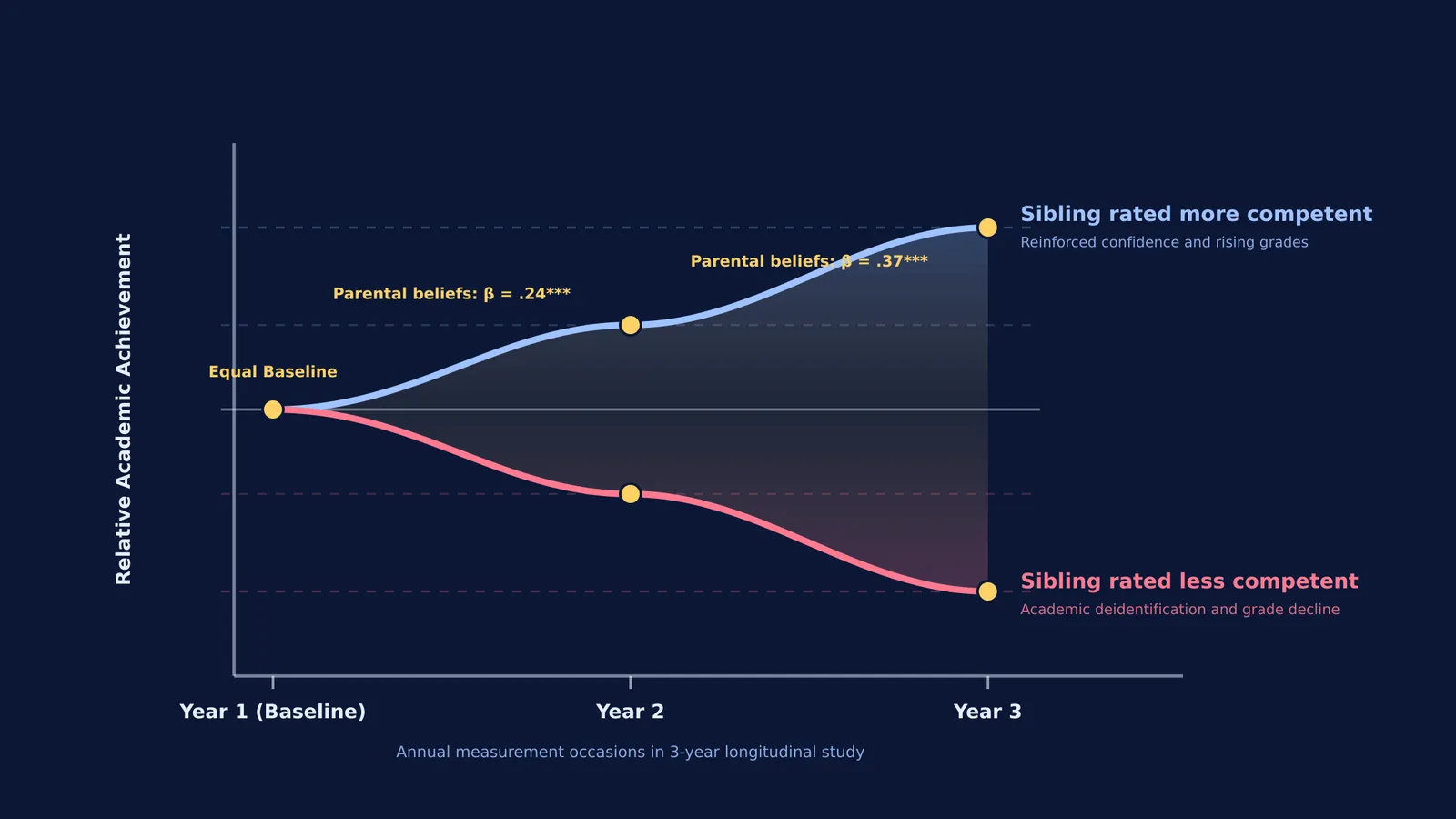
A three-year longitudinal study of 388 families in the Journal of Family Psychology by Alexander Jensen and Susan McHale tracked parental beliefs and adolescent report cards across four core subjects. Using cross-lagged structural equation modeling, the researchers found that parents' comparative beliefs about which sibling was more competent significantly predicted actual differences in their subsequent grades across consecutive years. Crucially, earlier grades did not dictate parents' beliefs; rather, parents' comparative expectations actively widened the academic divide over time, operating as a self-fulfilling prophecy.
The habit of comparison also strains long-term sibling relationships. A 15-year study of 152 families in Child Development by Xiaoran Sun, Susan McHale, and Kimberly Updegraff found that perceived parental favoritism in middle childhood predicted divergent college graduation outcomes. Conversely, sibling warmth in childhood predicted mutual academic attainment.
How should you praise siblings without starting a rivalry?
Reducing rivalry requires separating feedback. In Motivation and Emotion, Jennifer Henderlong Corpus, Christin M. Ogle, and Kelly E. Love-Geiger tested fourth- and fifth-grade students and found that social-comparison praise produced fragile motivation that collapsed during setbacks. In contrast, mastery praise—which highlights personal learning and strategy—fostered resilience.
To build healthy study habits at home, use this four-part routine:
Praise behind closed doors: Give detailed feedback in private, one-on-one check-ins so neither child feels exposed or defensive.
Track personal delta, not sibling ranking: Measure each child against their own previous score. Improving your score on algebra after revising formulas is real progress, whether the overall mark is high or moderate.
Acknowledge specific strategies: Highlight the process each child followed, aligning with research on praising process rather than ability. Point to the specific revision timetable or error log.
Separate study spaces: Give each child an independent schedule rather than enforcing identical routines, particularly when managing home routines during board exams.
Decoupling study routines allows siblings to concentrate on their own baselines. With Fermi's AI tutor, the software works out what the student already knows and builds a plan for the session, keeping attention on personal mastery rather than comparison with a sibling. If a student runs into a difficult numerical, the Fermi Problem Library provides worked problems with a step-by-step solver that explains the reasoning rather than printing an answer.
What should you say on report-card day?
What parents say when report cards arrive sets the emotional climate for weeks. Here is a practical script for what parents should say on results day:
Instead of: "Look at your sister; she scored top marks without extra help."
Say privately: "Your revision routine showed in your chemistry score today. Let's look at what helped that topic click."
Instead of: "Why can't you focus quietly like your brother?"
Say privately: "You worked through difficult derivations before taking a break. That shows solid concentration."
Instead of: "Who scored higher in maths between you two?"
Say openly: "We do not compare marks in this house. Each of you has your own targets, and we review papers individually."
When does academic rivalry signal deeper distress?
Fights over marks often stem from intense academic pressure. In a survey of 3,79,013 students across Classes 6 to 12 by NCERT, 81% reported that studies, examinations, and results were the primary drivers of anxiety. When exam stress mounts, siblings often vent that pressure through arguments over scores.
When academic friction is accompanied by persistent withdrawal, anxiety, or sleep disturbances, parents should consult school counsellors or psychological professionals. Free, confidential support is available across India through the Ministry of Health and Family Welfare's 24/7 toll-free helpline, Tele MANAS, on 14416. Reaching out ensures students receive timely emotional guidance alongside academic support.


