On this page
By the third week of summer vacation, many homes have drifted: late nights, later mornings, lots of screens and a child who says "I'm bored" at 4 pm. You don't need a strict timetable to fix that. You need a few fixed points in the day, and open space between them.
Why does a summer routine matter at all?
Long breaks have a measurable cost. A 1996 review by Harris Cooper and colleagues looked at 39 studies and found that achievement test scores decline over summer vacation (Cooper et al., 1996). In their meta-analysis of 13 recent studies, the loss came to about one month on grade-level scales. Maths, especially computation, slipped more than reading.
Reading is also where a little effort shows up. A 2013 meta-analysis of 41 summer reading programmes for children from kindergarten to Grade 8 found that both classroom lessons and home programmes built around children choosing and reading books improved reading outcomes compared with control groups (Kim and Quinn, 2013). Those programmes ran in the United States and Canada and mostly involved low-income children, so take them as a guide rather than a promise for every family.
None of this means summer should look like school. Free time is part of the point of a holiday, so the routine below protects a few things and leaves the rest alone.
What should a daily routine for kids in summer vacation include?
Four anchors are enough:
A steady wake time. Pick a time and keep it within about half an hour every day, including weekends. Sleep needs are clear: an American Academy of Sleep Medicine consensus says children aged 6 to 12 should sleep 9 to 12 hours per 24 hours, and teenagers aged 13 to 18 should sleep 8 to 10 hours (Paruthi et al., 2016). Count back from the wake time to set lights-out.
Outdoor play in the cooler hours. The WHO recommends that children and adolescents do at least an average of 60 minutes a day of moderate-to-vigorous physical activity across the week (WHO 2020 guidelines, Bull et al.). In an Indian summer, that play belongs in the early morning and evening.
Daily reading. A book your child chose, at a fixed point such as after lunch or before bed.
One learning activity. One short, focused session, not a study timetable.
On heat: the India Meteorological Department's heat wave advice says to avoid going out in the sun, especially between 12 noon and 3 pm, and to drink water even when not thirsty (IMD heat wave dos and don'ts). That window suits lunch, rest and reading indoors.
What does a sample summer day look like?
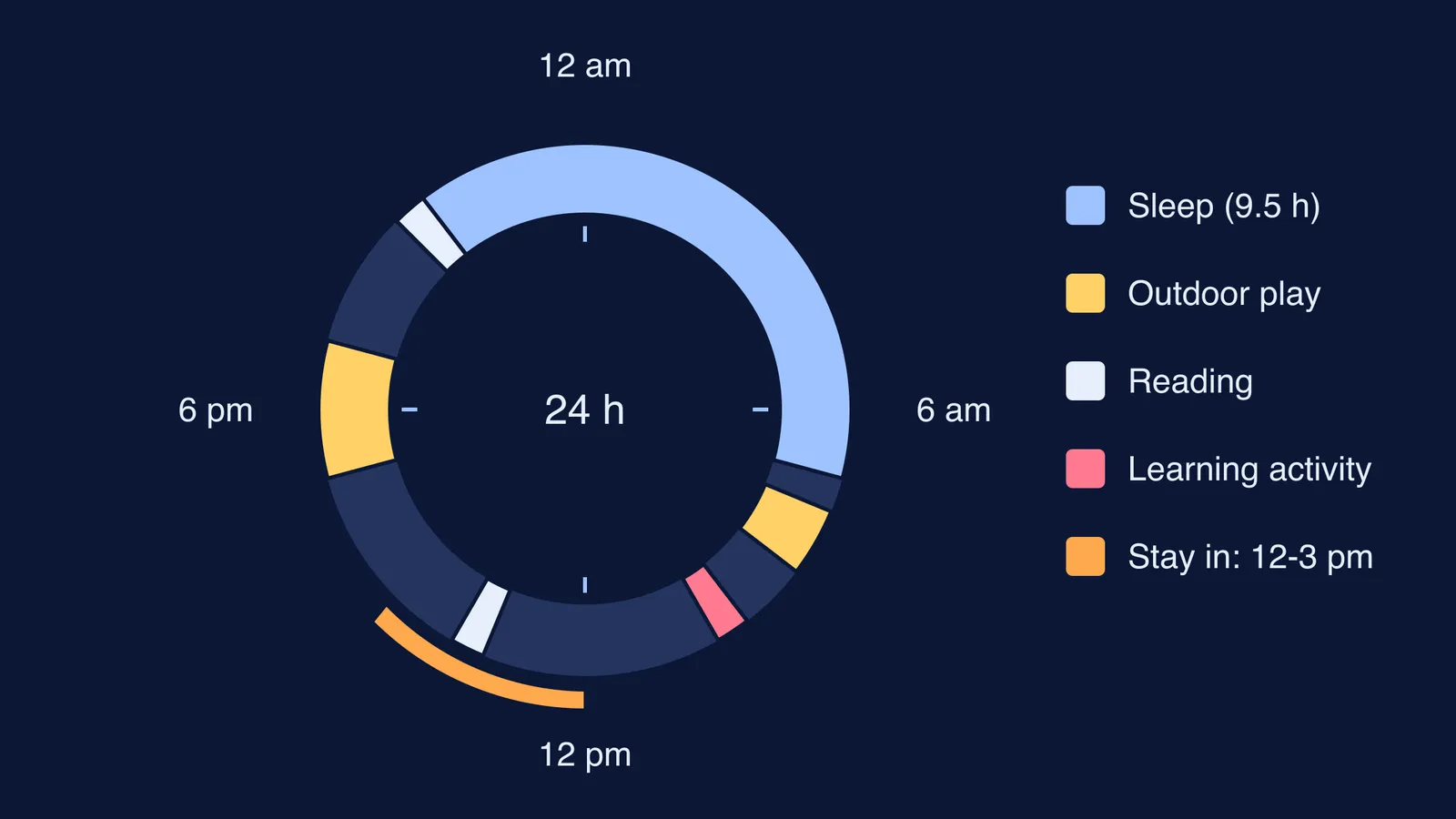
Here is a worked example for a 10-year-old who wakes at 7 am. Lights-out at 9:30 pm gives 9.5 hours of sleep, inside the 9 to 12 hour range above.
7:00 am: wake up, water, a quick breakfast.
7:30 to 8:30 am: outdoor play before the heat builds.
9:30 to 10:00 am: the one learning activity.
10:00 am to 12:00 pm: free time, a hobby or a small household chore.
12:00 to 3:00 pm: indoors for lunch, rest, and 30 minutes of reading.
3:00 to 5:00 pm: free time, including any agreed screen time.
5:00 to 7:00 pm: outdoor play as it cools.
9:00 pm: bedtime reading, then lights out at 9:30 pm.
For a teenager, shift the day an hour later if you like, but keep it steady. If late nights are already a problem, our piece on keeping a child's bedtime on weekends and holidays walks through resetting it gently.
How do you choose the one learning activity?
Keep it to 20 to 30 minutes on one topic your child can finish. Because maths slipped most in the Cooper review, maths practice on a few days a week is a sensible default. Other days can follow curiosity: a kitchen experiment or a page of holiday homework. Our summer holiday homework plan shows how to spread school assignments across the break so they fit this slot.
For a science idea that is easier to see than to read, the Fermi Simulation Lab has interactive simulations your child can explore in that day's slot.
How do you keep it loose without it falling apart?
Agree the plan together on day one instead of announcing it. You could say:
"This holiday, we have four things every day: same wake-up time, play outside, reading, and one learning thing. You choose the book and when the learning thing happens. The rest of the day is yours."
Then a few rules for real life:
Travel days, weddings and visits from grandparents are routine-free. Restart the next morning with the wake time.
If the learning activity turns into a fight, shorten it rather than skip the week.
Decide screen time once, not every afternoon. Our guide to screen time during summer holidays has ways to set it.
Start with the wake time tomorrow; the other anchors are easier once mornings are steady.