

On this page
The summer vacation is meant for rest, play and stepping away from the daily school grind. Yet, a large envelope of holiday homework often hangs over the household. When left unmanaged, those projects and worksheets pile up, turning the final week of the holidays into a stressful rush for both you and your child.
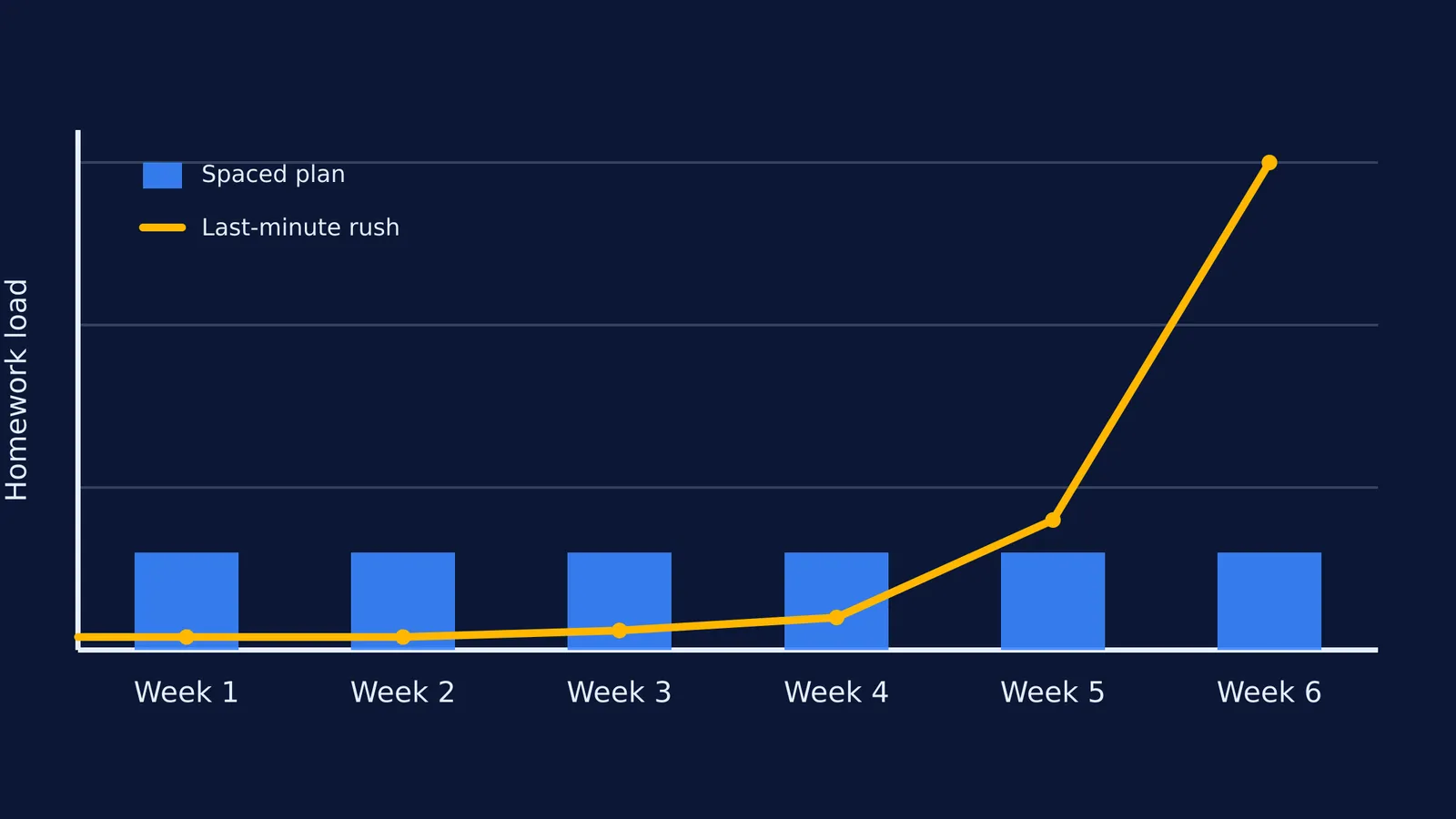
The solution is not to do more work, but to distribute it. Breaking the assignments into a weekly chart ensures the work gets done in small, manageable pieces. This approach also happens to be exactly how the brain learns best.
Why does summer homework pile up?
Homework piles up because long deadlines are notoriously hard for children—and adults—to judge. A six-week vacation feels like an endless expanse of time in May, making it incredibly easy to delay a time-consuming science project until the first week of July. This phenomenon, known as the planning fallacy, means we consistently underestimate how long tasks will take.
When children cram all their holiday homework into a few days, they not only suffer from stress, but they also miss out on the memory benefits of the assignments. A 2016 review by Sean H.K. Kang found that spacing out repeated encounters with study material over time produces superior long-term learning, compared with repetitions that are massed together. Doing a little bit of maths every week keeps the mathematical concepts fresh, whereas doing 50 sums in a single frantic night is quickly forgotten once the new term begins.
Furthermore, a complete break from academics for two months can lead to significant forgetting. A 1996 meta-analysis by Harris Cooper and colleagues indicated that the summer loss equaled about one month on a grade-level equivalent scale. The study noted that this effect was more detrimental for math computation and spelling than for reading. A light, spaced-out holiday study plan keeps those academic muscles active without ruining the spirit of the vacation.
How should you plan summer holiday homework for your child?
The most practical way to handle the workload is to build a visible weekly chart together in the first few days of the holidays.
Take an inventory: Gather all the holiday homework instructions on the dining table. Count the number of worksheets, note the reading chapters required for English or Hindi, and list the practical projects (like building a working model or keeping a daily weather diary). Having everything visible in one place removes the fear of the unknown.
Estimate the time: Ask your child how long they think each task will take, and then gently double it. Creative projects, in particular, always take longer than expected because gathering materials and waiting for glue to dry take up time.
Map the weeks: Draw a simple grid representing the six or seven weeks of vacation. Block out the weeks you are travelling, attending a summer camp, or having family visiting—these are strictly zero-homework weeks.
Distribute the tasks: Divide the total work by the remaining weeks. Assign specific tasks to specific weeks. For example, Week 1 might be completing the English reading, while Week 3 is dedicated solely to the science model. Do not mix too many subjects in one week.
What is a good weekly homework schedule?
A good schedule treats homework as a regular, predictable event rather than a looming threat.
If your child is stuck on a difficult concept while working through their holiday assignments, the Fermi Concept Library has a lesson for every idea in physics, chemistry, biology and maths. Fermi's AI tutor works out what they already know and builds a plan for the session, so they sit down to a clear next step instead of feeling lost.
Here is a script you can use to set up the routine:
*"We have five weeks of holidays and five maths worksheets. If we do one worksheet every Tuesday morning after breakfast, you will be completely free for the rest of the week, and we won't have to worry about it in July. Does Tuesday or Wednesday work better for you?"*
Giving them a choice over the day gives them a sense of ownership, making it easier to build a study routine that lasts.
During the school year, you might have strict rules for evening study and weekend revisions. During the holidays, the goal is entirely different: it is just maintenance and keeping the brain gently engaged. Much like managing an exam season at home, keeping the atmosphere calm and the schedule clear removes the daily friction. If they finish their Tuesday morning worksheet, they are done. You do not need to ask them to study more just because they have free time.
By the time the new term starts, the holiday homework is completely done, the core concepts are retained, and most importantly, the last week of vacation was actually spent resting and preparing for the school year ahead.


