On this page
It is 8.10 am, the school van is due in ten minutes, and your four-year-old is lying on the floor saying "I'm not going." If this is every morning, you are not doing something wrong.
Why does my preschooler refuse to go to school every day?
Most of the time the problem is not school. It is leaving you. The NHS says that from around 6 months to 3 years it is very common for young children to have separation anxiety. Preschool asks a small child to hand you over to near-strangers every morning, so the protest often peaks at the door.
The American Academy of Pediatrics adds that by age 3 most children clearly understand the effect their anxiety has on their parents. So a long, worried goodbye can make the moment feel bigger than it is.
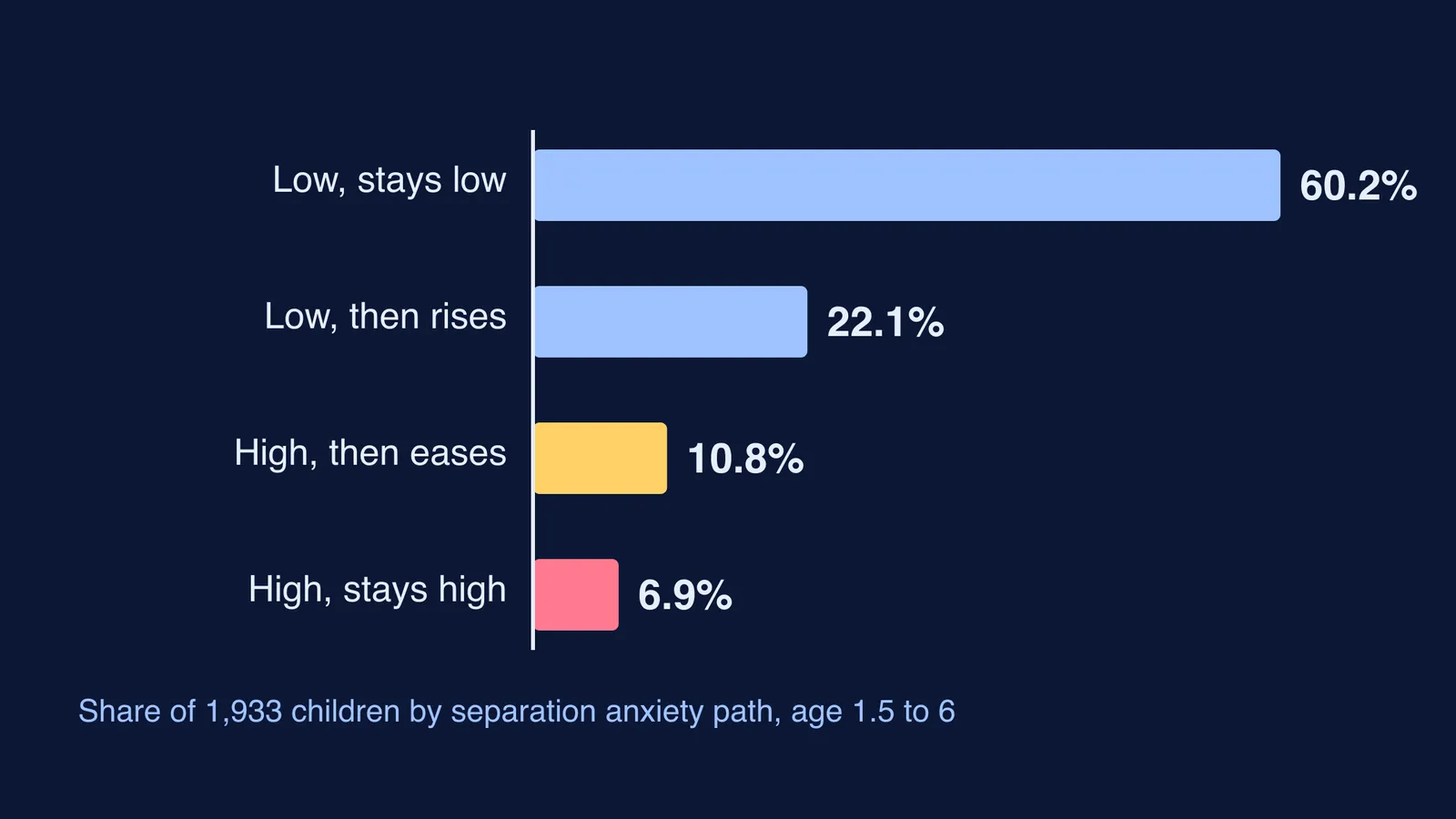
The longer view is reassuring. A team led by Marco Battaglia followed 1,933 Quebec families from when their children were 18 months to 6 years old. They found that 60.2% of children had low separation anxiety throughout, and that every group except one showed a substantial drop in symptoms by age 6. The 6.9% whose anxiety started high and stayed high were the only group linked to teacher-rated separation anxiety at age 6.
What does a calm school morning look like?
The AAP recommends doing the drop-off the same way at the same time each day, because a routine helps a child build trust. In practice that means fewer decisions before 8 am.
Lay out the uniform, water bottle and tiffin the night before.
Wake your child early enough that nobody has to shout "hurry".
Use a short picture chart: brush, bath, breakfast, shoes, bag.
Give one small choice, such as which of two snacks goes in the tiffin.
Leave the house at the same time, and use the same words at the gate.
If the whole house is rushed, our post on making school mornings less rushed has a two-part plan for the evening before and the morning itself.
How do you say goodbye at the school gate?
The AAP's advice is direct: "Keep the goodbye short and sweet. If you linger, the transition time does too." Give your full attention and affection, then leave promptly, even if your child protests. Here is a script you can adapt, in whichever language you speak at home.
On the walk: "Today you'll play, eat your tiffin, have story time, and then I'll come."
At the gate: a hug, and your special goodbye, such as a high five and "See you after lunch."
The handover: "Ma'am is here. I'm going now. I'll be back after lunch."
Then go. Don't come back for one more hug.
At pickup: "I said I'd come after lunch, and here I am."
The AAP suggests describing your return in terms a child understands, like "after nap time", instead of clock times. If your child cries hard at the gate, our guide on what helps when a child cries at school drop-off covers what is normal and when to worry.
What should you ask your child's teacher?
The teacher sees the part of the day you don't. A two-minute chat at pickup, or a short note in the diary, tells you whether the tears stop five minutes after you leave or carry on all morning.
How long does my child take to settle after I leave?
Who or what helps: a friend, a job like handing out crayons, a favourite corner?
Is my child eating, joining in and using the toilet?
Would it help if a grandparent or the van didi did drop-off some days?
Can you tell me one good moment from today, so I can talk about it tonight?
How long does settling take, and when should you worry?
There is no fixed number of days. The Quebec study concluded that most children with high separation anxiety at 18 months are expected to recover gradually by age 4 to 5. Expect good days and bad days, and a wobble after holidays or illness.
The NHS advises getting help if anxiety is severe, persists and interferes with everyday life, and suggests a visit to the doctor as a place to start. The AAP says it is rare for separation anxiety to persist daily after the preschool years. Talk to your paediatrician if, after several weeks of a steady routine, your child is still very distressed every day or the worry is getting in the way of sleep, eating or play. If you are struggling yourself, Tele MANAS, the Government of India's free mental health helpline, is on 14416 or 1800-891-4416, round the clock.
If your child hasn't started yet, our post on the right age to start preschool can help you think about timing. Years from now, when the worry is homework rather than goodbyes, Fermi's AI tutor works out what a student already knows and builds a plan for the session. For now, the plan is simpler: a calm morning, a short goodbye and a promise kept.