On this page
Grandparents are here for a week, the house is full, and your child has a unit test on Monday. You do not have to choose between a warm visit and a working routine. Shrink the routine on purpose, explain it kindly, and protect two things: one quiet study slot a day and the usual bedtime.
Will a few days of visitors break a study routine?
Probably not, if the routine bends instead of disappearing. In a study of how habits form in everyday life, 96 volunteers repeated a chosen behaviour daily in the same setting for 12 weeks, and missing one opportunity to perform the behaviour did not materially affect the habit formation process (Lally and colleagues, European Journal of Social Psychology).
The study looked at single missed days, not longer gaps, so an odd lost evening is unlikely to undo a routine. The bigger risk is the routine vanishing for the whole visit. Aim for a smaller version, at the same time and in the same place. If your child is still building the habit, start with how to build a study routine that lasts longer than a week.
How do you explain your child's study schedule to grandparents?
Most grandparents are not against studying. They want time with the child, and a closed door can feel like a rejection. Explain the plan on the first evening, before it becomes a problem, and give them a way to help.
A script you can adapt:
“Ma, Papa, Riya has a test on Monday, so every evening from 5 to 6:15 she will study in her room. After that she is all yours.”
“Could you help us keep that hour quiet? The best time to chat with her is right after school, over tea.”
“She sleeps at 10 on school nights, so let's do the photo albums before that.”
Let your child say some of this too. “I'm doing one hour of maths, then I want to hear about your trip” sounds very different from a parent laying down rules. If the talk turns to results, here is how to handle relatives asking about your child's marks.
How do you give your child a quiet slot without seeming rude?
Make the slot specific, short and visible. “Some time to study” invites interruptions. “5 to 6:15, back room, door closed” does not.
Psychologists call this an implementation intention: a plan written as “if situation Y happens, then I will do X”. A meta-analysis by Peter Gollwitzer and Paschal Sheeran found that, across 94 independent tests, these if-then plans had a medium-to-large positive effect on reaching goals (d = 0.65)38002-1). Help your child write two or three for the visit:
If Dadi calls me during my slot, then I will say “Ten minutes, Dadi” and finish the current question.
If the living room is noisy, then I will study in the back room with the door shut.
If we go out in the evening, then I will do 20 minutes of revision before we leave.
A short slot works better when your child knows exactly what to do in it. Fermi's AI tutor can work out what your child already knows and build a plan for the session, so the slot starts with a clear next step instead of a blank page.
What should change for a short visit, and what should not?
Let the length of the visit decide how much to bend.
A weekend or two to three days: keep one quiet slot a day and the usual bedtime. Drop the rest without guilt.
About a week: keep the slot on school days and add a short revision before bed. Move practice tests to after the guests leave.
Longer, or close to board exams: return to most of the normal routine by the third day. Our guide to managing relatives visiting during board exams has a fuller plan.
What should not change: the time of the slot, the place your child studies, and bedtime. Those are the cues that keep the habit going.
Bedtime matters for its own reason. The American Academy of Sleep Medicine recommends that teenagers aged 13 to 18 sleep 8 to 10 hours per 24 hours on a regular basis, and late dinners and long chats eat into that first.
Worked example: one evening, two versions
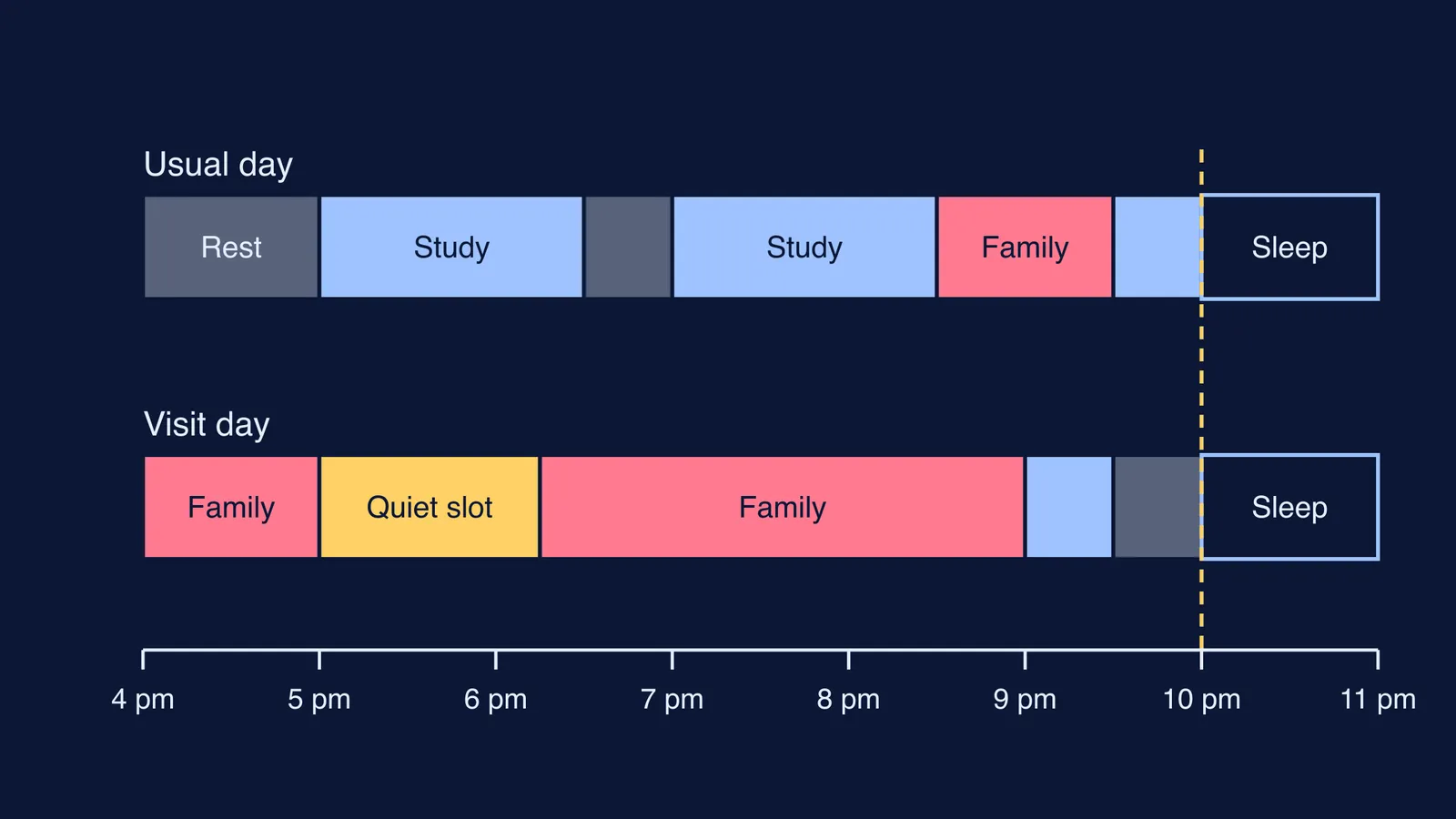
On a usual school day, a Class 10 student rests from 4 to 5 pm, studies 5 to 6:30, takes a break, studies 7 to 8:30, has dinner, revises from 9:30 to 10, and sleeps at 10. That is about three and a half hours of study.
On a visit day, she spends 4 to 5 pm with her grandparents, studies 5 to 6:15 in her quiet slot, stays with the family through dinner until 9, revises for half an hour, winds down, and still sleeps at 10. That is about half the usual study, with the same start time and the same bedtime.
When the visit ends, return to the full routine the next school day. Nothing needs to be made up in one weekend.