On this page
Your child's height is built in thin discs of cartilage near the ends of the long bones, and those discs have an end date. Here is how growth plates work, when they close, and what you can and cannot change.
What is a growth plate?
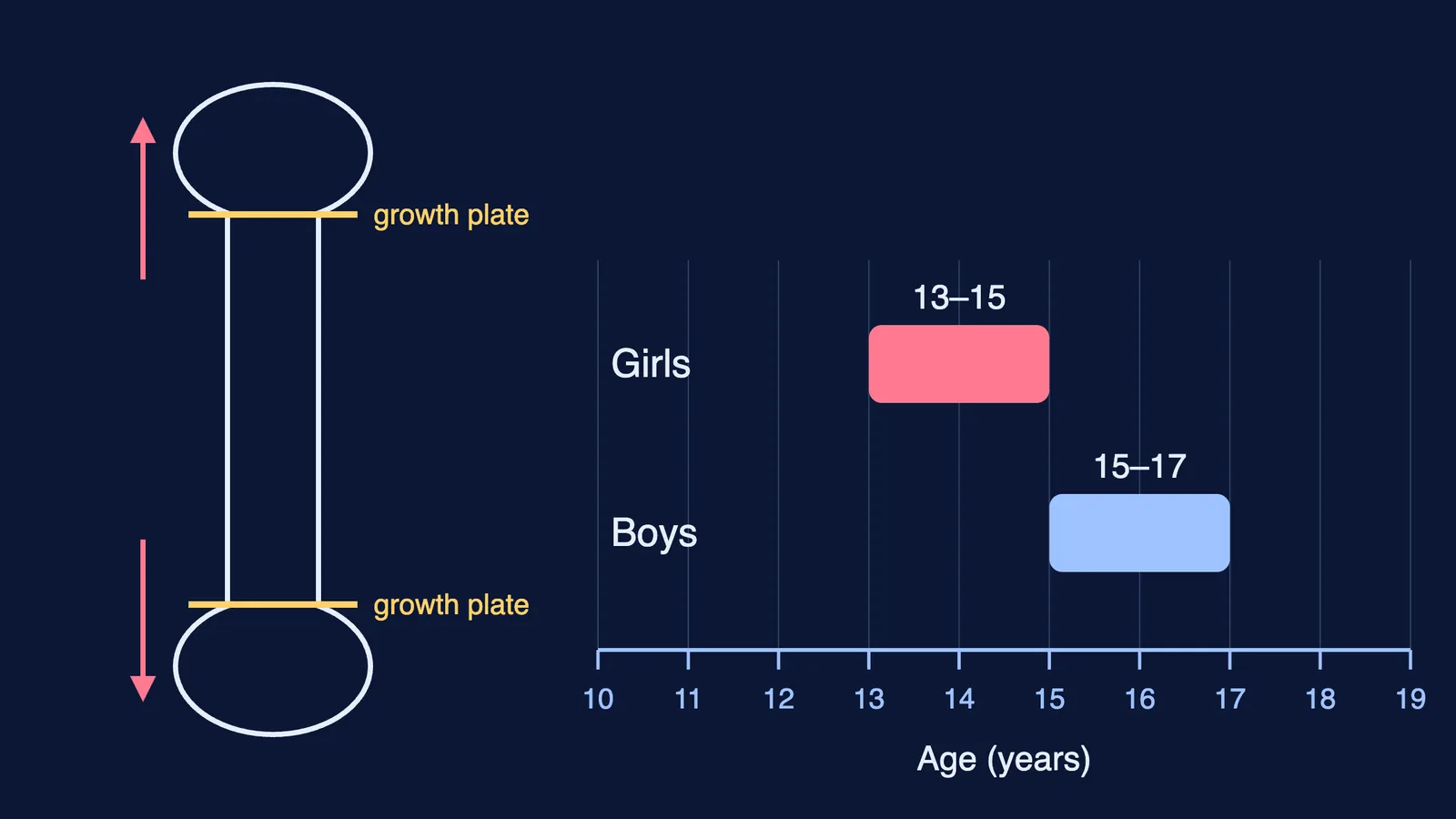
A growth plate is a layer of cartilage near each end of a long bone, where the bone grows in length. KidsHealth describes cartilage as a rubbery, flexible material; the nose, for instance, is made of it. See how it differs in cartilage vs bone.
The plate is divided into resting, proliferative and hypertrophic zones, according to a 2024 review in Clinical and Experimental Pediatrics. Cells in the resting zone are the reserve. In the proliferative zone they divide and line up in columns. In the hypertrophic zone they swell, the cartilage around them calcifies, and bone replaces it.
New cartilage is made on one side and turned into bone on the other, so the bone gets longer while the plate stays thin. The EFORT Open Reviews overview of the growth plate calls this endochondral ossification and lists growth hormone and oestrogen among the signals that control it. For a related puzzle, see why babies have more bones than adults.
When do growth plates close?
Growth plates usually close near the end of puberty: around ages 13 to 15 for girls and 15 to 17 for boys, according to KidsHealth. After a plate closes, that bone is no longer growing.
The Clinical and Experimental Pediatrics review explains that as a plate ages, the reserve cells in its resting zone are used up and the number of dividing cells falls; then the cartilage calcifies, blood vessels grow in, and the plate closes. The EFORT review adds that under the influence of oestrogen, cell division slows as the resting cells are consumed.
One unusual case shows oestrogen's role. In 1994, Eric Smith and colleagues reported in the New England Journal of Medicine on a 28-year-old man whose body could not respond to oestrogen because of a gene mutation. He was 204 cm tall, his growth plates had not fully closed, and he had kept growing into adulthood. The authors concluded that oestrogen is important for bone maturation in men as well as women.
This helps explain why the end of puberty is also the end of growth in height. If your child is nearing these years, see our guide on how to talk to your child about puberty using NCERT.
What decides how tall a child will be?
Mostly genes. A twin study of 30,111 pairs in eight countries estimated that genetic differences explained 87 to 93% of the variation in men's height and 68 to 84% in women's, depending on the country and the statistical model. These figures describe differences within a population.
Where food and health are not assured, the environment shows. The NCD Risk Factor Collaboration reanalysed 1,472 studies covering more than 18.6 million people born between 1896 and 1996. South Korean women became 20.2 cm taller over that century, while adult height changed little in South Asia. Genes do not change that fast across a population; childhood nutrition and health can.
Can you grow taller after your growth plates close?
Not in bone length. Once a plate has hardened into solid bone, the bone stops lengthening (KidsHealth), so no exercise can lengthen that bone afterwards. While the plates are still open, the useful steps are plain ones:
Regular, filling meals through childhood and the teen years, since nutrition is the part of height a family can influence.
Prompt care for injuries near a joint. OrthoInfo from the American Academy of Orthopaedic Surgeons says growth plate fractures happen twice as often in boys as in girls, because girls finish growing earlier. Most heal without complications with proper treatment, but one that is not treated properly can leave a limb crooked or unequal in length.
A paediatrician, not an online calculator, if growth worries you.
How do you estimate a child's target height?
Doctors often start with the parents' heights. The MSD Manual height potential calculator uses this rule: for a boy, add 13 cm to the mother's height and average it with the father's; for a girl, subtract 13 cm from the father's height and average it with the mother's. The likely adult range is 8.5 cm either side of the result.
A worked example, with a father of 172 cm and a mother of 158 cm:
Son: (172 + 158 + 13) ÷ 2 = 171.5 cm, so a likely range of about 163 to 180 cm.
Daughter: (172 − 13 + 158) ÷ 2 = 158.5 cm, so a likely range of about 150 to 167 cm.
Read the answer as a range, not a promise. If a child is growing well away from the family pattern, or growth seems to stop early, ask a paediatrician, who can examine and test properly.
If your teen wants to follow the biology from cells to whole bones, the Fermi Concept Library gives every biology concept its own lesson and its place in the map.