On this page
Your Class 10 child gets home at 3:30, the younger one is right behind, and nobody else is home until 7. By the time a parent walks in, the elder has fed, refereed and supervised for three hours, and the maths chapter is still closed. It is common where both parents work, and the fix is mostly about the clock.
Is it fair to ask an elder child to look after a younger sibling?
Helping is fine. The problem is open-ended duty: being "in charge" all evening means being interruptible all evening.
Researchers led by a team at the University of Tokyo surveyed 1,943 junior high and high school students in Cambodia and found that 60.1% had regularly cared for younger siblings over the past year, for between one and 10 hours a day (Yi et al., Asian Journal of Psychiatry, 2012). In that study, sibling caretaking was associated with more depressive symptoms in both boys and girls. A survey shows a link, not a cause, but it is a good reason to keep care time short and visible.
Who usually does the caregiving at home in India?
India's Time Use Survey 2024 found that on a given day, 41% of women aged 15 to 59 gave unpaid care to household members, against 21.4% of men, and women who did spent about 140 minutes a day on it compared with 74 minutes for men (MoSPI press note, 25 February 2025). When the parent who usually covers is at work, the load can slide to the eldest child. Fair sharing starts with the two adults.
What does a fair after-school timetable look like?
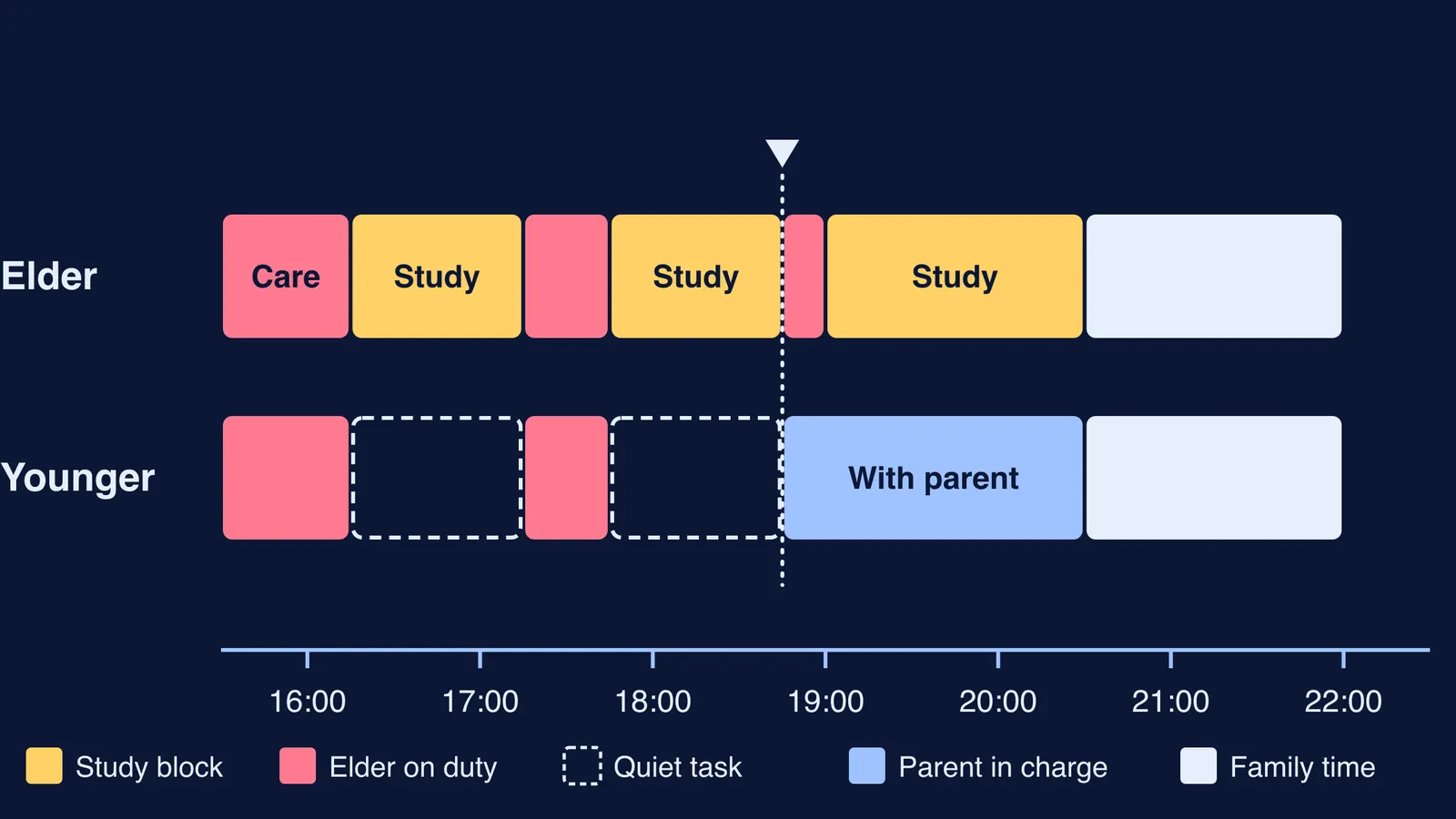
Here is a sample weekday for a 15-year-old and a 7-year-old, with a parent home by 6:45 pm. Change the times; keep the shape.
3:30 to 4:15 pm, elder on duty: snack, wash up, unpack the younger child's bag.
4:15 to 5:15 pm, study block 1: the younger child does homework or a "quiet box" (colouring, puzzles, a library book) at the same table.
5:15 to 5:45 pm, elder on duty: answer saved questions, play outside, second snack.
5:45 to 6:45 pm, study block 2: the younger child gets the agreed screen or play slot.
6:45 to 7:00 pm, handover: the parent arrives and the elder reports anything important in two minutes.
7:00 to 8:30 pm, study block 3, the longest: the parent has the younger child completely.
8:30 to 10:00 pm: dinner, family time, packing bags. Lights out by about 10:30.
That gives 3.5 hours of protected study and about 75 minutes of active care. Lights out at 10:30 with a 6:30 alarm gives eight hours in bed; the American Academy of Sleep Medicine recommends 8 to 10 hours per 24 hours for teenagers aged 13 to 18 and 9 to 12 hours for children aged 6 to 12 (Paruthi et al., Journal of Clinical Sleep Medicine, 2016).
If an hour feels too long, split each block into short work-and-break cycles, as in our guide to Pomodoro study blocks that protect focus. And so a 60-minute block is not spent deciding where to begin, Fermi's AI tutor can work out what your child already knows and build a plan for the session.
How can working parents share the load fairly?
Call home during care shifts, not study blocks, so your call is never the interruption.
On weekends, the parent who is home takes the younger child for a full half-day, so the elder gets one long block.
Teach the younger child small jobs: pour water, fetch a ready snack, start homework.
Use whatever help you have, even twice a week: a grandparent, a trusted neighbour, day care or an after-school class.
In exam weeks, cancel the care shifts and arrange cover.
Every Sunday, spend ten minutes on what worked and adjust the times.
If chores are a sore point too, a rotating chore rota for siblings keeps the rest of the work fair. For a wider age gap, see our family plan for one child preparing for JEE and the other in Class 6.
What should parents say to the elder child?
Say it once, when nobody is rushed:
"We need your help with Riya for two short shifts every day, not the whole evening. Your study blocks are yours, and Riya knows not to interrupt them. If it isn't working, or your marks or sleep start slipping, tell us. We will change the plan; we won't ask you to just manage harder."
And to the younger child: "When Didi is studying, you draw your question on a note. She will answer it at 5:15."
Then thank the elder child out loud, in front of the younger one.
If your elder child seems low, irritable or overwhelmed for weeks, talk to the school counsellor or a doctor, or call the free Tele MANAS helpline on 14416 at any hour.
Put this timetable on the fridge for one week, then review it together on Sunday.