On this page
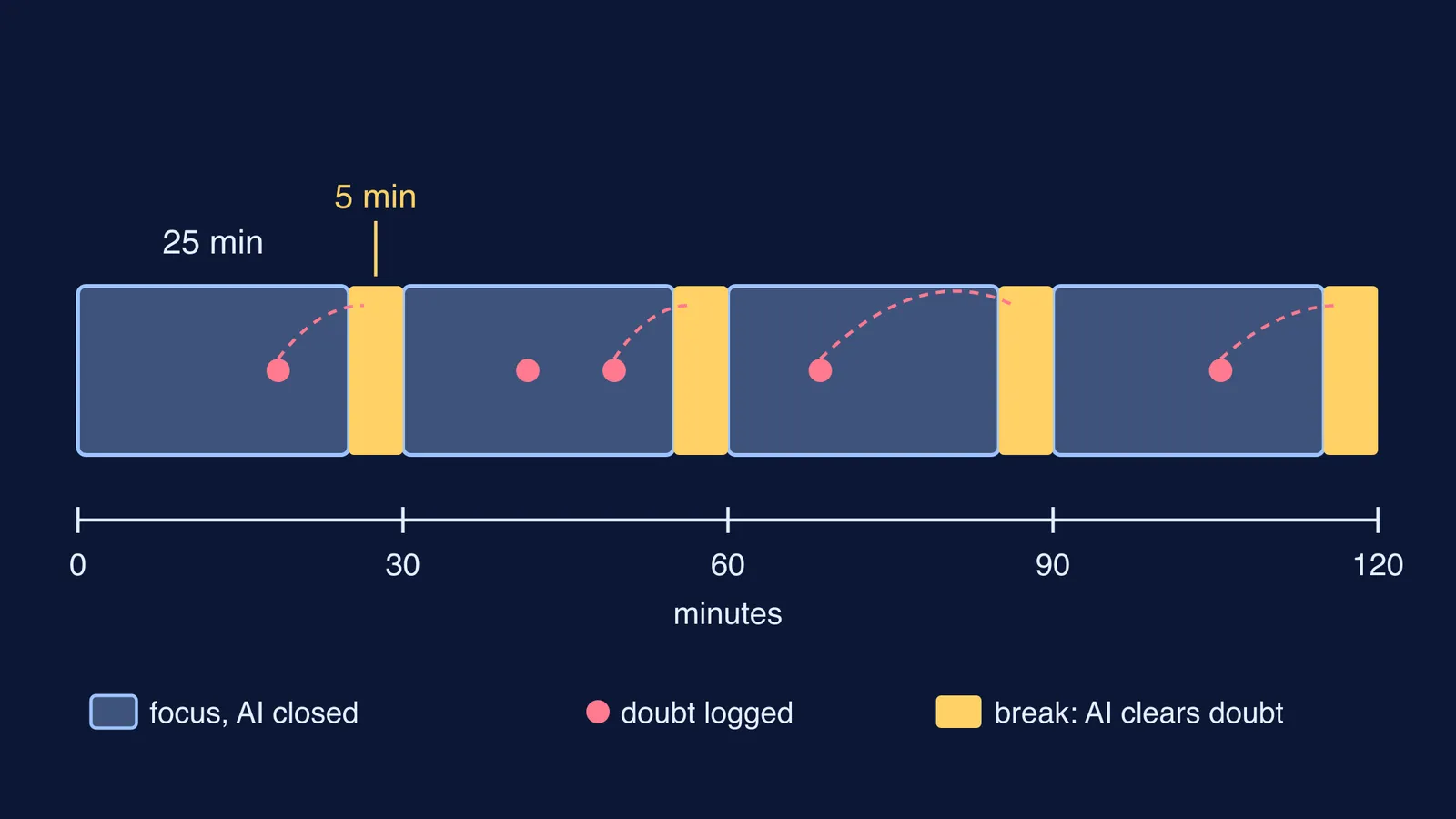
Most students open an AI tutor the moment a problem gets hard. One quick question becomes three, and the problem set is half done. The plan below keeps the tutor and drops the interruptions: you work in 25-minute blocks with the AI closed, write each doubt down, and clear it in the 5-minute break.
What is the Pomodoro technique, and does research back it?
The Pomodoro technique, created by Francesco Cirillo, is a timer method. Cirillo's own site describes how most people know it: "work for 25 minutes, take a break, and repeat", adding that the timer is only the starting point.
The research is encouraging but not settled. In a 2023 study in the British Journal of Educational Psychology, 87 Dutch university students studied with either self-regulated breaks or fixed breaks, one group taking 6 minutes off after every 24-minute block. Students who chose their own breaks reported more fatigue and distractedness and less concentration and motivation, though task completion was similar.
A 2025 study in Behavioral Sciences with 94 university students over a 2-hour session found no differences in productivity, task completion or flow between Pomodoro, Flowtime and self-regulated breaks. So the timer is not magic. What it gives you is a fixed point where the break, and the AI, belong. Our explainer on what research on Pomodoro breaks shows goes further into the evidence.
Why keep the AI tutor closed during the 25 minutes?
In Sophie Leroy's 2009 experiments, people who moved away from an unfinished task found it hard to pull their attention off it, and their next task suffered. She called this "attention residue". Jumping from a half-solved problem to a chat window is exactly that kind of switch away from an unfinished task.
A 2023 meta-analysis of 22 studies found a significant overall negative effect of smartphone use and presence on cognitive performance; of the areas tested, only the effect on memory was significant on its own. If your tutor lives on your phone, the phone stays on the desk, and it may keep pulling at you. For a practical test you can run yourself, see our one-week phone notification experiment.
There is also a learning reason. If the AI is one tap away, you stop struggling at the exact moment struggling would teach you something.
How do you log doubts without breaking focus?
Keep a paper doubt slip beside you. When you get stuck, spend no more than 30 seconds writing one line, then move to the next problem:
Problem number and chapter
The step where you got stuck
What you tried
Your question, in one sentence
After the session, copy the cleared doubts into a proper record so they stay solved. Our guide to keeping a doubt log with AI answers shows a format.
What does a two-hour 25-5 plan with an AI tutor look like?
Here is a worked example for 12 JEE Main kinematics problems.
Setup, 3 minutes: phone in another room or on the laptop with the AI tab closed, timer set, doubt slip ready, problems 1 to 12 listed.
Block 1, 25 minutes: problems 1 to 4. You log one doubt on problem 3, relative velocity in a river crossing.
Break 1, 5 minutes: 3 minutes with the AI tutor on that one doubt, 2 minutes standing up and drinking water.
Block 2, 25 minutes: retry problem 3 without help, then problems 5 to 7. Two new doubts.
Break 2, 5 minutes: clear the doubt that blocks the most problems. Carry the other forward.
Blocks 3 and 4: same rhythm. A doubt that needs more than one break becomes the task of the next block, not a longer break.
In the break, paste your slip line rather than the whole question:
"Problem 3, river crossing. I took the boat velocity relative to the ground, not the water. Don't solve it. Tell me which frame to start in, then ask me the next step."
That asks for a hint, not an answer. Fermi's AI tutor is built to teach rather than hand over answers: it notices where you are stuck and decides whether to explain, ask or show. If your doubt is that you picked the wrong method, the Fermi Problem Library has a step-by-step solver that explains the reasoning.
What if 25 minutes feels too short or too long?
Adjust the numbers, keep the rule. The 2023 study used 24-minute blocks and 6-minute breaks, and in the 2025 study fatigue rose faster with 25-5 breaks, though overall fatigue levels did not differ. If you tire early, try a slightly longer break. Long multi-part problems may suit longer blocks. What should not change is that the AI opens only in the break.
If studying leaves your child persistently exhausted or anxious, talk to a school counsellor or call Tele MANAS on 14416.
Try one 25-5 block tonight with a single chapter and a paper slip, and see how many doubts are still doubts by the break.