

On this page
Most doubt notebooks fail the same way. You paste in what an AI chatbot said, feel relieved, and never look at it again. Three weeks later the same type of question turns up in a mock test and the doubt is back. The fix is to make each entry something you can test, not just reread.
Why is copying the AI's answer not enough?
A field experiment published in PNAS in 2025 gave nearly a thousand high school maths students access to GPT-4 tutors (Bastani et al., PNAS). With a standard ChatGPT-style interface, practice grades rose 48%, but once access was taken away those students scored 17% lower than students who never had it. The authors describe students using the tool as a "crutch" during practice; a version built with learning safeguards largely avoided the drop.
Older memory research points the same way. In Roediger and Karpicke's experiments, students who took recall tests remembered more after two days and after a week than students who restudied, even though restudying made them more confident (Psychological Science, 2006). A review of 10 learning techniques rated practice testing and distributed practice as high utility, and rereading and highlighting as low utility (Dunlosky et al., 2013).
What should a doubt log entry include?
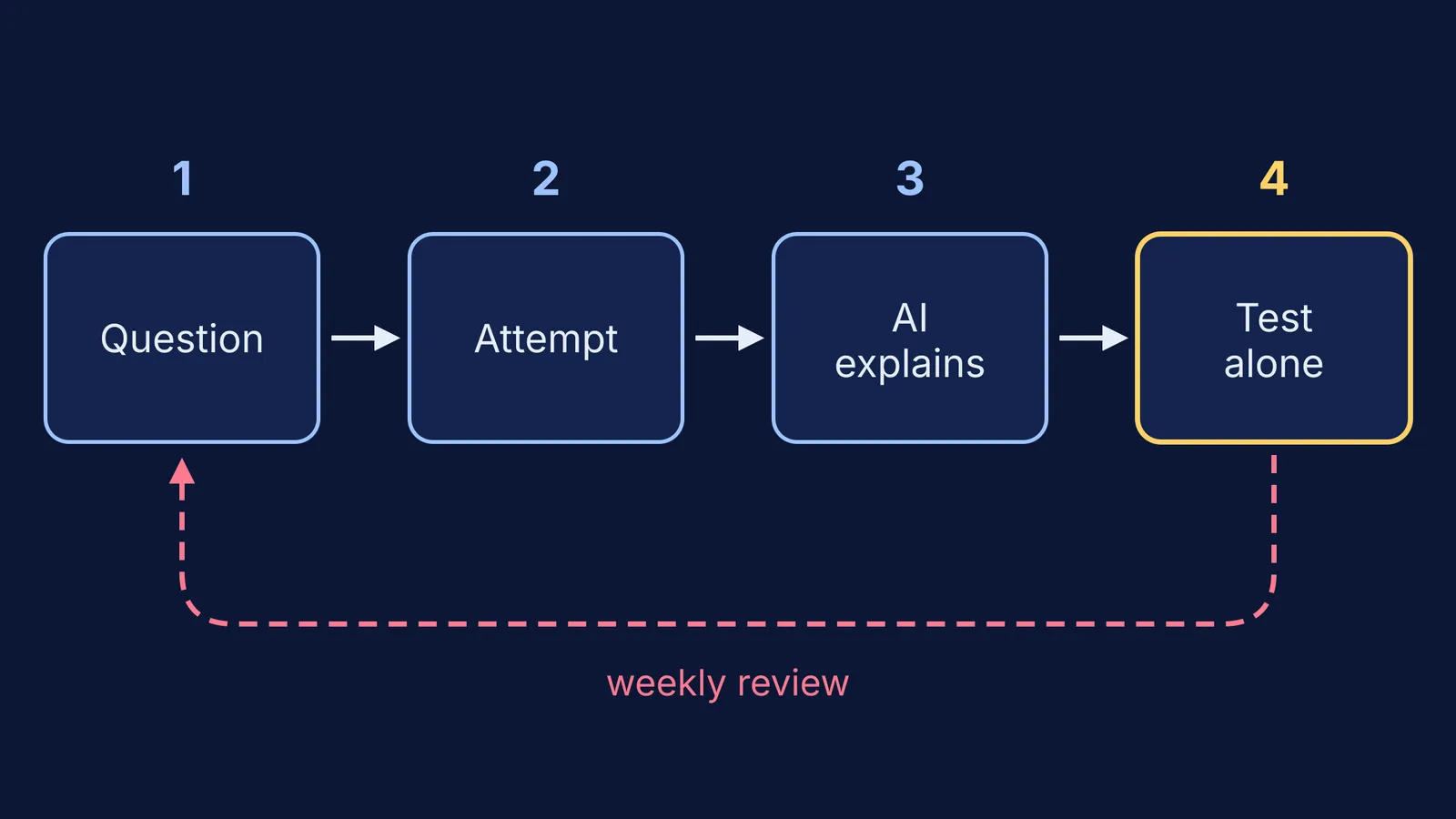
Use one half-page per doubt in a notebook, or one spreadsheet row, with five fields:
Source and date. Where the doubt came from, such as "HC Verma, friction chapter, Q14" or "Mock 3, Q22".
The question, in one line, in your words. "Why does the answer say the friction coefficient equals tan of the angle?"
Your attempt. What you tried, the exact line where you got stuck, and how sure you were. Write this before you ask the AI.
The explanation, in your words. Two or three lines naming the idea you missed. Do not paste the chatbot's whole reply.
A follow-up test. A new question of the same type, written down but not solved. Ask the AI: "Give me one similar question with different numbers. Do not give the answer."
The attempt field is not busywork. Janet Metcalfe's review of research on learning from errors found that making an error and then getting corrective feedback helps learning, that feedback analysing the reasoning behind the mistake is crucial, and that high-confidence errors are corrected more readily (Annual Review of Psychology, 2017). More in our post on why making mistakes helps you learn.
What does a filled-in entry look like?
A JEE-style physics doubt:
Source: Mock 3, Q22, 12 October.
Question: A block slides down a rough incline at constant speed. Why is the coefficient of friction tan of the angle?
Attempt: Wrote mg sin of the angle minus friction equals ma; stuck because I did not know a. Confidence: low.
Explanation, my words: Constant speed means a is zero. So friction exactly balances mg sin of the angle, and friction is μ mg cos of the angle, which gives μ equals tan of the angle.
Follow-up test: A block slides down a 37 degree incline at constant speed. Find μ. Then the block is pushed up the same incline and released: find its deceleration.
Reviews: 19 October, right. 2 November, right. Closed.
The second part adds a twist (friction flips direction going up), so you cannot pass by remembering the answer. For better practice questions from a chatbot, see how to make an AI chatbot quiz you properly.
How do you review a doubt log each week?
Pick a fixed slot, say 30 minutes on Sunday evening, and for each open entry:
Cover the explanation field.
Solve the follow-up test on fresh paper, without AI.
If you got it right, write the date and "right", and check it again two weeks later.
If you got it wrong, reopen it: new attempt, a narrower question to the AI, updated explanation, new follow-up test.
Close an entry after two correct solves at separate reviews.
Spend the last five minutes on patterns. Three open doubts that are all sign errors tell you what to revise next.
Spreading the checks across weeks applies the distributed practice finding from Dunlosky's review. For whole chapters, our 4-week spaced revision schedule fits around this review.
Parents: the useful Sunday question is "Which doubts did you close this week, and which reopened?" rather than how many pages are filled.
What if the same doubt keeps coming back?
If an entry reopens twice, the gap is usually in the method or the concept underneath, so log that smaller doubt instead. Fermi's AI tutor notices where a student is stuck and decides whether to explain, ask or show, and the Fermi Problem Library has worked problems with a step-by-step solver that explains the reasoning rather than printing an answer. Whichever you use, the follow-up test still goes in your log, and you still solve it alone.
Start tonight with one doubt from today's homework and all five fields filled in.


