On this page
When one child is in the JEE year and the other is in Class 6, the house quietly reorganises around the older one. The risk is that the younger child's ordinary needs, such as a fixed bedtime, someone checking the maths homework and someone to tell about their day, slip away without anyone deciding they should. Here is how to support the aspirant and keep the younger child's week normal.
Is it unfair to give the JEE child more attention?
Not necessarily, especially if both children understand why. The goal is fair, not equal.
In a Journal of Family Psychology study, Amanda Kowal and colleagues interviewed 135 children, average age about 11.7, and their older siblings about how parents shared affection and control. Children who believed a parent's preferential treatment was fair had fewer internalising problems and higher self-esteem. The authors also cite earlier research finding that children in middle childhood were more likely to judge fair shares by circumstances such as need than to insist on equal treatment, especially within families.
Unexplained differences can carry a cost. A 2024 meta-analysis in the same journal drew on 13 samples and found a small but significant link between parents treating siblings differently and differences in the siblings' behaviour problems. The link was stronger for differential hostility than for differential warmth.
In practice, the extra hours you give the JEE child are fine. Watch for the other thing: snapping at the younger one because the house is tense.
What should you tell the younger child?
One honest conversation at the start of the year does more than repeated apologies later. Cover these points:
“Your brother (or sister) has a very big exam this year, so they need quiet evenings and I will be helping them more. That is because of the exam, not because they matter more.”
“Our time hasn't gone. Every night before bed, it's just you and me, and you choose what we talk about.”
“When the exam is over, we'll do the trip we postponed.” Only say this if you will keep it.
“If you ever feel left out, tell me. You won't be in trouble for saying it.”
Ask the elder child to add one sentence of their own, such as thanking the younger one for keeping the noise down. If the two already clash over noise, our guide to stopping a younger sibling disturbing study time has ground rules that work for both.
How do you keep a Class 6 child's routine normal during a JEE year?
Choose a few anchors that do not move, whatever happens in the older child's week.
Bedtime. The American Academy of Sleep Medicine consensus recommends 9 to 12 hours of sleep per 24 hours for children aged 6 to 12, and 8 to 10 hours for teenagers aged 13 to 18.
A homework slot with a named adult. Decide who checks Class 6 work each day, and at what time, so it does not depend on whoever is free.
Daily one-to-one time. Even 15 minutes, phone away, at the same time each night.
One unchanged weekend activity. Keep the younger child's sport, class or park visit, even if the family outing is paused.
One shared meal. Dinner together reminds both children they are siblings first, not “the exam” and “the disturbance”.
When you are needed elsewhere, Fermi's AI tutor works out what a student already knows and builds a plan for the session, so your younger child sits down to a clear next step rather than waiting for you.
What does a normal weekday look like for both?
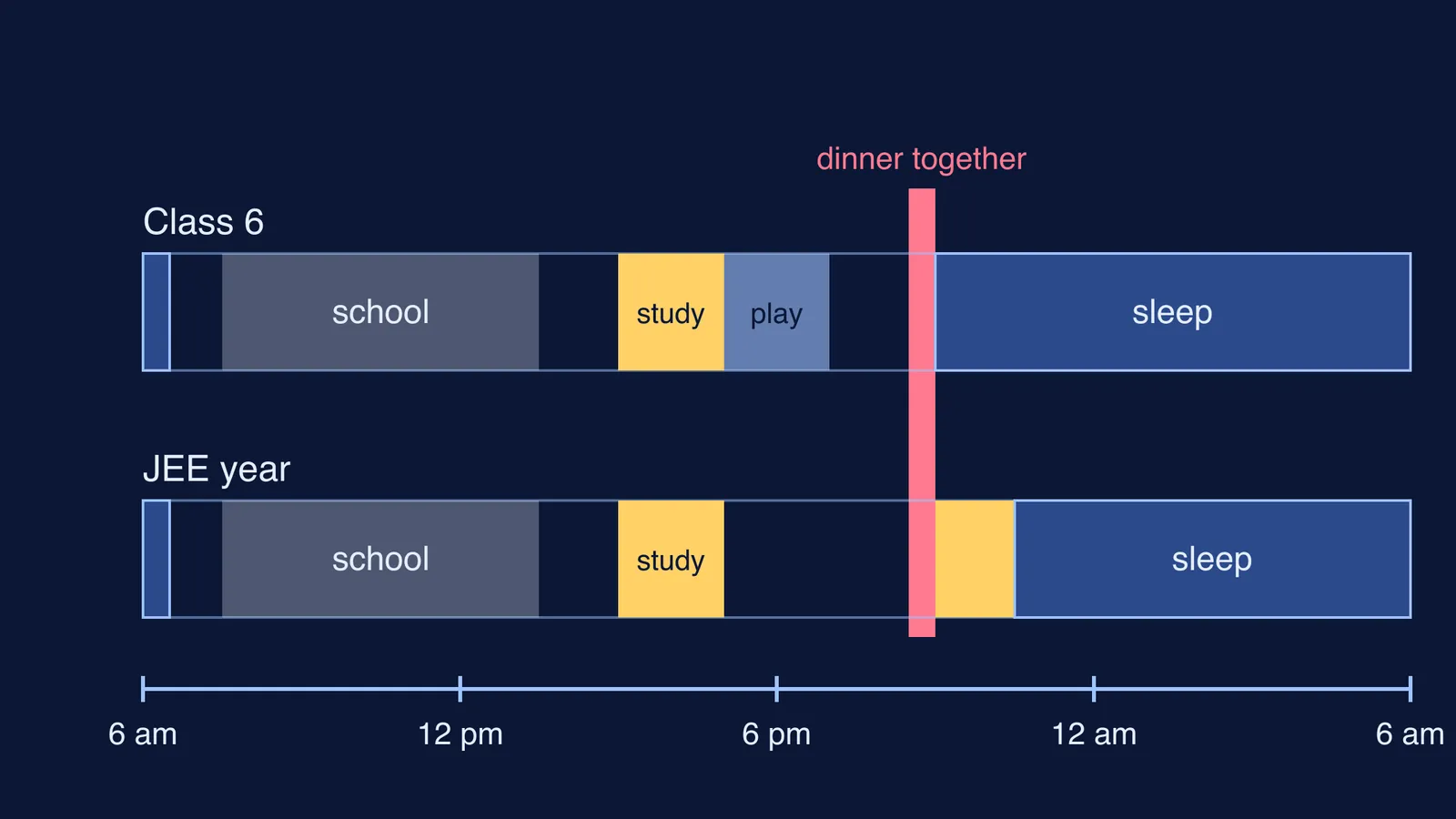
Here is one worked example for a family where both children attend school in the morning. The sleep times sit inside the AASM ranges for each age:
6:30 am: both wake; breakfast together.
7:30 am to 1:30 pm: school for both.
3:00 to 5:00 pm: the elder child studies; the younger child does homework in a different room, with one adult checking in.
5:00 to 7:00 pm: the younger child plays outside or goes to their class.
8:30 pm: dinner together.
9:00 pm: the younger child's one-to-one time, then lights out (about 9.5 hours of sleep).
9:00 to 10:30 pm: the elder child's last study block, then bed (about 8 hours of sleep).
If both children face exams in the same weeks, adjust this with our plan for when both children have exams at once. For the question of breaks, read whether to go on holiday during the JEE or NEET year.
When is it more than a busy year?
If, for several weeks, the younger child's sleep, appetite, mood or school reports change, or the aspirant withdraws from everyone, talk to the class teacher, school counsellor or your family doctor. You can also call Tele MANAS, the Indian government's toll-free tele-mental health helpline, on 14416. It runs 24x7, and the government reported in April 2025 that it was available in 20 languages.
Start tonight: tell your younger child when their time with you is, and keep it.