On this page
You can square both sides of an inequality only when both sides are non-negative. If either side can be negative, squaring may keep the sign, flip it, or quietly add wrong solutions. Here is why, a four-case decision list, and a worked example where blind squaring fails.
Why does squaring sometimes flip the inequality?
The NCERT Class 11 chapter on linear inequalities says the sign is reversed when you multiply or divide both sides by a negative number. Squaring is trickier: it multiplies each side by a different number, a by a and b by b.
Try three pairs:
Both sides non-negative: 2 < 5 becomes 4 < 25. Direction kept.
Both sides negative: −5 < −2 becomes 25 > 4. Direction flipped.
Mixed signs: −3 < 2 becomes 9 > 4 (flipped), but −1 < 2 becomes 1 < 4 (kept). No rule you can trust.
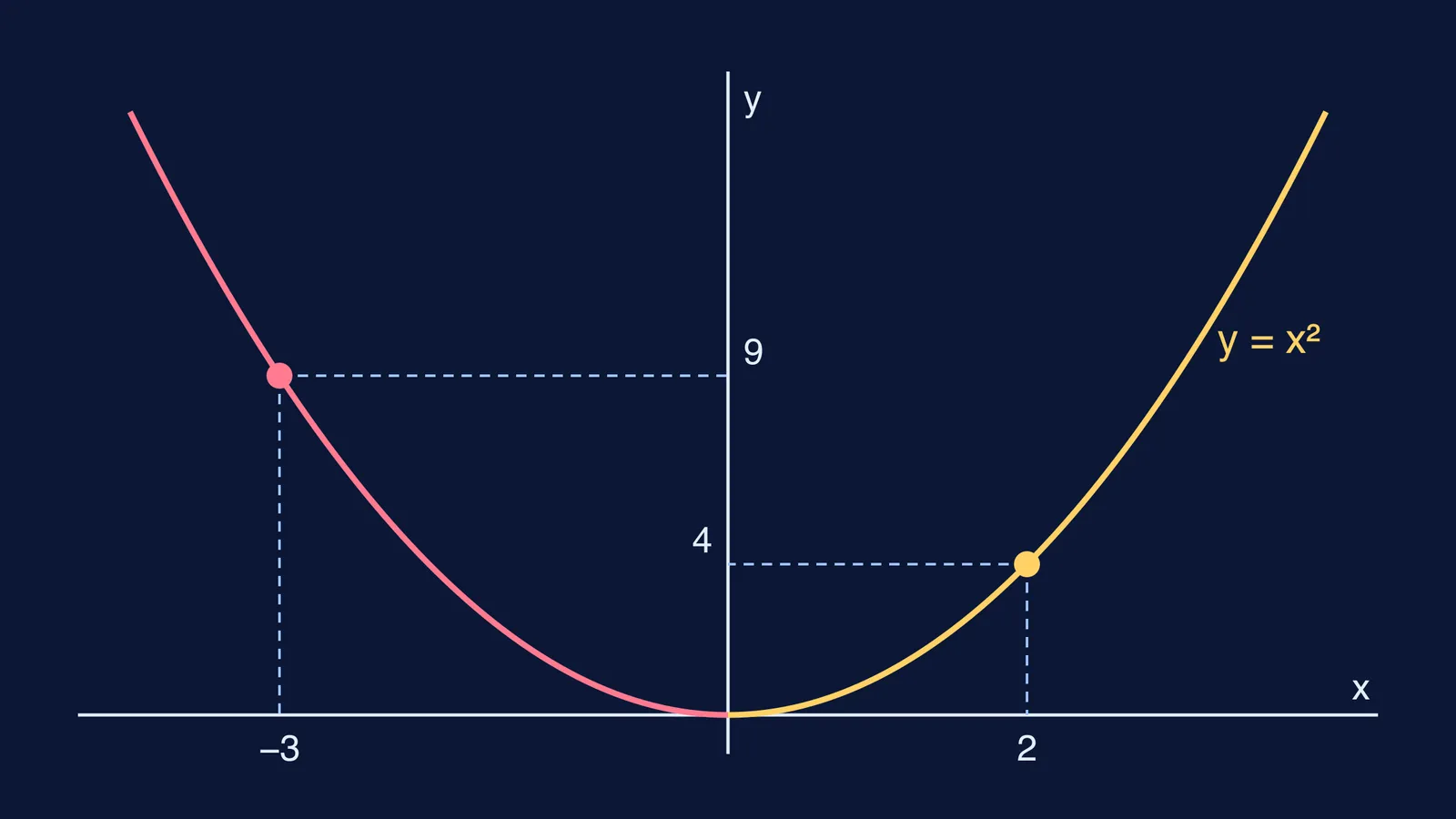
A monotonically increasing function can be applied to both sides without breaking an inequality, and a decreasing one reverses it (inequalities in mathematics)). The function y = x² decreases for x ≤ 0 and increases for x ≥ 0, as the graph above shows.
A one-line exam test: If a < b, then b² − a² = (b − a)(b + a). Since b − a is positive, the squares keep the direction exactly when a + b > 0. So the question to ask is not "which side is bigger?" but "what is the sign of a + b?"
When is it safe to square both sides of an inequality?
Use this decision list:
Both sides are ≥ 0 for every x you are considering: square, and keep the sign. The standard statement is 0 ≤ a ≤ b exactly when 0 ≤ aⁿ ≤ bⁿ for n > 0 (power rule for inequalities)).
Both sides are ≤ 0: multiply both by −1 (flipping the sign), then square. The squares point the other way.
Signs mixed or unknown: do not square yet. Split into cases by sign.
Both sides are absolute values: always safe, because an absolute value is never negative. Since |x| = √(x²) (absolute value), |a| < |b| means the same as a² < b².
Worked example: how do you solve √(x + 3) < x − 3?
Blind squaring gives x + 3 < x² − 6x + 9, so (x − 1)(x − 6) > 0, meaning x < 1 or x > 6. With the domain x ≥ −3, that suggests −3 ≤ x < 1 or x > 6. Test x = 0: √3 ≈ 1.73 is not less than −3. Wrong.
The safe method:
Domain: x + 3 ≥ 0, so x ≥ −3.
Sign check: the left side is ≥ 0, so the right side must be positive: x > 3.
Now both sides are non-negative, so square: (x − 1)(x − 6) > 0, giving x < 1 or x > 6.
Intersect with x > 3: the answer is x > 6.
Check x = 7: √10 ≈ 3.16, which is less than 4. True. Check x = 6: 3 < 3 is false, so 6 is excluded, as expected.
The reverse, √(x + 3) > x − 3, needs two cases. For −3 ≤ x < 3 the right side is negative, so every such x works. For x ≥ 3, squaring gives 1 < x < 6, so 3 ≤ x < 6. Together: −3 ≤ x < 6.
Can you square an inequality with absolute values?
Yes, and it is often the quickest route. For |x − 1| < |x + 3|, both sides are non-negative, so square: x² − 2x + 1 < x² + 6x + 9, which simplifies to −8x < 8. Dividing by −8 reverses the sign, as the NCERT rule for negative numbers says, giving x > −1. Check x = 0: 1 < 3, true. Check x = −2: 3 < 1, false.
When only one side has a modulus, as in |x − 2| < x, the right side could be negative, so use the case split in our guide to solving modulus equations and inequalities by cases.
A 20-second check before you square
Have I written the domain?
Is each side ≥ 0 for every x still in play? If not, which cases do I need?
After solving, have I intersected with the domain and the sign conditions?
Have I tested one value inside and one outside my answer?
For the equation version of this trap, read why squaring both sides gives extra roots. For multiplying and dividing, see when the inequality sign flips.
If you keep slipping at the same step, the Fermi Problem Library has worked problems with a step-by-step solver that explains the reasoning rather than printing an answer. If increasing functions feel shaky, the Fermi Concept Library gives each concept its own lesson.
Next time you reach for the square, write "both sides ≥ 0?" in the margin first.