

On this page
You square both sides of √(x + 5) = x − 1, factor a neat quadratic and get two answers. Then you substitute one back and it fails. Squaring both sides is a one-way step, and it can hand you roots that the original equation never had. Here is where fake roots come from and how to rule them out before you solve.
Why does squaring both sides give extra roots?
The squaring property of equality says that if a = b, then a² = b², but the reverse is not guaranteed, as the LibreTexts Elementary Algebra chapter on radical equations points out. Take −3 and 3. They are not equal, yet both square to 9. Squaring wipes out the sign, so the squared equation is true for more values of x than the one you started with.
An extraneous solution is a root that comes out of the solving process but is not a solution of the original equation, according to OpenStax College Algebra 2e, section 2.6. The same section says these roots are not due to a mistake in the method; they come from raising both sides to a power. Its own example, √(15 − 2x) = x, gives x = −5 and x = 3, and only x = 3 survives the check.
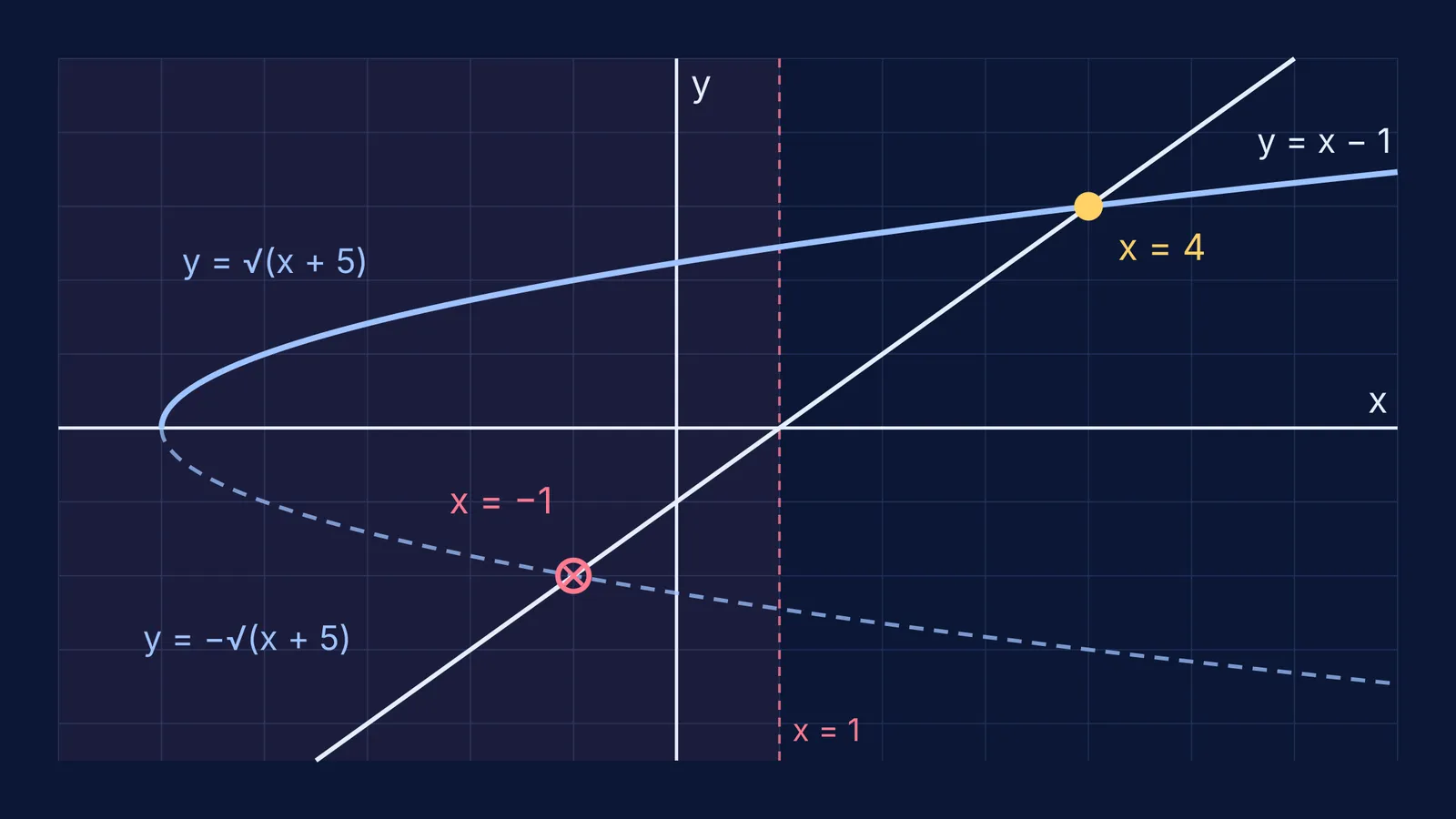
When you square √(x + 5) = x − 1, you get x + 5 = (x − 1)². That squared equation is also what you get when you square √(x + 5) = −(x − 1). You have merged two different equations into one, and the quadratic gives you the roots of both.
Worked example: solving √(x + 5) = x − 1
Write the conditions first. The radicand must not be negative, so x + 5 ≥ 0, which means x ≥ −5. A square root is never negative, so the right side must satisfy x − 1 ≥ 0, which means x ≥ 1. Together: x ≥ 1.
Square both sides: x + 5 = x² − 2x + 1.
Tidy up: x² − 3x − 4 = 0.
Factor: (x − 4)(x + 1) = 0, so x = 4 or x = −1.
Filter with the condition: x = −1 breaks x ≥ 1, so reject it without any arithmetic.
Check the survivor in the original: √(4 + 5) = √9 = 3, and 4 − 1 = 3. It works.
Where did −1 come from? Put it into the original: the left side is √4 = 2, the right side is −2. It actually solves the other equation, √(x + 5) = 1 − x, where both sides equal 2. On a graph, y = √(x + 5) meets y = x − 1 only at (4, 3); the fake root is where the line meets the lower half, y = −√(x + 5), which squaring brought in.
What domain conditions should you write before squaring?
Before you square, note:
The side opposite a square root must be zero or positive. This is the condition that catches the fake roots in every example here.
Every expression under an even root must be zero or positive.
If a square root equals a negative number, as in √(2x − 3) = −1, there is no solution.
With two radicals, isolate one, square, isolate the other, and square again. Each squaring needs its own sign condition.
Try one more: √(x + 2) = x. The condition is x ≥ 0. Squaring gives x² − x − 2 = 0, so x = 2 or x = −1. The condition rejects −1 straight away, and √4 = 2 confirms x = 2.
This check is a close cousin of the fact that √(x²) equals |x|, not x, and of the domain checks in solving logarithmic equations and inequalities, where a step like combining logs can also add roots.
How do you check a root quickly in an exam?
Use this routine on every radical equation in a test:
Before solving, write the conditions in a box beside the question, for example x ≥ 1.
After solving, cross out any root that breaks a condition.
Substitute each remaining root into the original equation, not the squared one. The squared equation will accept the fake root every time.
In a multiple-choice question, a fake root can sit among the options looking perfectly reasonable, so the substitution is worth a few extra seconds. The same check works on AI-generated solutions, as we show in plugging the answer back in to check AI working.
If you keep getting the extra root, the Fermi Problem Library has worked problems with a step-by-step solver that explains the reasoning rather than printing an answer. If the shaky part is the idea itself, such as why a square root is never negative, the Fermi Concept Library has a lesson for each concept in mathematics.
Next time you square both sides, write the condition first. It takes one line and saves you a wrong answer.


