

On this page
Is the square root of x squared always equal to x?
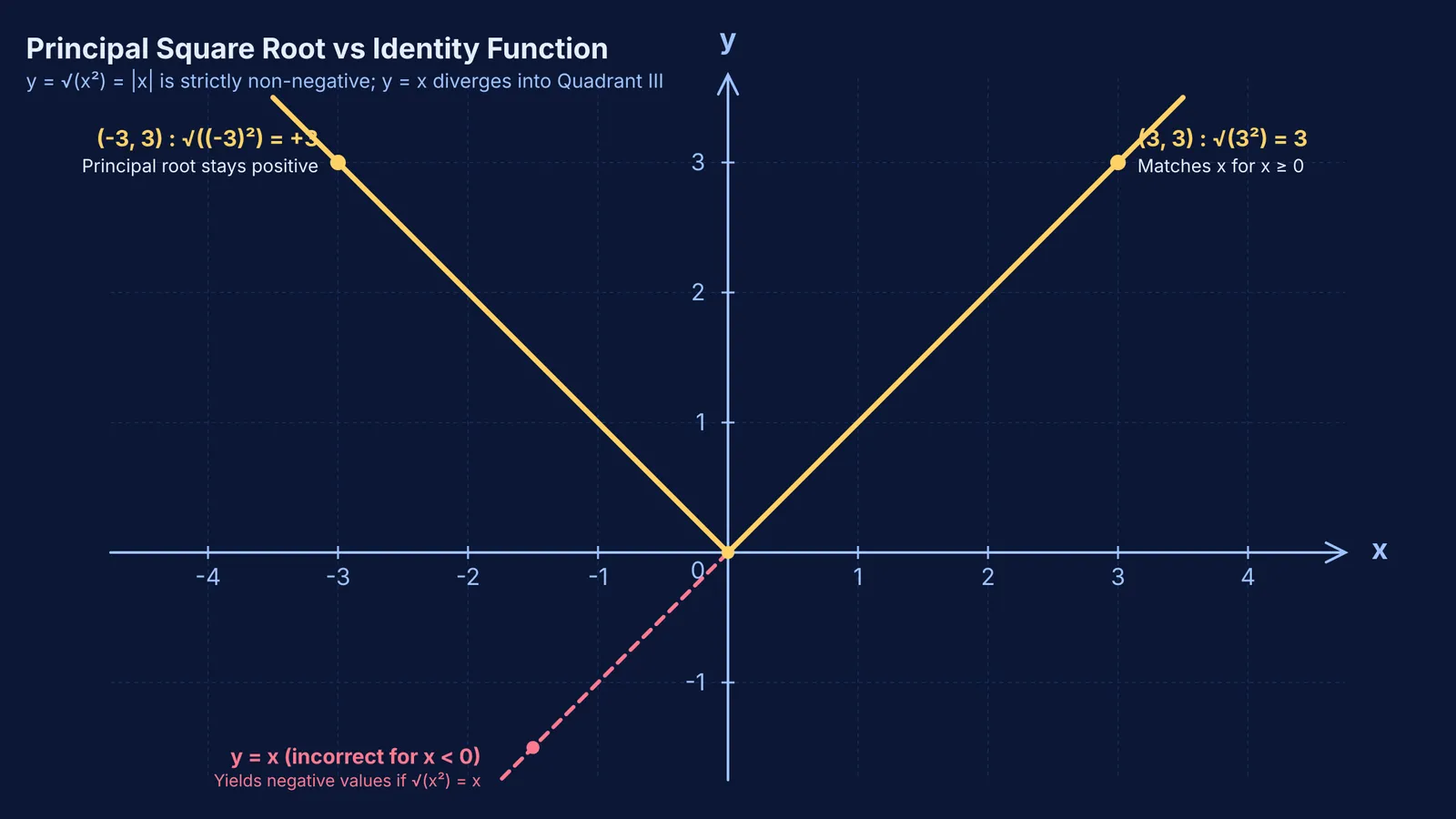
When evaluating √(x²), the instinct to cancel the square root with the exponent 2 is immediate. It feels natural to write √(x²) = x. For positive numbers, this works: if x = 5, then √(5²) = √25 = 5. But cancellation fails when x is negative. If x = −5, then (−5)² = 25, and √25 is positive 5, not −5. Writing √(x²) = x for negative numbers asserts that 5 = −5, an obvious contradiction.
The identity across all real numbers is √(x²) = |x|. By mathematical definition, the radical symbol √ denotes the unique non-negative principal square root, as documented on Wolfram MathWorld. When x ≥ 0, |x| = x. When x < 0, |x| = −x, converting the negative input into a positive output.
In a study of 152 prospective secondary mathematics teachers published in the *Journal for Research in Mathematics Education*, Ruhama Even (Even, 1993) observed that many educators struggle to explain the univalence requirement of functions. When the single-value rule is treated as an arbitrary convention rather than a structural property of functions, students easily reduce radical operations to mechanical, error-prone cancellation.
Why is the square root of 4 equal to 2 and not ±2?
A related confusion is the difference between solving a polynomial equation and evaluating a radical expression. Many students know that x² = 4 has solutions x = 2 and x = −2, and mistakenly infer that √4 = ±2.
These two mathematical operations answer different questions:
The polynomial equation x² = 4 asks: which numbers squared yield 4? The answers are +2 and −2.
The radical expression √4 asks: what is the principal square root of 4? As noted on Wolfram MathWorld's square root reference, the radical symbol denotes strictly the non-negative root: √4 = 2.
If √4 produced both +2 and −2, the square root would not be a function. A mathematical function must assign exactly one output to each valid input. To indicate the negative root, write −√4 = −2; for both roots, write ±√4 = ±2.
In *Educational Studies in Mathematics*, Ruhama Even and Dina Tirosh (Even & Tirosh, 1995) demonstrated that students often conflate the arithmetic definition of radicals with quadratic solving. Similarly, in a study of 46 Grade 9 students published in *Infinity Journal*, Gilbert Baybayon and Minie Rose Lapinid (Baybayon & Lapinid, 2024) found that learners frequently mishandle algebraic signs and overlook the distinction between evaluating radicals and finding quadratic roots.
Where does assuming √(x²) = x cause errors in exams?
In exams like JEE Main and CBSE Class 12, omitting the absolute value sign creates serious errors in calculus.
Consider evaluating a limit at negative infinity: lim (x → −∞) √(4x² + 9) / (3x − 1).
A student who assumes √(x²) = x writes √(4x² + 9) = x √(4 + 9/x²). Dividing through by x gives √4 / 3 = 2/3. This is incorrect. Because x is negative, √(x²) = |x| = −x. The numerator is actually −x √(4 + 9/x²), so dividing by x yields −2/3. Dropping the modulus reverses the sign.
In definite integrals, evaluate: ∫ from −3 to 3 of √(x²) dx.
Writing √(x²) = x gives ∫ from −3 to 3 of x dx = [x²/2] from −3 to 3 = 0. But √(x²) is non-negative everywhere, so the area above the horizontal axis cannot be zero. Applying √(x²) = |x| correctly splits the integral: ∫ from −3 to 0 of (−x) dx + ∫ from 0 to 3 of x dx = 9/2 + 9/2 = 9.
When solving √(x² − 6x + 9) = 4, recognizing that the left side equals |x − 3| is essential. Solving |x − 3| = 4 yields both x = 7 and x = −1. Forgetting the absolute value loses the root x = −1 entirely.
How can you master radical and modulus simplifications?
To avoid sign errors in algebraic simplifications, follow this three-step routine:
Never simplify √(expression²) directly to the bare expression; always write |expression| first.
Determine the sign of the inside expression from the problem's domain. If positive, write |x| = x; if negative, write |x| = −x.
Distinguish between evaluating radicals and solving equations. Write ± only when finding roots of an equation like x² = c.
These rules are essential when solving equations and inequalities with modulus and applying quadratic conditions and discriminant tests. They also connect to geometric methods like counting roots by curve intersections.
When practicing multi-step algebra problems, the Fermi Problem Library provides worked problems with a step-by-step solver that explains the reasoning rather than printing an answer. To build clarity across core definitions, the Fermi Concept Library covers every concept in physics, chemistry, biology, mathematics and computing, each with its own lesson and its place in the map. For targeted feedback on where sign errors occur, Fermi's AI tutor works out what you already know and notices where you get stuck across problem sessions.


