

On this page
When a Class 10 or 12 student sits down to solve a complex JEE or NEET problem, their mind enters a state of deep concentration. But when a toddler or younger sibling runs into the room asking for a toy, that concentration shatters. A brief interruption can easily derail an entire study block.
For families with a large age gap between children, balancing the older sibling's need for quiet and the younger sibling's need for attention is a daily struggle. Setting up practical home arrangements can protect the older child's academic performance without making the younger child feel ignored or unfairly compared, a tension explored in Why comparing siblings backfires, and what to say instead.
Why does an interruption cost so much time?
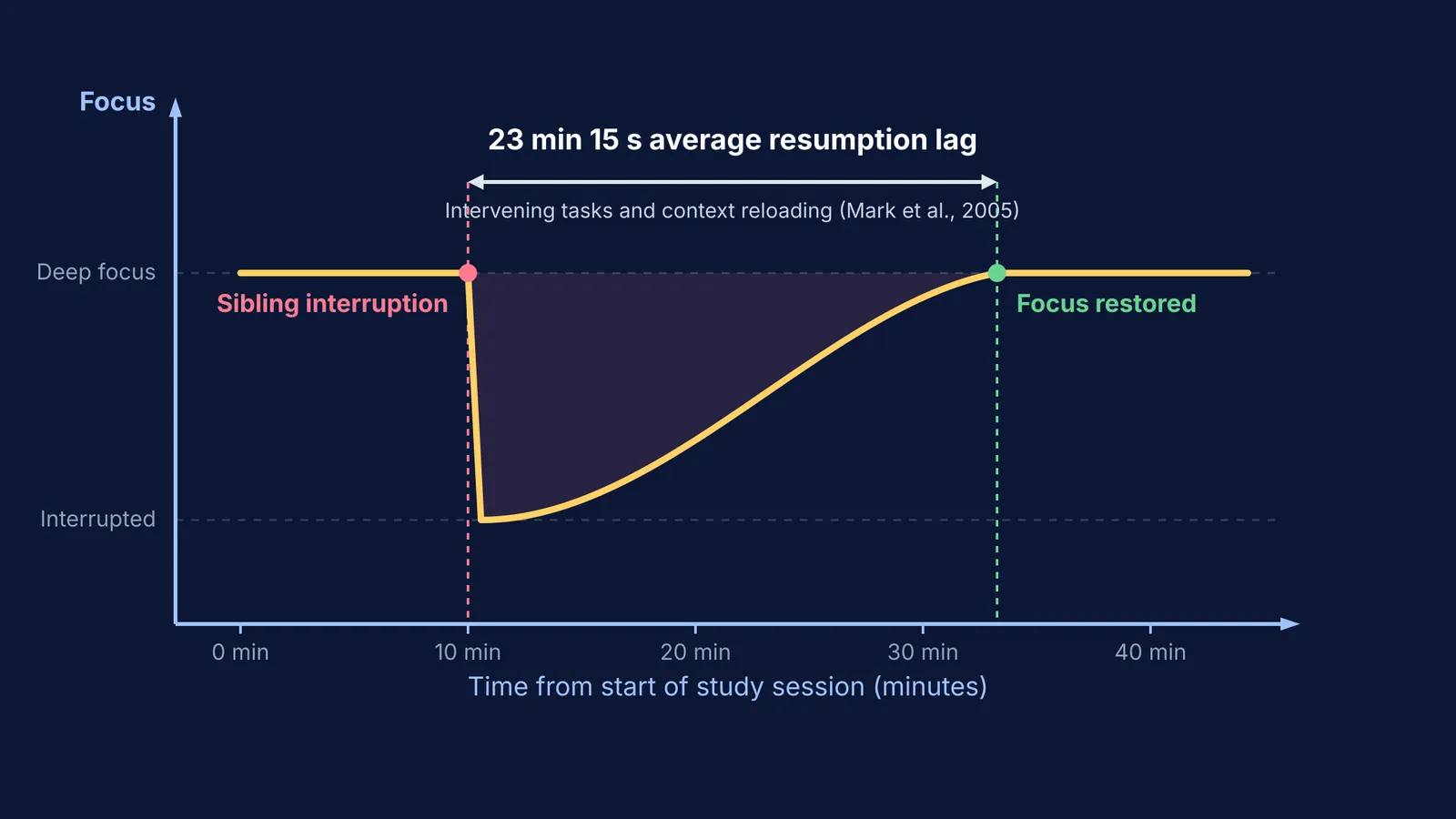
An interruption is never just the few seconds it takes to answer a younger sibling's question. The real cost lies in "resumption lag"—the time it takes for the brain to reload the previous context back into working memory.
It takes an average of 23 minutes and 15 seconds to return to an original task after being interrupted, according to a University of California, Irvine study led by Gloria Mark. When a student looks away from an organic chemistry mechanism to help a sibling, they often find themselves working on unrelated intervening tasks before they can focus on chemistry again. For subjects like physics or mathematics that require holding multiple variables in mind, this cognitive reset is exhausting.
To put this in perspective, toddlers naturally seek out a new activity every few minutes. If a younger sibling's restlessness causes an interruption every half hour, and each interruption costs the older sibling over 20 minutes of focus, an entire study session can disappear without any meaningful work getting done.
How can you arrange the home environment to stop interruptions?
The most effective way to protect a teenager's study time is to create physical and visual boundaries that a young child can understand. Toddlers cannot consistently remember abstract rules like "be quiet", so the environment must do the work.
Set up visual cues: Place a clear, visual signal on the older child's door or desk. A red "stop" sign or a specific coloured lamp tells the younger sibling that the older one is busy. Practice this rule when the stakes are low, rewarding the toddler for respecting the signal.
Create parallel play stations: Younger children interrupt because they want to be close to their family. Set up a "study station" for the toddler in a separate room (like the living room or kitchen) with puzzles or colouring books. This allows them to feel they are doing their "work" alongside their older sibling, but safely out of earshot.
Use a dedicated interceptor: During the older child's most critical study blocks, the other parent or caregiver must actively intercept the toddler. If the teenager is working through a timed mock test, someone else must be the primary point of contact for the younger sibling.
What should you do when a sibling shares a room?
When a teenager and a young child share a single bedroom, keeping the younger sibling out is impossible. In these cases, you have to engineer privacy within a shared footprint.
Divide the space physically: Use a tall bookcase, a heavy curtain, or a portable screen to divide the room. Even a partial visual barrier reduces the chance that the younger sibling will catch the older one's eye and start a conversation.
Invest in noise-cancellation: A good pair of over-ear headphones, even without playing music, muffles the ambient noise of a toddler playing.
Shift the study location: A shared room is primarily for sleeping. Have the older child study at the dining table or a quiet corner of the living room while the toddler is asleep, or vice versa.
For families struggling to build consistent household habits around revision, reading up on Exam season at home: routines that help the whole family can offer a broader framework for managing household time.
How can AI help a student recover from a distraction?
Even with the best boundaries, interruptions will happen. The challenge is helping the student pick up exactly where they left off without getting frustrated.
A common mistake is for the student to reread an entire chapter from the beginning, wasting more time. Instead, they should leave a "trail of breadcrumbs" by quickly writing down their immediate next thought on a sticky note the moment they hear someone approaching.
If they are stuck on a difficult numerical after an interruption, jumping to the answer key often breaks their learning process. Instead, the Fermi Problem Library has worked problems with a step-by-step solver that explains the reasoning rather than printing an answer. This allows the student to verify their previous steps and gently re-engage with the logic they were holding before the toddler entered the room.
Understanding the mechanics of why focus drops can also reassure a student who feels they are not making progress. If a student is studying for hours but their marks remain stagnant, they can read about Why some JEE aspirants plateau despite studying every day to see how fragmented attention affects learning.
With clear physical boundaries and the right tools to recover from inevitable interruptions, both siblings can get what they need out of the evening.


