

On this page
When two children have exams in the same fortnight, the house runs short of three things at once: quiet space, evening hours and your attention. A Class 12 student's board papers and a younger sibling's school exams rarely line up neatly, but the clashes are predictable, so you can plan for them.
How do you manage when both children have exams at the same time?
Start with one shared calendar, not two. Get each child's date sheet from the school or board (CBSE posts its official date sheets on cbse.gov.in) and write every paper on one wall calendar. Our guide to planning family life around a board exam date sheet covers the one-child version; with two, the calendar also shows where the children collide.
Then agree on one rule before the first paper, so you are not refereeing every evening:
Next paper first. The child whose exam is next morning gets first claim on the quiet room and on your help that evening.
Clash nights split by room, not by time. If both have a paper next morning, each child gets their own space for the whole evening, and you move between them.
Exam days are light days. After a paper, a child gets an hour to eat and rest before anyone asks how it went.
A worked fortnight
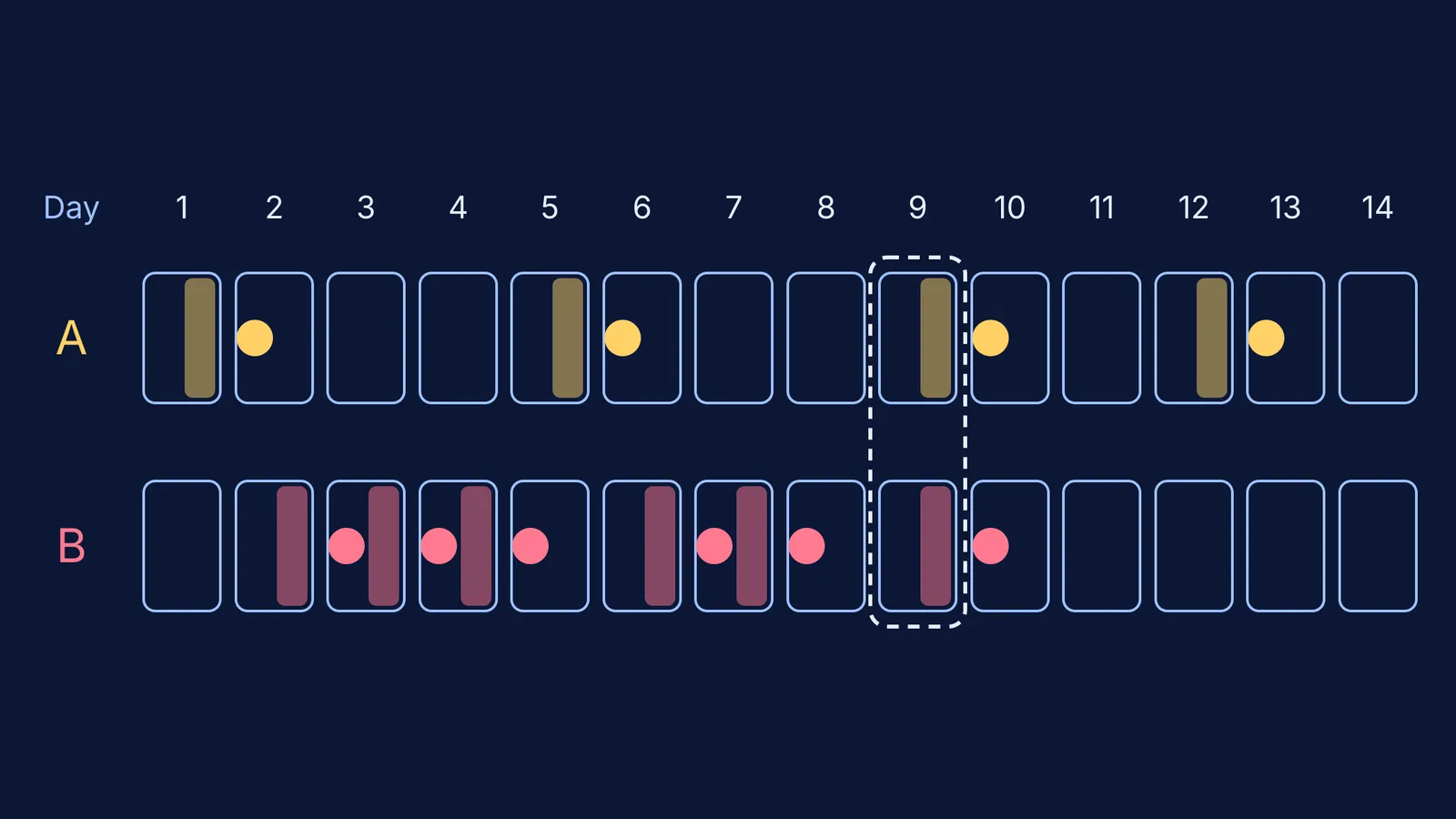
Here is the rule for two siblings: A, in Class 12, with board papers on days 2, 6, 10 and 13, and B, in Class 8, with school exams on days 3, 4, 5, 7, 8 and 10.
Day 1 evening belongs to A.
Days 2, 3 and 4 evenings belong to B, who has three papers in a row. A revises in the second room.
Day 5 evening goes back to A; days 6 and 7 go to B.
Day 8 evening is shared. Day 9 is the clash: both write on day 10. A takes the room with the door, B takes the dining table with the TV off, and you sit with B for the first hour before turning to A's doubts.
After day 10, B is done, and the day 12 evening belongs to A before the last paper on day 13.
Write this out before day 1 and stick it up. Children argue less with a plan they saw in advance than with a decision made at 8 pm.
Who gets the quiet room when siblings study at home?
If you have one quiet space, rotate it by the next-paper rule rather than by age. If you have none, create zones: a table facing a wall, headphones for the child who is not in priority, and the TV and phone calls moved out of earshot. Our piece on finding a study space in a noisy joint family has more ideas for small homes.
The child who is not in priority still needs useful work. Formula lists, flashcards or a timed past paper suit a corner seat.
How do you keep attention fair between two children?
Board exams carry more public weight, so the Class 12 child can absorb all the worry while the younger one gets the leftovers. Children notice. A 2024 meta-analysis in Child Development pooled 88 sources covering 26,451 children and adolescents, and found that being treated less favourably than a sibling was linked to more internalising and externalising behaviour (Jensen and Thomsen, 2024). Larger differences in parenting between siblings were linked to more of these problems too.
Fair does not mean identical. It means each child can see that their exams matter:
Ask about each paper on its day, not only the board ones.
Avoid comparing marks or effort. Our post on sibling rivalry over marks has words to use instead.
Give each child ten minutes of your time a day that is not about revision.
Meanwhile, the waiting child need not sit stuck: the Fermi Problem Library has worked problems with a step-by-step solver that explains the reasoning rather than printing an answer.
How much sleep do children need during exams?
A late-night Class 12 routine can quietly set bedtime for the whole house. Teenagers aged 13 to 18 should regularly sleep 8 to 10 hours in every 24, according to the American Academy of Sleep Medicine's consensus statement (Paruthi et al., 2016). Turn lights and screens off in a shared bedroom at the younger child's bedtime, and let the older one finish revision elsewhere.
If a child seems persistently low or panicky, or stops eating or sleeping properly, talk to the school counsellor or a doctor. India's national Tele MANAS helpline offers counselling and referrals on the toll-free numbers 14416 and 1800-891-4416 (details via IIT Kanpur's counselling service).
Put the calendar up tonight; the rule will do most of the refereeing for you.


