On this page
Ask most students the pH of clean rain and the answer comes fast: 7, because rain is just distilled water from the sky. Write your own guess down. Then we will dissolve carbon dioxide into a raindrop on paper and see where the pH lands.
What is the pH of clean rain?
Normal rain has a pH of about 5.6, slightly acidic because carbon dioxide dissolves into it and forms weak carbonic acid, according to the US Environmental Protection Agency. The USGS Water Science School gives the same figure and reminds us that 7 is neutral on the 0 to 14 scale.
So 7 is right for pure water in a sealed bottle, and wrong for water that has fallen through air. A falling drop picks up carbon dioxide on the way down:
CO₂(g) ⇌ CO₂(aq): the gas dissolves.
CO₂(aq) + H₂O ⇌ H₂CO₃: some of it becomes carbonic acid.
H₂CO₃ ⇌ H⁺ + HCO₃⁻: the acid gives up a hydrogen ion.
Step 3 moves the pH. Carbonic acid is weak, so only a little ionises.
How do you calculate the pH of rain?
You need three numbers.
CO₂ in the air: the monthly mean at Mauna Loa for September 2026 was 426.07 ppm, according to NOAA's Global Monitoring Laboratory. That is a partial pressure of about 0.000426 atm.
Henry's law constant for CO₂ at 25 °C: values around 0.034 mol per kg of water per bar are listed in the NIST Chemistry WebBook, which for dilute rainwater is practically 0.034 mol/L per atm.
First acid constant, Ka1: 4.3 × 10⁻⁷, the value used in Penn State's atmospheric chemistry course notes.
Now the worked example:
Dissolved CO₂ = 0.034 × 0.000426 = 1.45 × 10⁻⁵ mol/L.
Each acid molecule that ionises makes one H⁺ and one HCO₃⁻, so call both x. Then Ka1 = x² ÷ (1.45 × 10⁻⁵).
x = √(4.3 × 10⁻⁷ × 1.45 × 10⁻⁵) = √(6.2 × 10⁻¹²) = 2.5 × 10⁻⁶ mol/L.
pH = −log(2.5 × 10⁻⁶) = 5.60.
Check the shortcut: water alone supplies only 10⁻⁷ mol/L of H⁺, about 25 times less than the acid, so leaving it out changes little. The Penn State notes use 350 ppmv of CO₂ and also get a pH of 5.6.
What happens to rain pH if CO₂ goes up?
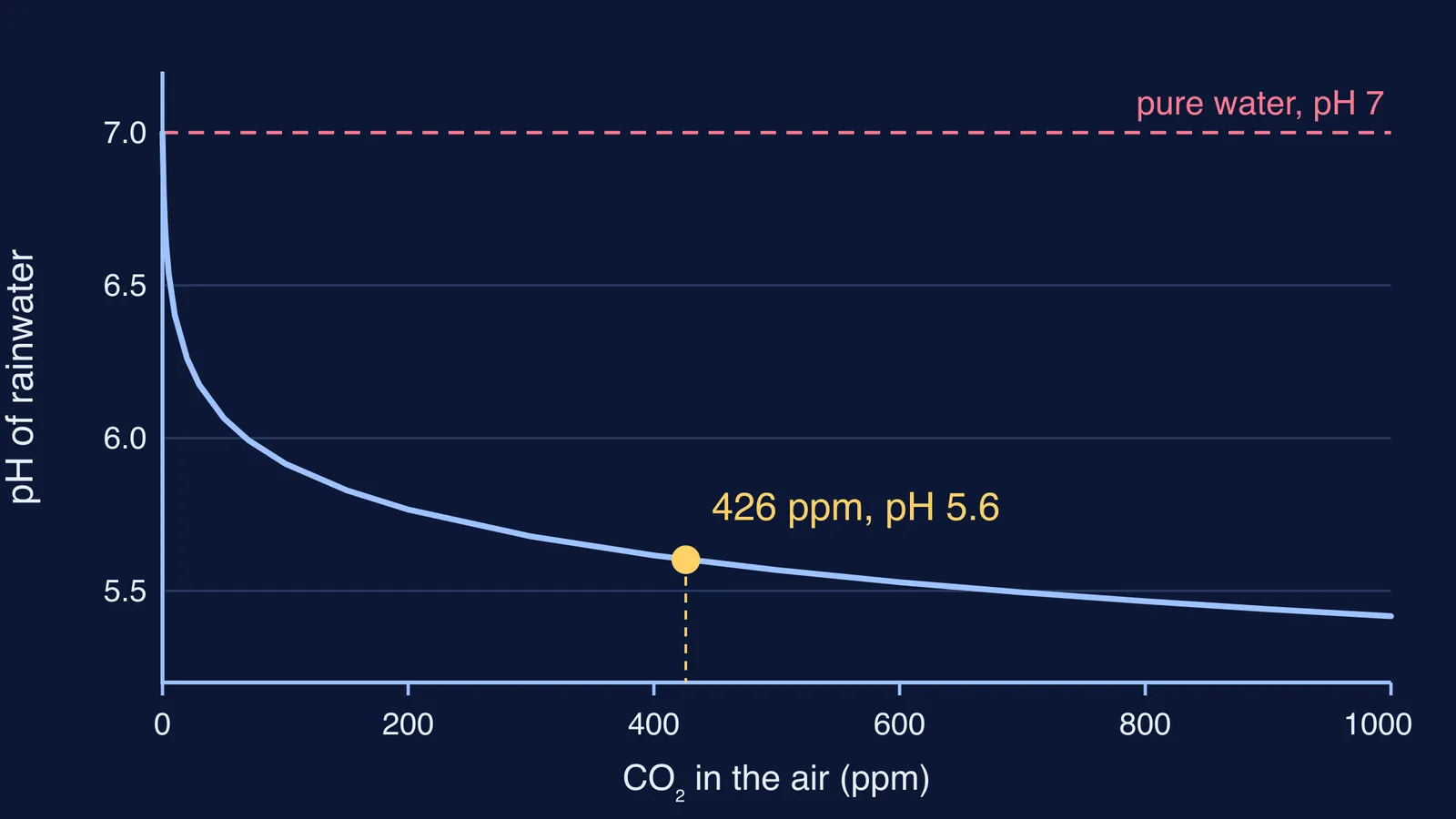
Keep water's own ions and the model fits in one line at 25 °C: pH = 7 − ½ log(1 + 1.46 × CO₂ in ppm). The 1.46 is the Henry's constant times the Penn State Ka1, times 10⁻⁶ to turn ppm into atm, divided by water's ion product, 10⁻¹⁴.
Predict first: if CO₂ doubled, would the pH fall by 1, by 0.5, or by less? Then check:
0 ppm: pH 7.00
10 ppm: pH 6.40
100 ppm: pH 5.92
350 ppm: pH 5.65
426 ppm (today): pH 5.60
852 ppm (double today): pH 5.45
Doubling CO₂ lowers the pH by only about 0.15. Two things blunt the effect: H⁺ grows with the square root of dissolved CO₂, and pH is a logarithm of H⁺. The steep drop comes in the first few ppm, then the curve flattens, as the chart at the top shows.
A curve like this is the kind of idea the Fermi Simulation Lab is for: interactive simulations for ideas that are easier to see than to read. If you get stuck at step 2 of the calculation, Fermi's AI tutor can work through it with you, drawing the figure and checking understanding as it goes.
When does rain count as acid rain?
Acid rain usually has a pH between 4.2 and 4.4, says the EPA's acid rain page. Sulphur dioxide and nitrogen oxides, mostly from burning fossil fuels, react with water, oxygen and other chemicals to form sulphuric and nitric acids.
Each pH unit is a ten-fold change in acidity, according to the USGS, so rain at pH 4.3 has about 20 times more H⁺ than rain at 5.6. Run our formula backwards and CO₂ alone would need about 170,000 ppm, roughly 17% of the air, to reach pH 4.3. Rain far below 5.6 points to strong acids, not carbon dioxide.
For what that rain does when it lands, read how acid rain attacks Taj Mahal marble. The same CO₂ chemistry in seawater is in how CO₂ makes ocean water acidic, and you can place 5.6 among everyday liquids with our pH chart of common substances.
How can you check you really understand it?
Write your prediction for the pH of clean rain, with one reason.
Write the three equilibria, from gas to ion.
Do the four-line calculation with the latest CO₂ figure from NOAA.
Explain in one sentence why doubling CO₂ moves the pH by only about 0.15.
Explain why rain at pH 4.3 needs strong acids, not more CO₂.
If you can do steps 4 and 5 without notes, you understand the idea, not just the number 5.6.