On this page
Sea water is slightly basic, yet it takes in a large share of the carbon dioxide from our vehicles and power plants. That CO2 reacts, making the ocean more acidic and leaving less of the material corals, oysters and tiny snails use to build shells. Here you predict first, then test with real numbers. You need only Class 11 equilibrium and logarithms.
What happens when CO2 dissolves in sea water?
According to NOAA's ocean acidification guide, the ocean absorbs about 30% of the carbon dioxide released into the atmosphere.
Once dissolved, the chain runs like this:
CO2 + H2O gives carbonic acid, H2CO3, a weak acid.
Carbonic acid splits into a hydrogen ion (H+) and a bicarbonate ion (HCO3-).
Some of those extra H+ ions bond with carbonate ions (CO3 2-) already in the water, turning them into more bicarbonate.
Step 3 is the one that matters for marine life: NOAA notes it leaves fewer carbonate ions available for calcifying organisms, the animals that build shells and skeletons. The same page says the ocean's average pH is now around 8.1, and that surface pH has fallen by 0.1 units since the Industrial Revolution, which it describes as approximately a 30 percent increase in acidity.
Predict first: how much does pH really change?
Before you read on, write down two guesses.
A pH drop of 0.1 sounds tiny. By what factor does the hydrogen-ion concentration rise?
If pH falls from about 8.2 to 7.8, does carbonate fall by a little, by half, or almost to zero?
Test it: a worked example with real constants
Hydrogen ions. pH is minus the log (base 10) of the hydrogen-ion concentration, so a drop of 0.1 multiplies [H+] by 10 to the power 0.1, which is about 1.26. A drop of exactly 0.1 gives about 26% more hydrogen ions; NOAA's "approximately 30 percent" is a rounded figure for a fall of about 0.1. A drop of 0.4 multiplies [H+] by 10 to the power 0.4, about 2.5.
Carbonate. The second dissociation step is HCO3- giving H+ + CO3 2-, with constant K2 = [H+][CO3 2-]/[HCO3-]. Rearranged, the carbonate-to-bicarbonate ratio equals K2/[H+], or 10 to the power (pH - pK2).
For sea water at salinity 35 and 25 °C, the constants of Mehrbach and colleagues give pK2 = 8.955 on the seawater pH scale, as tabulated by Millero and co-workers in Deep-Sea Research I (2002)00093-6). Plug in:
At pH 8.2, carbonate/bicarbonate = 10^(8.2 - 8.955), about 0.18.
At pH 8.1, the ratio is about 0.14.
At pH 7.8, the ratio is about 0.07.
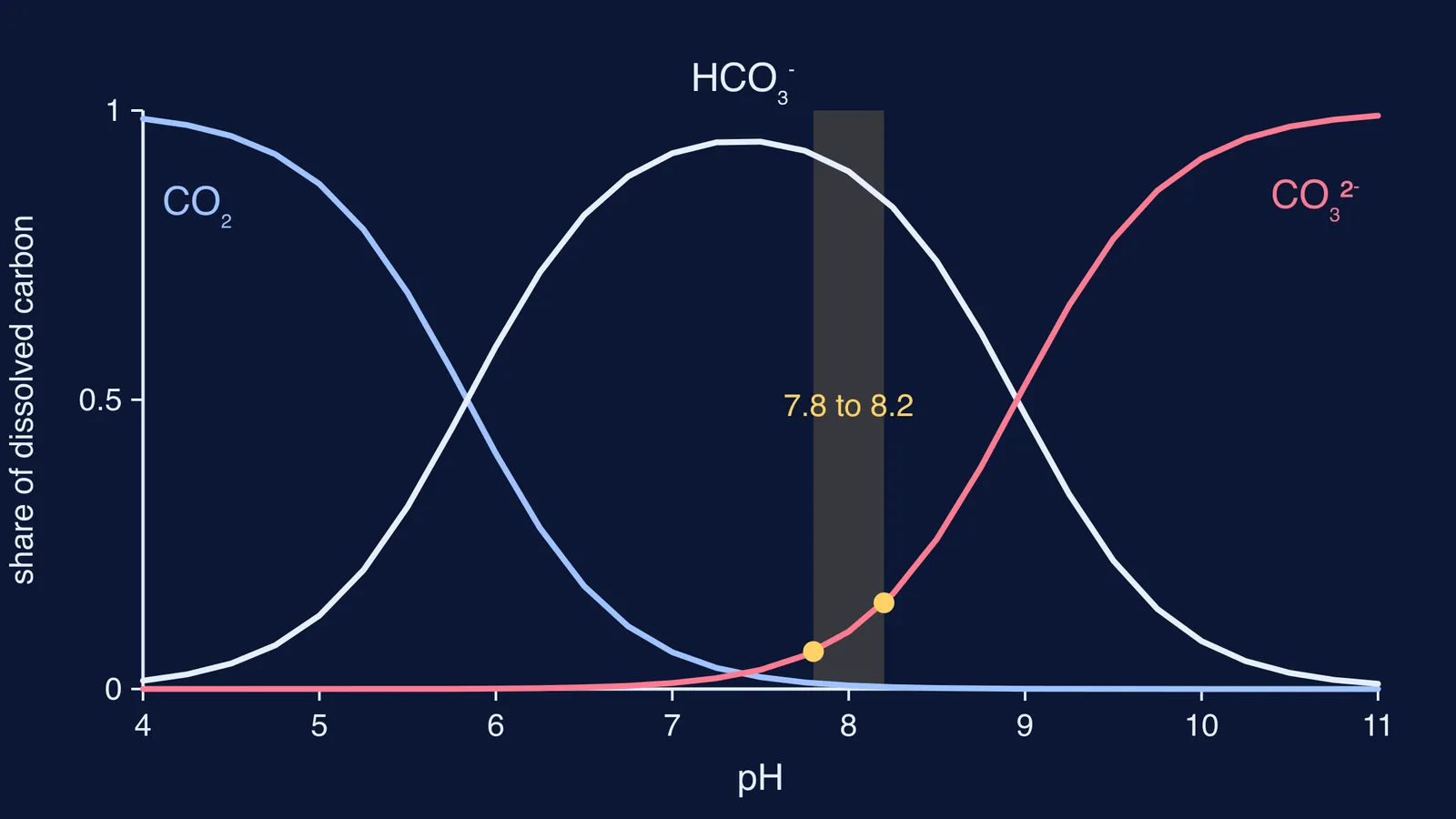
So going from 8.2 to 7.8 cuts carbonate, relative to bicarbonate, by about 60%. Holding total dissolved carbon fixed (a simplification, since more CO2 actually adds carbon), the same constants put carbonate at about 15% of the dissolved carbon at pH 8.2 and about 6.5% at pH 7.8. That is the shaded band in the chart at the top of this post.
Why 7.8? NOAA projects that surface waters could reach a pH around 7.8 by the end of this century, a level last seen 14-17 million years ago.
Why does less carbonate hurt shell-building animals?
Shells and coral skeletons are made of calcium carbonate, so scarce carbonate makes them harder to build and keep.
A review in the Annual Review of Marine Science by Scott Doney, Victoria Fabry, Richard Feely and Joan Kleypas (2009) notes that acidification lowers calcium carbonate saturation states, which affects shell-forming organisms from plankton to seafloor molluscs, echinoderms and corals, and that many calcifying species show reduced calcification and growth rates in laboratory experiments under high CO2.
NOAA's guide adds a vivid test: pteropod shells (tiny swimming sea snails) placed in sea water with the pH and carbonate levels projected for 2100 slowly dissolved after 45 days.
How can you check you really understand it?
Try this five-step self-test without notes:
Write the three equilibria linking CO2, carbonic acid, bicarbonate and carbonate.
Explain in one sentence why extra H+ lowers carbonate.
Calculate the [H+] factor for a 0.3 pH drop.
Use pK2 = 8.955 to find the carbonate-to-bicarbonate ratio at pH 8.0.
Explain why a calcium carbonate shell is harder to build at pH 7.8 than at 8.2.
If step 4 trips you up, it can help to see the idea rather than read it: the Fermi Simulation Lab has interactive simulations for ideas that are easier to see than to read. If the gap is in logs or equilibrium constants, the Fermi Concept Library gives each concept its own lesson.
Next time someone calls a 0.1 pH change small, show them the maths.