On this page
W = Fd only holds while the force stays the same. Pull a spring and the force grows with every millimetre, so no single F fits the formula. The fix is to draw force against displacement and measure the area under the line. Below you do that with readings from a spring simulation, then check the result against ½kx².
What does area under a force-displacement graph mean?
The NCERT Class 11 Physics chapter Work, Energy and Power (section 5.5) builds the idea in three steps. Over a very small displacement Δx the force hardly changes, so the work there is about F(x)Δx, a thin rectangle on the graph. Add the rectangles from the start position to the end position. Then let Δx shrink towards zero: the sum becomes the exact area under the curve.
The work done by a variable force is the definite integral of F(x) dx from the initial to the final position, which is the area under the force-displacement graph (NCERT, equation 5.7).
Area below the displacement axis counts as negative work. In NCERT's Example 5.5, a rectangle plus a trapezium gives 1750 J for a trunk pushed along a platform, while the friction rectangle below the axis is -1000 J. The OpenStax University Physics section on work also adds positive and negative areas under the force curve.
How do you find work from a spring simulation?
An ideal spring obeys Hooke's law: the force is proportional to the extension, F = kx in size, with k the spring constant in N/m (NCERT, section 5.9). Use any spring simulation that shows the applied force and the extension. The Fermi Simulation Lab has interactive simulations for ideas that are easier to see than to read.
Worked example, with k = 200 N/m:
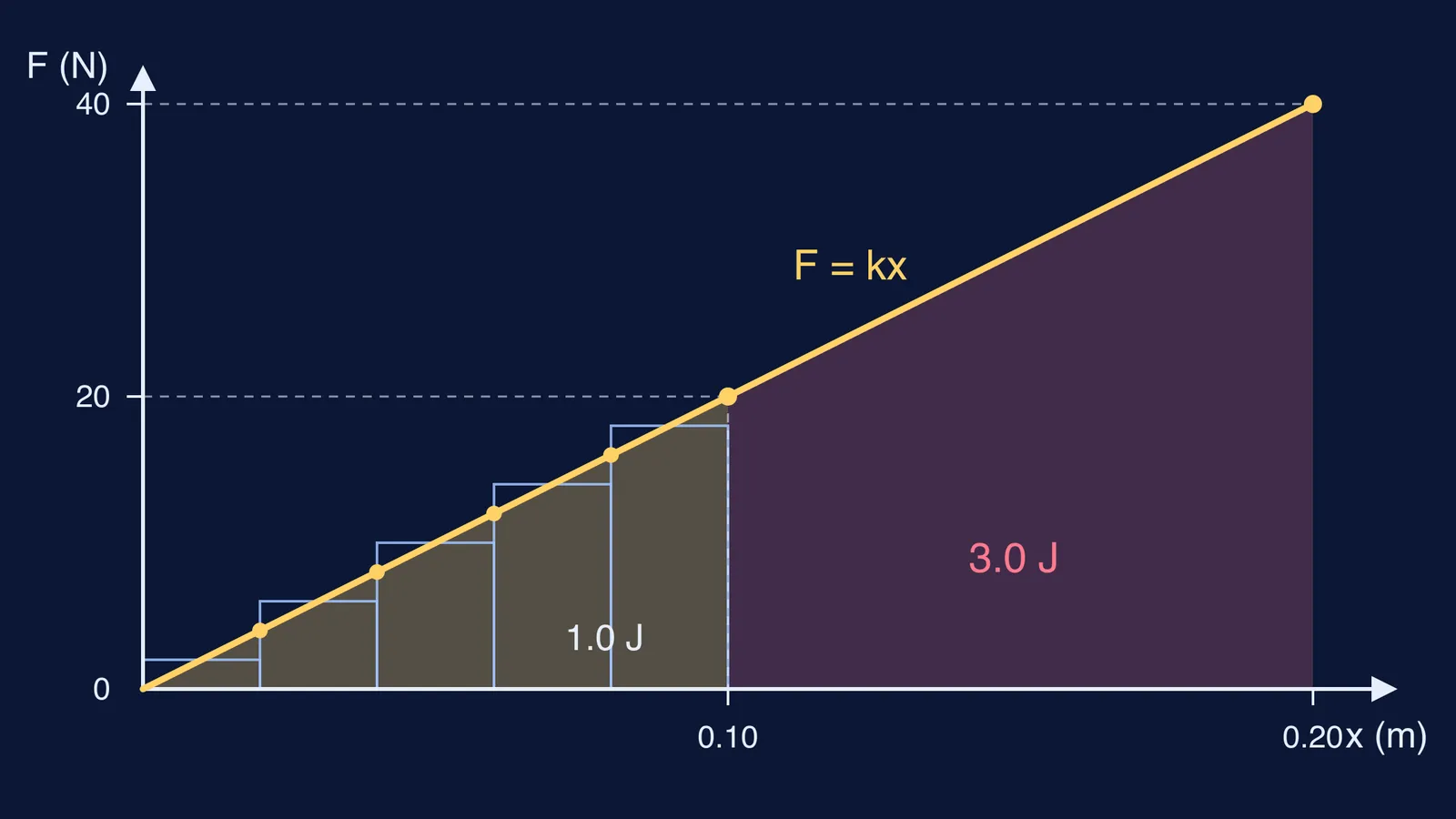
Drag the spring to 0.02, 0.04, 0.06, 0.08 and 0.10 m. Note the force each time: 4, 8, 12, 16 and 20 N.
Plot the five points. They fall on a straight line through the origin.
Estimate the area with strips 0.02 m wide. Using the force at the left edge of each strip gives 0.02 × (0 + 4 + 8 + 12 + 16) = 0.8 J. Using the right edge gives 0.02 × (4 + 8 + 12 + 16 + 20) = 1.2 J. The true answer lies between them.
Use the force at the middle of each strip: 0.02 × (2 + 6 + 10 + 14 + 18) = 1.0 J.
Find the exact area. The shape is a triangle with base 0.10 m and height 20 N, so the area is ½ × 0.10 × 20 = 1.0 J.
Check against the formula: ½kx² = ½ × 200 × 0.10² = 1.0 J. The graph and the formula agree.
Do step 3 once by hand: it shows why the integral is a limit of sums. Midpoint strips are exact here only because the line is straight.
Why is the area exactly half k x squared?
The graph of F = kx is a straight line from the origin. Stretched to x, the force has reached kx, so the shaded region is a triangle of base x and height kx. Half of base times height is ½ × x × kx = ½kx². NCERT gets the same result by integration and notes that it "may also be obtained by considering the area of the triangle" (section 5.9, equation 5.15).
Watch the sign. The spring pulls back against the stretch, so the spring force does -½kx² of work, while your pulling hand does +½kx².
Now stretch from 0.10 m to 0.20 m. The region is a trapezium: ½ × (20 + 40) × 0.10 = 3.0 J. The formula gives ½ × 200 × (0.20² - 0.10²) = 3.0 J. The second 10 cm costs three times the first, so doubling the stretch quadruples the total work. OpenStax's Example 7.5 shows the same pattern: 0.54 J for a 6 cm stretch and 1.62 J more to reach 12 cm. Our post on work done between two spring extensions works through that trap.
Which mistakes cost marks in these questions?
Multiplying the final force by the extension. That gives kx² instead of ½kx².
Measuring extension from the wrong point. x is measured from the spring's natural length, not from where the block happens to start.
Using ½kx² between two extensions as ½k(x2 - x1)². The right form is ½k(x2² - x1²).
Dropping the sign when part of the graph sits below the axis.
For more of these, read our list of common mistakes in work-energy problems. When the force is a vector and the path bends, the same idea becomes a sum of F·dr; see work done by a force along a path.
If you get stuck on a textbook question of this kind, the Fermi Problem Library has worked problems with a step-by-step solver that explains the reasoning rather than printing an answer.
Try it now: pick a new spring constant, take five readings, draw the graph and check the area against ½kx² before you look at any formula.