On this page
Try this before reading on. You sit under a bright red lamp for an hour, or under a dim ultraviolet lamp for the same hour. Which is more likely to damage the molecules in your skin? Write down your answer.
Many people pick the bright lamp, because brighter feels stronger. The physics says the opposite, and one calculator comparison shows why: the energy of a single photon against the energy of a single bond.
Why does UV cause sunburn but infrared does not?
The World Health Organization) splits ultraviolet into three bands: UVA (315-400 nm), UVB (280-315 nm) and UVC (100-280 nm). WHO says UVB "is responsible for delayed tanning and burning", and that UVC is completely filtered by the atmosphere. Infrared sits on the far side of visible light, and NASA notes that although your eye cannot see infrared, you detect it as heat.
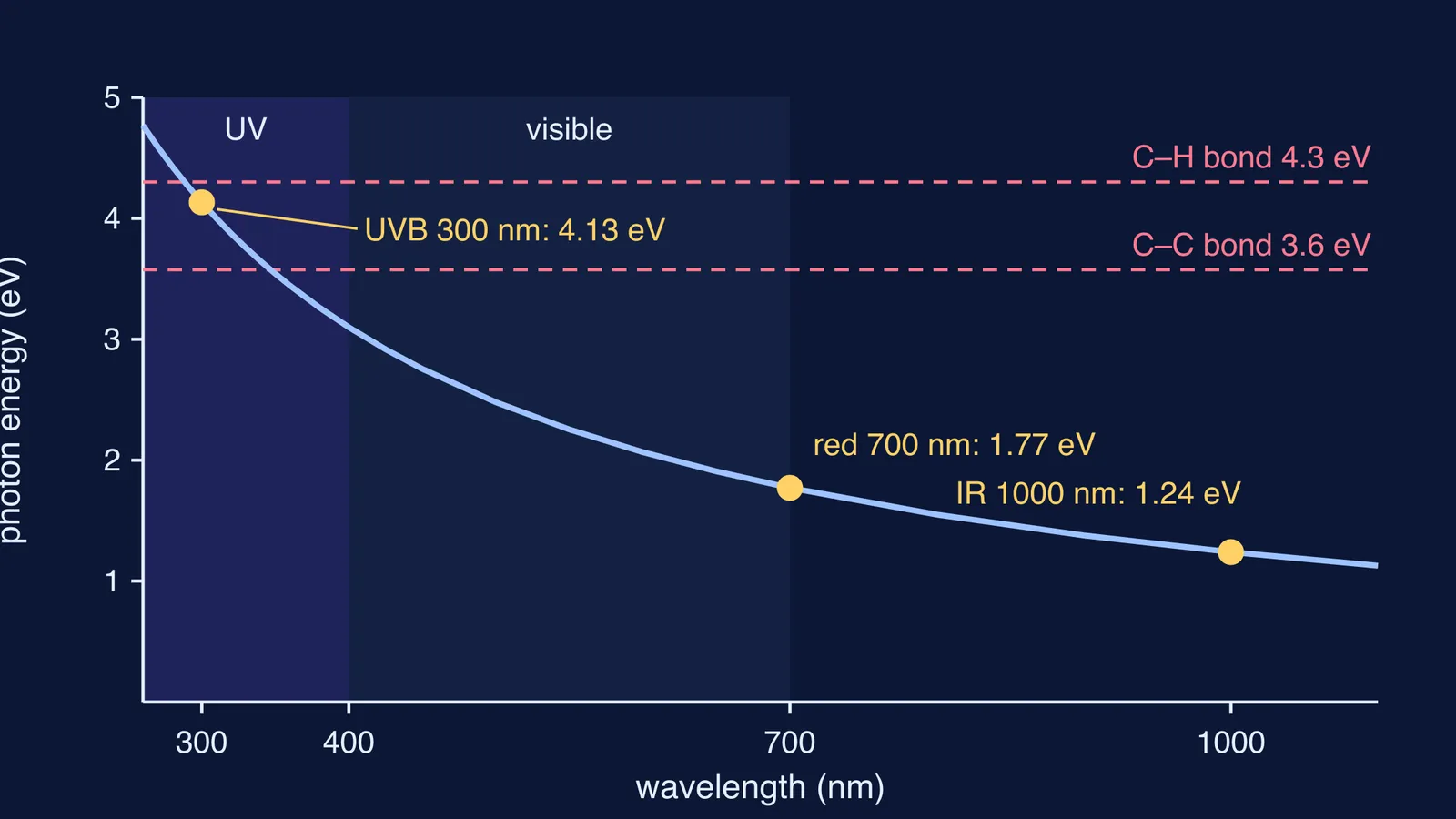
Light arrives in packets called photons, absorbed one at a time. The energy of one photon is E = hc/λ, where h is the Planck constant, exactly 6.62607015 × 10⁻³⁴ J s according to NIST, and c is the speed of light, exactly 299,792,458 m/s according to NIST. Brightness tells you how many photons arrive each second. Wavelength tells you how much energy each one carries.
How much energy does one UV photon carry compared with a bond?
Do each step yourself before checking.
Combine the constants. Dividing hc by the electron charge (exactly 1.602176634 × 10⁻¹⁹ C, NIST) gives about 1240 eV nm, so the energy in electronvolts is 1240 divided by the wavelength in nanometres.
UVB at 300 nm: 1240 / 300 = 4.13 eV per photon.
Red at 700 nm: 1240 / 700 = 1.77 eV per photon.
Infrared at 1000 nm: 1240 / 1000 = 1.24 eV per photon.
Convert a bond energy. The OpenStax Chemistry 2e table gives average bond energies of 345 kJ/mol for C-C and 415 kJ/mol for C-H. Divide kJ/mol by 96.49 (the Avogadro constant times the electron charge) to get 3.58 eV and 4.30 eV per bond.
Compare. The UVB photon (4.13 eV) clears the C-C bond (3.58 eV). Red (1.77 eV) reaches about half of it, infrared (1.24 eV) about a third.
Flip it round: the longest wavelength that can match a C-C bond is 1240 / 3.58, about 347 nm, inside the UV band. For C-H it is about 288 nm. Our walk-through on converting photon energy to kJ per mole does the same sum in chemists' units.
So the bright red lamp cannot do what the dim UV lamp does, however long you wait. (A very intense source of any colour can still cause a thermal burn, but that is heating, not one-photon chemistry.)
What does UV actually do to DNA in your skin?
Bond energy is a quick screen, not the full story: a photon only matters if a molecule absorbs it. Writing in PNAS, David Mitchell explained that DNA absorbs energy from both UVC and UVB, and that "a small proportion is converted into covalent dimer photoproducts between adjacent pyrimidine bases" (Mitchell, 2006). The same paper says solar UVB induces "erythema (sunburn), DNA damage, and ultimately skin cancer".
So UV does not simply snap bonds: the absorbed energy lets two neighbouring bases rearrange their bonds and join together. The most common result is a lesion called a cyclobutane pyrimidine dimer (CPD).
A 2011 laser study by Ahmad Besaratinia and colleagues tested this wavelength by wavelength (FASEB Journal, 2011). They describe a "steep rolloff in the absorbance of DNA between wavelengths 290 and 305 nm", note that UVA and UVB make up about 95% and 5% of the UV in sunlight at the ground, and suggest that CPDs are "the principal lesion responsible for most DNA damage-dependent biological effects of sunlight". Much of the shorter, harsher UV never reaches you; here is how the ozone layer shields living things from UV.
How can you test this prediction yourself?
A short plan for the dining table:
Write your prediction for bright red versus dim UV.
Work out photon energies for 300, 400, 550, 700 and 1000 nm using E = 1240 / λ.
Plot them and draw a horizontal line at 3.58 eV for the C-C bond (345 kJ/mol in OpenStax).
Mark which wavelengths clear it. Double the brightness on paper: does any point move? (It should not.)
See E = hc/λ in a real measurement with the LED colours and Planck constant simulation.
To explain it to a sibling or parent, try: "Each photon is one punch. A UV photon punches harder than a bond in DNA can take. A red photon only taps, and a million taps still are not a punch. They just warm you up."
If photons still feel abstract, the Fermi Simulation Lab has interactive simulations for ideas that are easier to see than to read.
For sun protection, follow official UV guidance. Then redo step 2 for a 254 nm germicidal lamp.