On this page
Throw a bare stick and it tumbles. Add a heavy point at the front and feathers at the back, and it flies point-first. What changed is where the air pushes compared with where the weight acts. Two ideas from Class 11 physics, centre of mass and torque, explain the whole thing.
Why do arrows have feathers at the back?
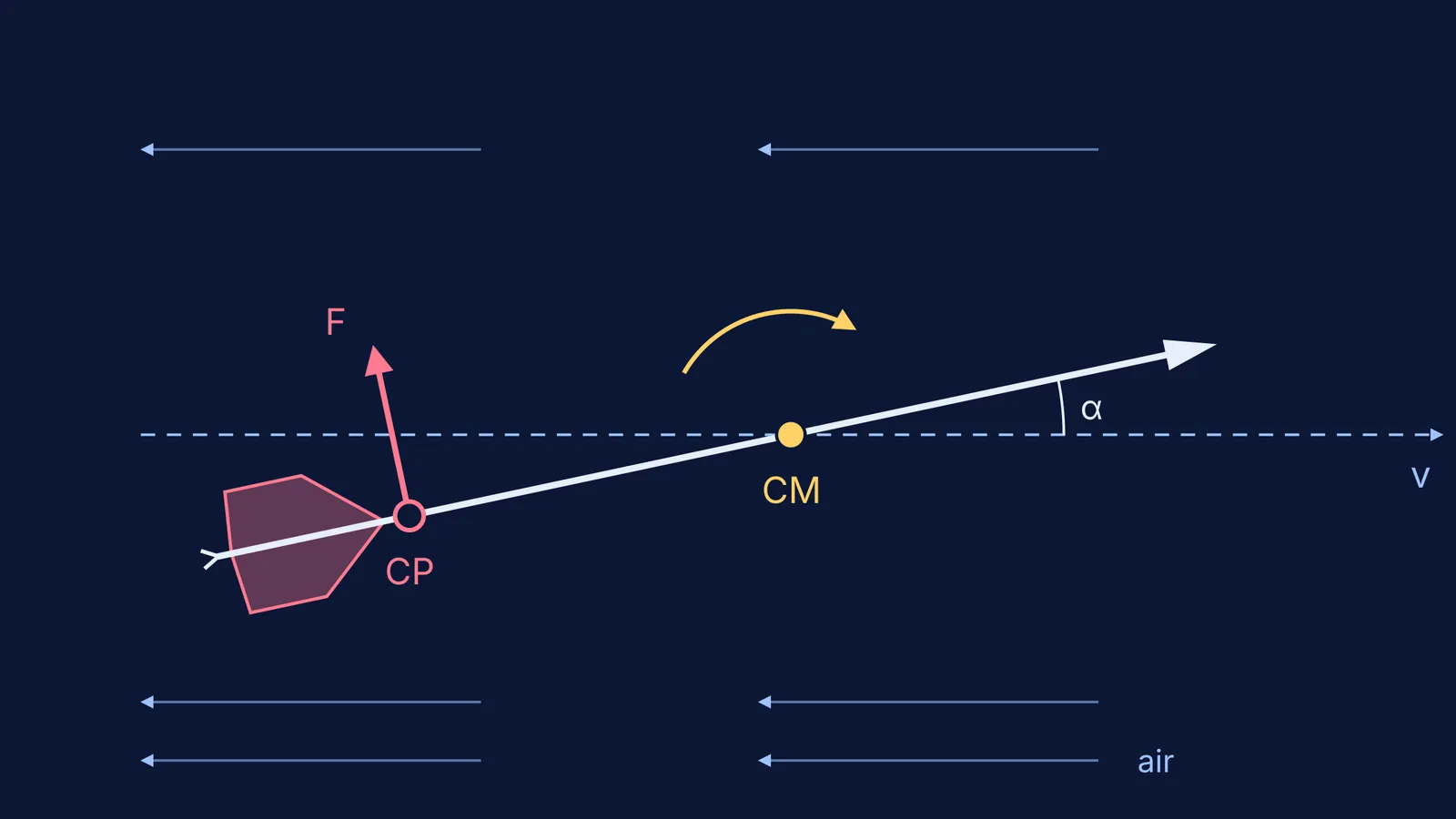
The centre of mass (CM) is the point where you can treat all of an object's mass as concentrated. The centre of pressure (CP) is the point where you can treat all the air forces as acting.
NASA's Glenn Research Center gives the stability rule for rockets: a rocket is stable when its centre of pressure sits below (that is, behind) its centre of gravity. The lift and drag forces then move the nose back towards the direction of flight, which engineers call a restoring force (NASA Glenn, Rocket stability). An arrow follows the same rule.
The vanes add surface at the tail, far behind the middle, where the air can push sideways on them. That pulls the centre of pressure backwards. The heavy point pulls the centre of mass forwards.
Writing in Bow International, Dr James Park put it this way: "Virtually all arrows will be aerodynamically stable since their aerodynamic centre is behind their centre of mass" (Bow International). He adds that the air forces "are trying to keep the point in front of the nock". He also corrects a common idea: it is mainly the sideways lift on the fletching, not its drag, that turns the arrow back into line.
What happens when an arrow tilts in flight?
Say the point is tilted slightly upward, at an angle α to the velocity, as in the diagram above.
Air now meets the arrow slightly from below, so there is a sideways air force on the arrow as well as drag.
The fletching adds a lot of side area far back on the shaft, so the combined sideways force acts at the CP, behind the CM.
A force F acting at a distance d from the CM produces a torque τ = F × d about the CM.
With the CP behind the CM, an upward push on the tail turns the arrow nose-down, back towards the flight path. The torque restores.
Move the feathers to the front and the CP sits ahead of the CM, so the torque turns the nose further away and the arrow tumbles.
Park notes that a real arrow usually overshoots and then has to swing back the other way, the behaviour engineers call "under damped" (Bow International).
Do feathers slow an arrow down?
Yes, and bigger vanes cost more. In a 2020 study, Julio Ortiz and colleagues measured arrows with two sizes of straight vanes in a JAXA wind-tunnel facility that holds the model in place with magnets. At the same Reynolds number, they found drag coefficients of 1.56 for the short vanes and 2.05 for the large ones (Ortiz et al., 2020, Proceedings).
In the same study, arrows shot at about 56.4 m/s lost around 8% of their speed in free flight, measured with an acceleration sensor inside the shaft (Ortiz et al., 2020).
So designers want enough vane area to keep the CP behind the CM, but no more than needed. Many archers also set the vanes at a slight angle so the arrow spins. Park writes that with an X10 shaft and a fletch angle of about 1 degree, the arrow turns once for about every 2 to 3 metres of travel (Bow International).
Where else do you see the same physics?
Badminton shuttlecocks. The feather skirt sits behind the heavy cork, which is why a shuttle always turns cork-first; we explain it in why a shuttlecock always flips cork first.
Model rockets and darts. Fins at the back do the fletching's job.
Weathervanes. The large tail swings downwind, so the pointer faces the wind.
For where drag comes from, see our explainer on fluid friction and streamlined shapes.
How can you test this at home?
You need a drinking straw, a paper clip, some card and tape.
Throw the bare straw gently, end-first, and watch it wobble.
Slide the paper clip onto one end to move the CM forward. Throw it clip-first.
Tape three small card fins at the other end and throw it clip-first again.
Move the fins to the clip end and throw once more.
Weight at the front with fins at the back should fly straightest; fins at the front should be worst. For each throw, ask whether the CP is behind the CM.
The Fermi Simulation Lab has interactive simulations for the ideas that are easier to see than to read. To revise centre of mass itself, the Fermi Concept Library gives each physics concept its own lesson and its place in the map.