

On this page
Have you ever noticed that no matter how awkwardly you hit a badminton shuttlecock, it always straightens itself out mid-air? Within a fraction of a second, the cork points perfectly forward.
A shuttlecock behaves unlike any other sports projectile. While a tennis ball spins and curves according to the Magnus effect, a shuttlecock is a "bluff body" built entirely for high drag and sudden deceleration. The secret to its self-righting flight lies in two points of physics that are deliberately kept far apart.
Why does a shuttlecock always turn cork first?
When you hit a tennis ball, its mass is distributed evenly. A shuttlecock is entirely lopsided. A standard feather shuttlecock is remarkably light, but almost all of its mass sits in the dense cork base. The remaining 16 feathers make up a wide, hollow cone.
This creates a massive separation between two aerodynamic points:
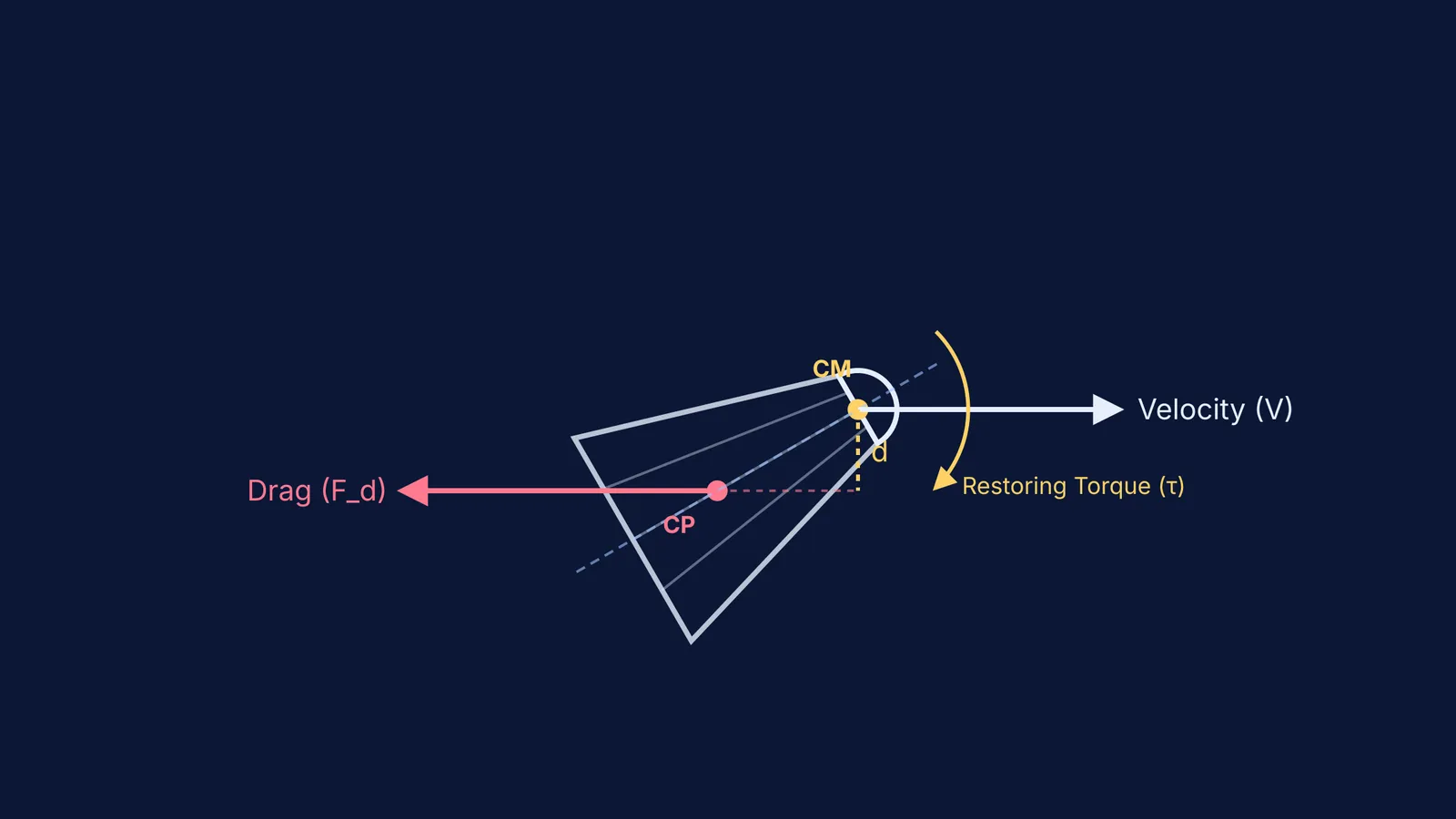
Centre of mass (CoM): The point where the shuttlecock balances, located very close to the cork nose.
Centre of pressure (CoP): The point where all the aerodynamic drag forces act, located far back inside the wide feather skirt.
When the shuttlecock leaves the racket sideways or backwards, the air rushes against the wide skirt. Because the drag acts at the back (the CoP) and the heavy pivot point is at the front (the CoM), the air pushes the tail backwards. This creates a restoring torque—a twisting force—that pivots the nose forward until it points directly into the wind.
According to a foundational 1992 Cambridge University thesis on shuttlecock aerodynamics by Dr Alison J. Cooke, this correcting moment is so powerful that a shuttlecock stabilises and flies cork-first within 0.2 to 0.8 metres of leaving the racket.
What is a restoring torque?
To picture restoring torque, imagine a weather vane on a roof. The pivot is near the front, and the large fin is at the back. When the wind hits the side of the fin, it pushes the fin downwind, making the arrow point perfectly into the oncoming breeze.
A shuttlecock does the exact same thing in mid-air. When it is travelling at an angle of attack (meaning the nose is not pointing straight along its velocity vector), the air resistance pushes at an angle against the flared skirt.
Because the drag force (F_d) acts at the centre of pressure, at a perpendicular distance (d) from the centre of mass, it generates a torque (τ = F_d × d). This twists the shuttlecock around its centre of mass. The moment the nose points perfectly into the relative wind, the perpendicular distance drops to zero, the torque disappears, and the shuttlecock glides stably.
Why does a shuttlecock fall straight down?
Once it turns around, a shuttlecock faces another extreme aerodynamic force: high base drag. The open skirt acts like a parachute, pulling the air with it to create a large, low-pressure wake.
Cooke's research found that a feather shuttlecock has a drag coefficient (C_D) of around 0.44 to 0.60, depending on its speed. Because it is so light relative to its wide skirt, it experiences a sharp deceleration. It can leave a top professional's racket at over 565 km/h, but it loses speed so rapidly that it drops in a skewed, "parachute" trajectory.
In textbook physics, you might use the equation of trajectory to trace a symmetric parabola. In reality, the high air drag ruins the symmetry. The shuttlecock ascends quickly, flattens out as drag eats its horizontal velocity, and then falls almost vertically. This steep descent is what makes dropshots in badminton so deadly.
This steep drop is also why synthetic nylon shuttlecocks feel "faster" to play with. Plastic skirts tend to buckle inward at high speeds, reducing their diameter and their drag. Because they hold less air, they fly further and shallower than stiff natural feathers.
See the physics for yourself
Visualising how forces like drag and gravity act on different points of an object can be tricky when you are reading a textbook or trying to picture a horizontal projectile from a cliff. This is where the Fermi Simulation Lab helps. You can set up objects with separate centres of mass and pressure, change the air resistance, and watch how the restoring torque flips them in real-time.
If you are stuck on rigid body dynamics, Fermi's AI tutor can help you work out the maths. Instead of just giving you the answer to whether two projectiles will collide midair, it holds a conversation to find where you are stuck and builds a plan to guide you through the relative motion step-by-step.
Next time you watch a badminton match, look closely at the net. You are watching one of the most robust aerodynamic designs in action—correcting itself 80 centimetres at a time.


