

On this page
Chemistry questions about light usually want energy in kJ per mole, not joules per photon, because bond energies are listed per mole. The method has two steps: find the energy of one photon with E = hc/λ, then multiply by Avogadro's number. Below you will find the full calculation for 500 nm light, a shortcut you can check in ten seconds, and a list of which common bonds light of a given colour can match.
How do you calculate the energy of one mole of photons?
The energy of a single photon is E = hc/λ, where h is the Planck constant, c is the speed of light and λ is the wavelength in metres. All three constants you need are exact, defined values:
The Planck constant is h = 6.62607015 × 10⁻³⁴ J s, according to NIST's CODATA values.
The speed of light is c = 299,792,458 m/s, according to NIST.
The Avogadro constant is N_A = 6.02214076 × 10²³ per mole, according to NIST.
One mole of photons is 6.02214076 × 10²³ photons, so its energy is N_A times the energy of one photon.
Worked example, blue-green light at 500 nm:
Convert the wavelength: 500 nm = 500 × 10⁻⁹ m = 5.00 × 10⁻⁷ m.
Multiply h and c: 6.62607015 × 10⁻³⁴ × 2.99792458 × 10⁸ = 1.98645 × 10⁻²⁵ J m.
Divide by λ: 1.98645 × 10⁻²⁵ ÷ 5.00 × 10⁻⁷ = 3.973 × 10⁻¹⁹ J per photon.
Multiply by N_A: 3.973 × 10⁻¹⁹ × 6.022 × 10²³ = 2.393 × 10⁵ J/mol.
Convert to kJ: 2.393 × 10⁵ J/mol ÷ 1000 = 239.3 kJ/mol.
Write units on every line. The two slips to watch for are leaving λ in nanometres in step 3 and forgetting to divide by 1000 in step 5.
Is there a shortcut for photon energy in kJ/mol?
Yes. Multiply the three constants once: h × c × N_A = 0.119627 J m per mole, using the NIST constants above. Put λ in nanometres and the answer in kilojoules, and the formula becomes:
E (kJ/mol) ≈ 119,627 ÷ λ (nm)
Check it against the worked example: 119,627 ÷ 500 = 239.3 kJ/mol, the same answer. You may already know the per-photon version, E (eV) ≈ 1240 ÷ λ (nm). Our post on the 1240/λ photon-energy formula in eV and nm explains it, and how to convert kJ/mol to eV per atom shows how the two versions connect. Use the shortcut to check your answer; in a written exam, show the full working.
Which bonds does light have enough energy to break?
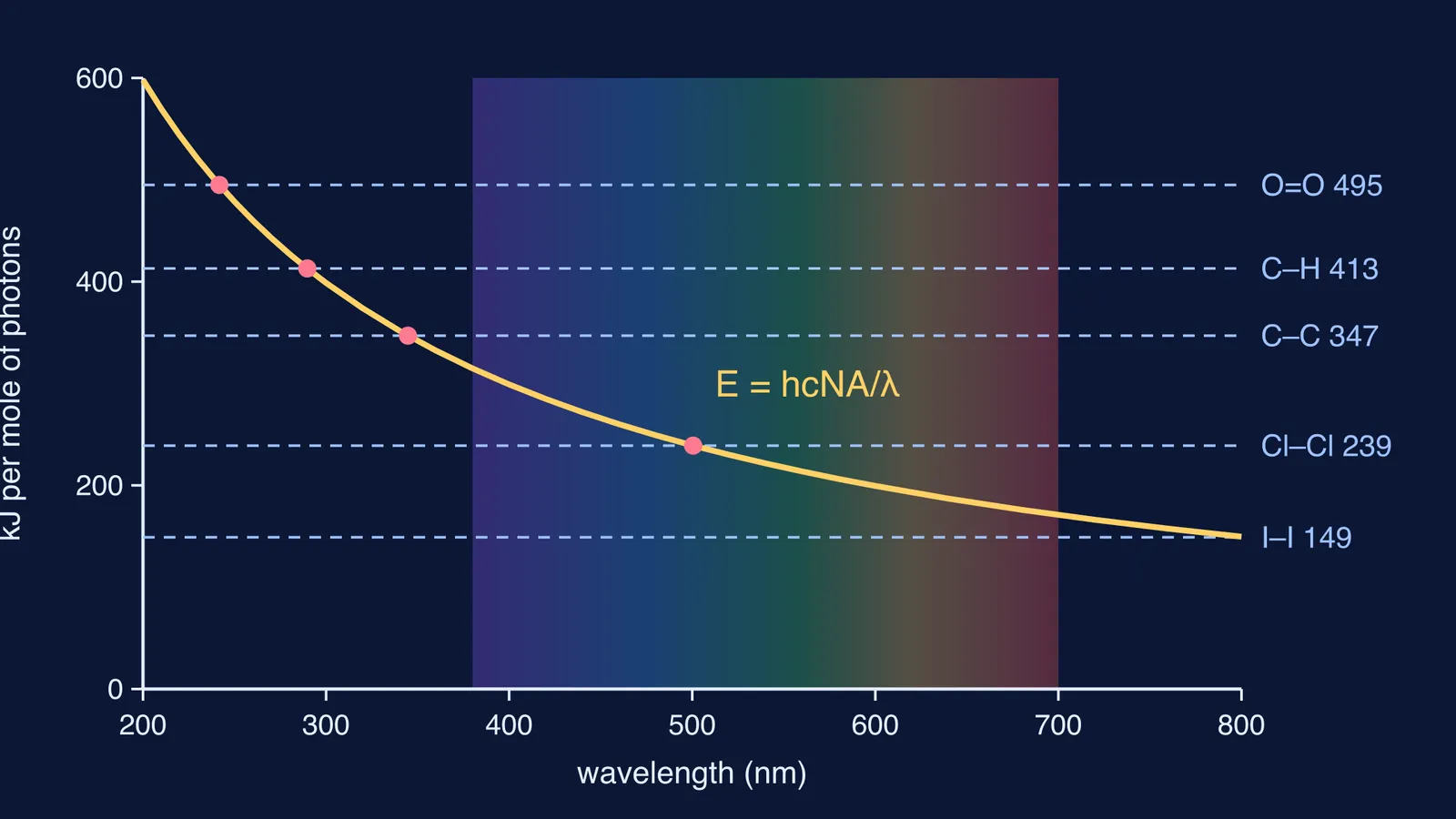
Bond energies in textbooks are averages for breaking one mole of a given bond in the gas phase. The LibreTexts bond energy table/Chemical_Bonding/Fundamentals_of_Chemical_Bonding/Bond_Energies) lists I–I at 149 kJ/mol, Br–Br at 193, Cl–Cl at 239, C–C at 347, C–H at 413 and O=O at 495.
Turn the shortcut around and you get the longest wavelength whose photons carry enough energy per mole: λ (nm) ≈ 119,627 ÷ bond energy (kJ/mol). Using those LibreTexts values:
I–I (149 kJ/mol): about 803 nm, just past red, so all visible light qualifies.
Br–Br (193 kJ/mol): about 620 nm, orange light and shorter.
Cl–Cl (239 kJ/mol): about 500 nm, blue-green light and shorter.
C–C (347 kJ/mol): about 345 nm, ultraviolet.
C–H (413 kJ/mol): about 290 nm, ultraviolet.
O=O (495 kJ/mol): about 242 nm, ultraviolet.
The human eye typically detects wavelengths from 380 to 700 nm, according to NASA, which works out to roughly 171 to 315 kJ/mol. The WHO) divides ultraviolet into UVA (315–400 nm), UVB (280–315 nm) and UVC (100–280 nm). So visible light can match a Cl–Cl bond, C–C needs UVA or shorter, C–H needs UVB or shorter and O=O needs UVC.
What should you check before writing the final answer?
Is λ in metres before you divide? 1 nm = 10⁻⁹ m.
Did you multiply by N_A exactly once, and only because the question asks per mole?
Did you divide J by 1000 to get kJ?
Are you comparing like with like: kJ/mol against kJ/mol, never J per photon against kJ/mol?
Is the size sensible? Visible light, 380 to 700 nm according to NASA, should land between about 170 and 315 kJ/mol.
If you keep reaching the wrong number and cannot see where, the Fermi Problem Library has worked problems with a step-by-step solver that explains the reasoning rather than printing an answer. If the idea of a photon itself feels shaky, the Fermi Concept Library gives every concept in physics and chemistry its own lesson. For the other half of these questions, read bond enthalpies: estimating reaction enthalpy and knowing its limits.
Next time a question gives you a wavelength and a bond, divide 119,627 by one to compare it with the other, then show the full working.


