On this page
A packet of chia seeds or quinoa often carries one word in large print: superfood. It sounds like a grade, as if a lab had tested the food and placed it in a higher class. It is not. Here is what the word means, what Indian rules say a food claim must prove, and how the famous imports compare with food already in your kitchen.
Is “superfood” a scientific term?
No. Nutrition science describes food by what is in it: protein, fibre, vitamins, minerals and fats. “Superfood” is not one of those categories.
The chapter on functional foods, superfoods and supplements in David Bender’s Oxford book Nutrition: A Very Short Introduction describes superfoods as “ordinary foods that are especially rich in nutrients or antioxidants”. The important word is ordinary. A superfood is a normal food that is high in something, and a great many foods are high in something.
So the honest answer to “are superfoods real?” has two parts. The foods are real, and many are nutritious. The idea that one food has powers beyond its nutrients is marketing.
What does Indian law say a food claim must prove?
In India, food claims fall under the FSSAI Advertising and Claims Regulations, 2018, which food businesses had to follow from 1 July 2019. They separate two kinds of claim:
A nutrition claim says what is in the food, such as “high in fibre” or “source of protein”.
A health claim says the food, or something in it, is linked to health, such as a lower risk of a disease.
The general principles in the same regulations make a good reading guide. Claims must be “truthful, unambiguous, meaningful, not misleading”. They must not suggest that “a balanced and varied diet cannot provide appropriate quantities of nutrients”. They must state how many servings a day give the claimed benefit, and any nutritional or health attribute must be “scientifically substantiated”.
“Superfood” does not appear among the terms the regulations define. The claims they do set out come with numbers: a food can be called high in dietary fibre only if it has at least 6 g per 100 g, or 3 g per 100 kcal.
How do superfoods compare with ordinary Indian foods?
Here is a worked example from the US Department of Agriculture’s FoodData Central database, which lists nutrients per 100 g of raw or dry food.
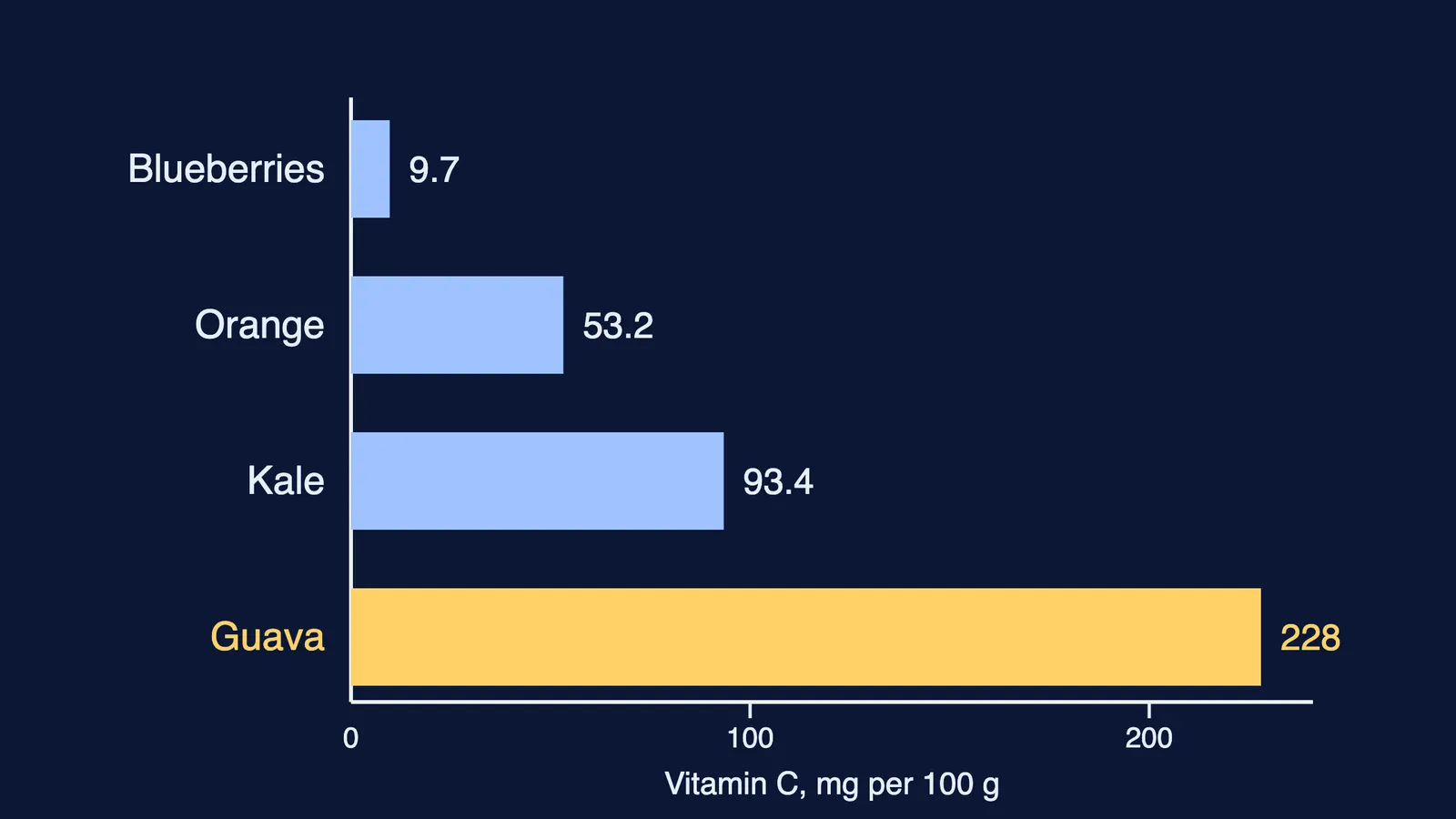
Vitamin C:
Blueberries: 9.7 mg (USDA record)
Orange: 53.2 mg (USDA record)
Kale: 93.4 mg (USDA record)
Guava (amrood): 228 mg (USDA record)
Gram for gram, guava has more than 23 times the vitamin C of blueberries.
Protein, dry weight:
Quinoa: 14.1 g (USDA record)
Chana (Bengal gram): 20.5 g (USDA record)
Lentils (masoor): 24.6 g (USDA record)
Dietary fibre:
Chia seeds: 34.4 g (USDA record)
Flaxseed (alsi): 27.3 g (USDA record)
Chana: 12.2 g (USDA record)
Chia leads on fibre here, but all three would clear the FSSAI bar of 6 g per 100 g for “high in fibre”.
None of this makes chia or quinoa bad. It shows that a food sold as special can be matched, nutrient for nutrient, by an everyday one. Our post on millets and the nutrition science of ragi, jowar and bajra makes the same case for grains.
How do you read a health claim on a packet?
Use this five-question check in the shop or on your phone:
What exactly is claimed? A number (“6 g fibre per 100 g”) can be checked. A mood (“superfood”, “goodness”) cannot.
Per what amount? Find the per 100 g figure, then scale it to one serving you would really eat.
Compared with what? Look up one ordinary food that does the same job, such as guava for vitamin C or chana for protein.
Who showed it, and in whom? A health benefit needs studies in people. A test-tube result, or a link seen in a survey, is weaker evidence; our guide to correlation versus causation with student examples shows why.
Does it ask you to replace meals? The FSSAI rules say ads must not undermine healthy lifestyles or show a food as a meal replacement unless another regulation permits it.
The same questions work on other wellness claims. We used them on alkaline water claims and stomach chemistry.
If a nutrient on the label is a fuzzy idea, such as what vitamin C or dietary fibre actually does in the body, the Fermi Concept Library has a lesson for every concept in biology and chemistry, so you can check the science behind a claim yourself.
This is everyday guidance, not medical advice. If a diet change is about a health condition, speak to a doctor or a registered dietitian.
Next time a packet says superfood, turn it over: the nutrition table is the part worth reading.