

On this page
Alkaline water is often sold with big promises: it balances your body's pH and calms acidity. School chemistry lets you test that: the pH scale and neutralisation from Class 10, plus pOH and buffers from Class 11.
What does the pH number on the bottle mean?
pH is the negative logarithm of the hydrogen ion activity, which in dilute solutions is roughly the concentration: pH = -log[H+], as the WHO background document on pH in drinking-water explains. Each step of 1 is a tenfold change in [H+].
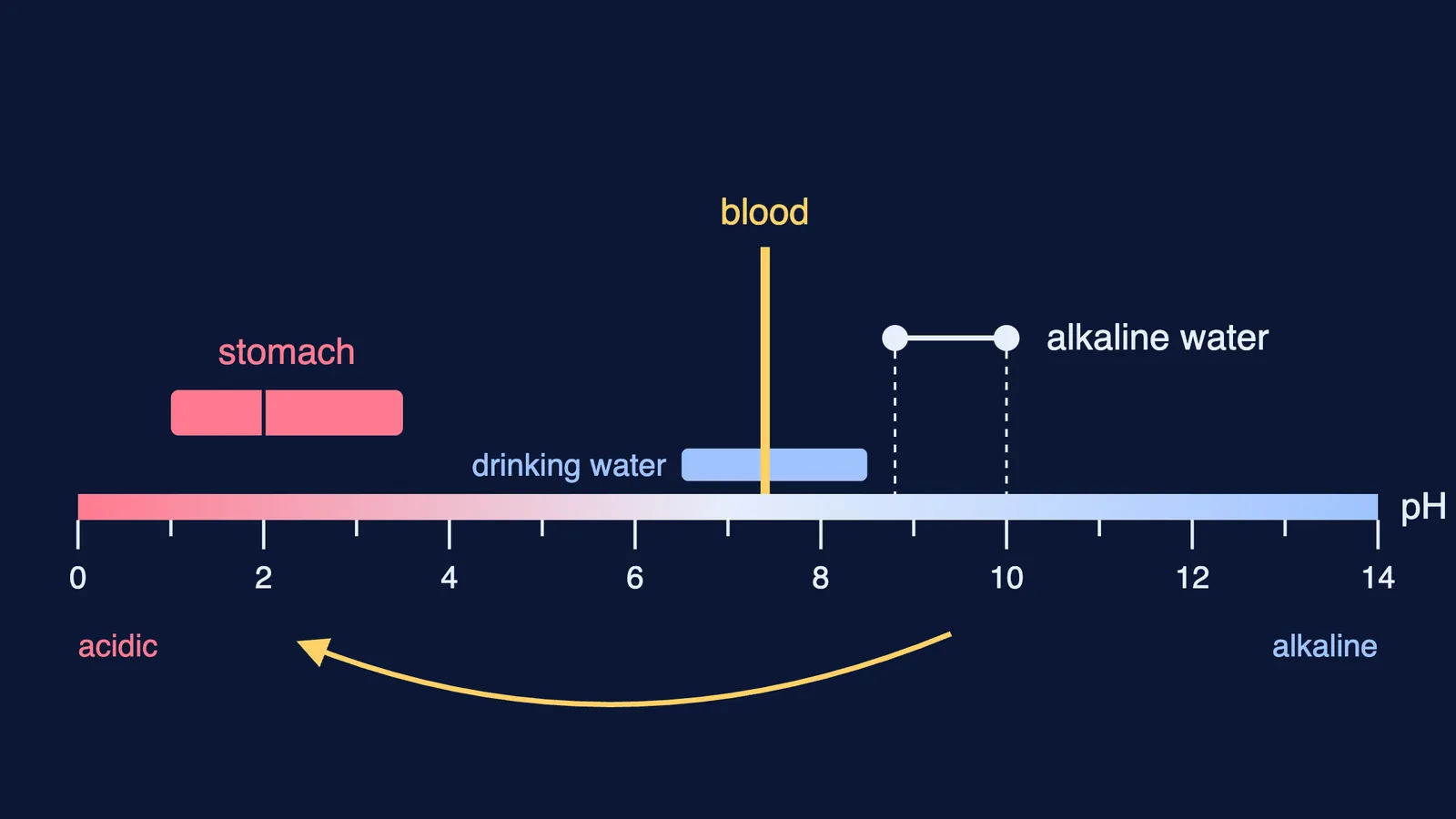
The pH of most drinking water lies within 6.5 to 8.5, according to the same document, which sets no health-based limit for pH and notes that pH "usually has no direct impact on water consumers". Alkaline waters sit higher: the bottled water in a 2010 study had a pH of 10.0, and a 2012 lab study tested water at pH 8.8.
What happens to alkaline water in your stomach?
Stomach fluid contains hydrochloric acid and has a pH between 1.0 and 3.5, with a mean of about 2.0, according to the WHO pH document. That acid has real jobs in digestion. How much of it does one glass cancel?
Worked example: one glass against your stomach
Take a 250 mL glass at pH 10, as in the 2010 study, and stomach fluid at the WHO mean of pH 2.
pOH = 14 - 10 = 4, so [OH-] = 10^-4 mol/L.
Moles of OH- in the glass = 0.25 L x 10^-4 mol/L = 2.5 x 10^-5 mol.
Stomach fluid at pH 2 has [H+] = 10^-2 mol/L, so each millilitre holds 10^-5 mol of H+.
H+ + OH- gives H2O in a 1:1 ratio, so about 2.5 mL of stomach fluid cancels every hydroxide ion in the glass.
One caveat: some alkaline waters also carry dissolved bicarbonate or other minerals, which soak up more acid than pH alone suggests, so 2.5 mL is a minimum. In the lab, Jamie Koufman and Nikki Johnston found that a pH 8.8 artesian water containing natural bicarbonate buffered acid far better than two popular bottled waters, and inactivated the enzyme pepsin. That was a test tube, not a person. For the same sum with a measured dose, see how much acid one antacid tablet neutralises.
Can alkaline water change your blood pH?
Without disease, the body's pH stays between 7.35 and 7.45, averaging 7.40, according to the StatPearls chapter Physiology, Acid Base Balance. Below 7.35 is acidemia and above 7.45 alkalemia, and breathing and the kidneys compensate to push pH back toward normal. A key chemical shock absorber is the blood's bicarbonate buffer.
A water that pushed your blood above 7.45 would cause alkalemia, a medical problem, not a benefit.
What do studies on alkaline water show?
The 2010 study by Daniel Heil split 38 young, healthy adults into matched groups: one drank pH 10.0 mineral water for two weeks of a four-week study, the other plain bottled water throughout. In the alkaline group, urine pH rose from 7.52 to 7.69 and urine output fell from 2.51 to 2.05 L a day, and the changes reversed after the switch back. The paper also reports fingertip blood pH rising from 6.23 to 7.07. But 6.23 is far below the 7.35 floor, which suggests this was not a standard blood pH measurement.
A 2017 chart review in JAMA Otolaryngology-Head & Neck Surgery looked back at 184 patients with throat reflux. At six weeks, 62.6% of those given alkaline water plus a 90% plant-based Mediterranean-style diet had a clinically meaningful drop in symptom score, against 54.1% of those given acid-reducing medicine; that gap was not statistically significant, though the gap in average percentage drop was. The water came bundled with a diet change, the groups were treated in different years and nobody was randomised, so the water's own effect is unknown.
On cancer, a 2016 systematic review in BMJ Open screened 8,278 citations and found no randomised trials, and no studies at all of alkaline water for cancer treatment. Its authors concluded that promoting alkaline water to the public for cancer prevention or treatment is not justified.
How can you check an alkaline water claim yourself?
Ask five questions of any advert or forward:
Which pH is the claim about: the water, your stomach, your blood or your urine?
Would the effect survive stomach acid? Redo the worked example with the label's pH.
Is the proof a change in urine? That fits the kidneys clearing extra base; it does not show your blood changed.
Was there a randomised control group, and how many people, for how long?
Was the water the only thing that changed?
If pH and logarithms feel shaky, the Fermi Concept Library has its own lesson for every concept in chemistry and biology, and the Fermi Problem Library works problems like the one above with a step-by-step solver that explains the reasoning.
Next time a bottle promises to balance your pH, ask it two things: which pH, and against how much stomach acid?


