On this page
The p-n junction in Chapter 14 of NCERT Class 12 Physics is where many students first get stuck. The depletion layer shrinks in one bias and grows in the other, and the current jumps from microamperes to milliamperes. An AI chatbot can explain it, but it can also get a detail wrong with full confidence. So ask in a fixed order and check each answer against the textbook.
What should you ask an AI about forward and reverse bias?
Ask one thing at a time, and make the AI commit to a direction (wider or narrower, mA or µA) before it explains. Copy these in order:
"In a silicon p-n junction, what happens to the depletion layer width and the barrier height in forward bias and in reverse bias? Answer in two lines first, then explain why using drift and diffusion."
"Which current dominates in each bias, diffusion or drift, and roughly how big is it? Give the order of magnitude with units."
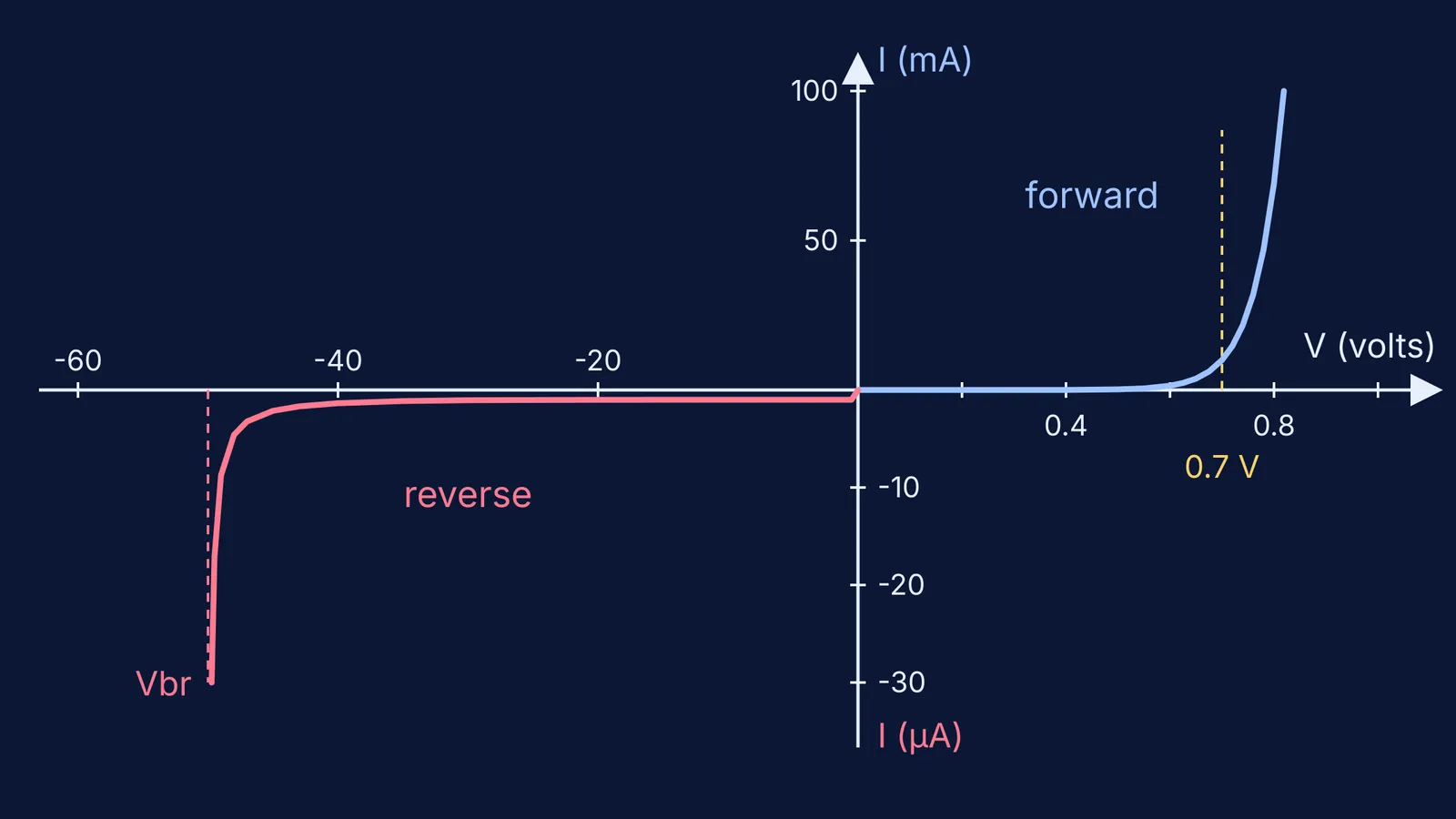
"Describe the I-V curve of a silicon diode in words, quadrant by quadrant. Mention the threshold voltage, the shape, the units on each axis and what happens at large reverse voltage."
After each answer, close the chat and write the idea in your own words before reading on. That is what makes it yours in the exam.
What does NCERT say happens in each bias?
This is your answer key. Every point below is from sections 14.5 and 14.6 of the NCERT Class 12 Physics Part II chapter on semiconductor electronics.
At equilibrium, the depletion region is of the order of one-tenth of a micrometre thick.
In forward bias (p-side to the positive terminal), the depletion layer width decreases and the effective barrier height falls to V0 − V.
Forward current comes from injected minority carriers diffusing across, and its magnitude is usually in mA.
In reverse bias, the barrier rises to V0 + V and the depletion region widens.
Reverse current is a drift current of the order of a few µA, and it barely depends on the applied voltage until the breakdown voltage.
The threshold or cut-in voltage is about 0.7 V for a silicon diode and about 0.2 V for germanium.
If an answer disagrees, push back: "NCERT section 14.6.2 says the reverse current is not very dependent on voltage. Where does your answer differ, and why?"
How do you check the AI's I-V curve in words?
Compare its answer to prompt 3 with Figure 14.16(c) in the same NCERT chapter, point by point. A description that passes says:
Right of the origin, current stays almost zero until about 0.7 V, then rises sharply (exponentially).
Left of the origin, current is a small, nearly constant negative value in µA, the reverse saturation current.
At the breakdown voltage, the reverse current suddenly increases.
Red flags: a straight line through the origin (that is a resistor, not a diode), reverse current of exactly zero, reverse current that grows steadily with voltage, or the germanium value of 0.2 V given for silicon.
Then test it on numbers. NCERT defines dynamic resistance as r = ΔV/ΔI, and its Example 14.4 reads a silicon diode curve at 10 mA for 0.7 V and 20 mA for 0.8 V, and −1 µA at −10 V. Ask the AI for the forward resistance between the first two points and the reverse resistance at −10 V. The textbook's answers are 10 Ω and 1.0 × 10^7 Ω. Ask the AI why that million-fold gap matters. For more practice, see how to find a diode's dynamic resistance from its I-V graph.
Why not just read the AI's answer and move on?
Because getting help is not the same as learning. In a field experiment with nearly a thousand high school maths students, Bastani and colleagues (PNAS, 2025) found that access to a plain GPT-4 chatbot improved grades on practice problems by 48%. When access was taken away, students who had used the plain chatbot scored 17% lower than students who never had it. A version with prompts designed to safeguard learning largely removed that harm.
So keep the AI in the role of explainer and examiner. Ask it: "Give me three short questions on depletion width in each bias, wait for my answers, and tell me which one I got wrong." For a recap with diagrams, read how depletion layer width changes in forward and reverse bias, then predict the current before each change in these five tests in a p-n junction simulation.
Fermi's AI tutor teaches rather than just answering: it notices where you are stuck, decides whether to explain, ask or show, and checks understanding as it goes. When the junction is easier to see than to read, the Fermi Simulation Lab has interactive simulations for ideas like this.
Start with prompt 1 tonight, with the NCERT chapter open beside the chat.