On this page
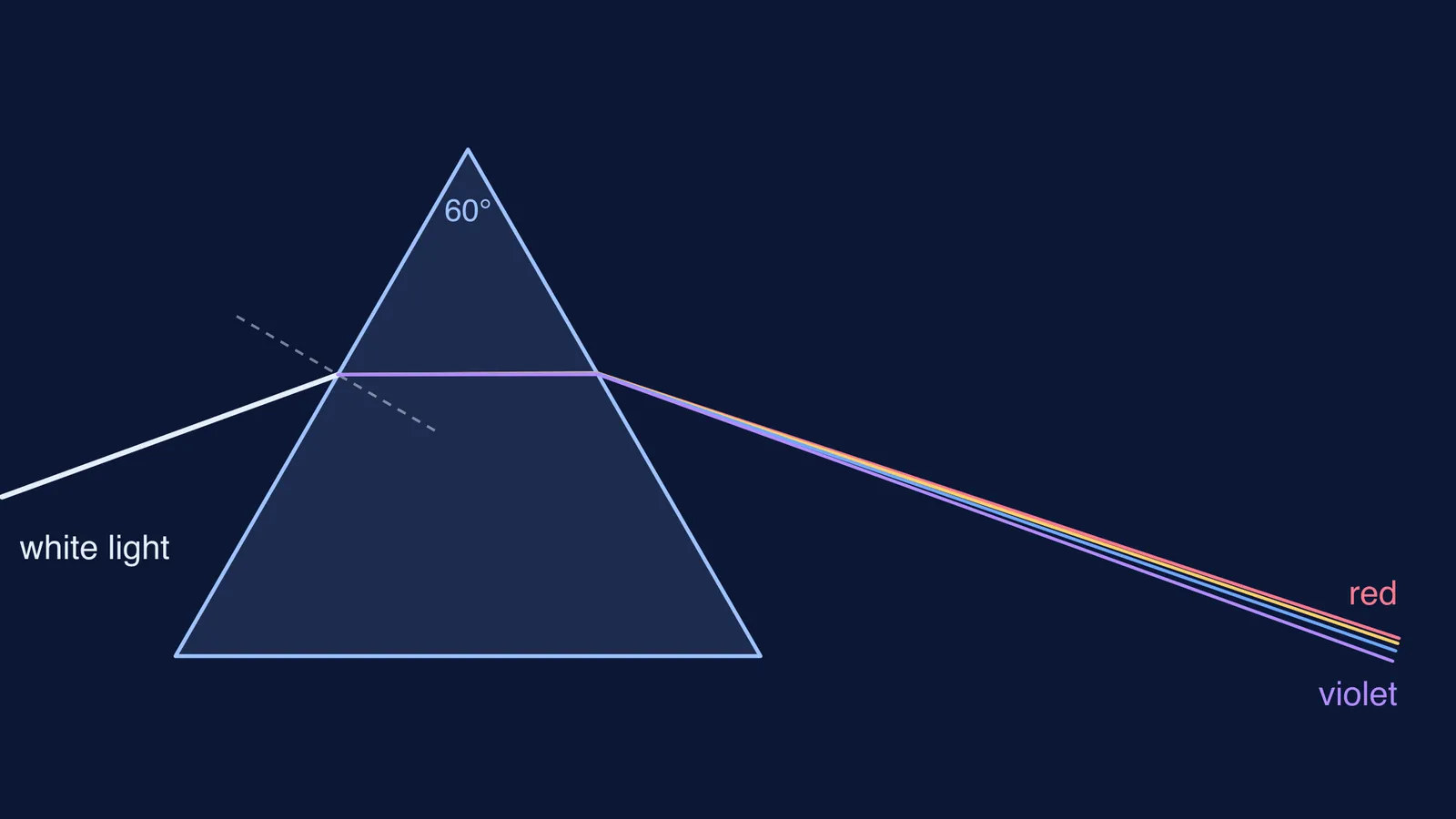
Shine sunlight through a glass prism and a band of colours appears on the wall, red at one end and violet at the other. The prism does not add those colours. They were already in the white light, and the glass sorts them by bending each one through a slightly different angle.
Why does a prism split white light into colours?
White light is a mixture of many colours. Isaac Newton set out this idea in his new theory about light and colors, a letter published in the Philosophical Transactions of the Royal Society in February 1672. Historian Alan Shapiro, writing in Physics Today, summarises Newton's conclusion as "white light and, in particular, sunlight consist of a mixture of innumerable colors", with rays of different colours having different refrangibility, which means how strongly they bend.
The refractive index n of a material tells you how much light slows inside it: light travels at c/n. When light crosses into glass at an angle, Snell's law, n₁ sin i = n₂ sin r, sets how sharply it bends. If n were the same for every colour, every colour would bend equally and white light would leave the prism still white. It is not the same.
Why does violet bend more than red?
Because glass has a higher refractive index for violet light than for red. Schott's product page for its N-BK7 optical glass lists these values:
violet, 404.7 nm: n = 1.53024
blue, 486.1 nm: n = 1.52238
yellow, 587.6 nm: n = 1.51680
red, 706.5 nm: n = 1.51289
The index falls steadily as the wavelength gets longer. Dividing 1 by each index, violet light travels at about 0.653c inside this glass and red at about 0.661c. The slower colour bends more at each face, so violet is turned furthest from its path and red least. The frequency of each colour does not change in the glass; only its speed and wavelength do.
How many degrees does each colour turn in a prism?
Take an equilateral prism (apex angle A = 60°) made of N-BK7 and send a ray in at i = 50° to the normal of the first face. Work one colour at a time with the Schott N-BK7 indices above.
First face: sin r₁ = sin 50° / n. For violet, sin r₁ = 0.7660 / 1.53024 = 0.5006, so r₁ = 30.04°. For red, sin r₁ = 0.5063, so r₁ = 30.42°.
Inside the prism, r₁ + r₂ = A, so r₂ = 29.96° for violet and 29.58° for red.
Second face: sin e = n sin r₂. Violet leaves at e = 49.84°, red at e = 48.32°.
Deviation δ = i + e − A. Violet: 50 + 49.84 − 60 = 39.8°. Red: 50 + 48.32 − 60 = 38.3°.
Yellow at 587.6 nm lands in between, at 38.7°. So the whole fan from red to violet is only about 1.5° wide. On a wall 1 m from the prism, that spreads the colours over roughly 2.6 cm (1 m × tan 1.5°), which is why the strip widens as the wall gets further away.
Deviation also depends on the angle of incidence. Our posts on finding the angle of minimum deviation in a simulation and on when no ray emerges from a prism use the same four steps.
How can you test dispersion in a virtual prism?
Write each prediction down before you look, then check it in any interactive ray-optics simulation or with a real prism and a torch.
Send in a single colour, such as red only. Predict: it bends, but it does not split into more colours.
Send in white light and slowly change the angle of incidence. Predict: the deviation first falls, then rises again, and the colours stay in the same order, violet always turned most.
Place a second, identical prism upside down after the first. Predict: its bending undoes the first prism's, and the colours come back together towards white.
For other ideas that are easier to see than to read, the Fermi Simulation Lab collects interactive simulations. If Snell's law itself feels shaky, Fermi's AI tutor works out what you already know and builds a plan for the session, so you start from the gap rather than from page one.
What do students get wrong about dispersion?
"The prism makes the colours." It only separates colours already in the white light.
"Red bends most because its wavelength is longest." It is the reverse: longer wavelength, lower index, less bending.
"Colour changes inside the glass because the wavelength changes." Colour follows frequency, which stays fixed.
"A rainbow is just reflection." Raindrops refract and disperse light too, which is why our explainer on why a rainbow appears at 42 degrees starts from the same refractive indices.
Next time you see a strip of colour from a glass or a window edge, estimate its width from the distance to the wall and check it against the fan you worked out above.