On this page
Ask a Class 6 student whether 24 × 0.5 is bigger or smaller than 24, and some will say bigger before they stop to think. The instinct comes from first meeting multiplication as repeated addition, where 3 × 4 means three fours added together and the answer always grows. Decimals break that picture. The fix is to swap it for a better one: multiplication as scaling.
Predict first: what are 24 × 0.5 and 24 × 1.5?
Before you calculate, decide for each sum: bigger or smaller than 24, and roughly how big?
24 × 0.5: bigger or smaller? Your guess:
24 × 1.5: bigger or smaller? Your guess:
Now check. 24 × 0.5 = 12, because 0.5 is one half and half of 24 is 12. 24 × 1.5 = 36, because 1.5 is one whole plus one half, so you get 24 + 12. If your first guess for 24 × 0.5 was "bigger", you have met a mix-up that maths education researchers have written about for decades.
Why does multiplying by a decimal make a number smaller?
Read "×" as "scaled by", or as "of". 24 × 0.5 means "0.5 of 24", which is half of it. The multiplier tells you how many copies of the number you get, and that count does not have to be a whole number. Half a copy is smaller than the original.
The rule that falls out works for any positive number:
Multiply by more than 1: the answer is bigger (24 × 1.5 = 36).
Multiply by exactly 1: no change (24 × 1 = 24).
Multiply by a number between 0 and 1: the answer is smaller (24 × 0.5 = 12, and 24 × 0.25 = 6).
Fractions follow the same logic: 24 × 3/4 = 18, since three quarters of 24 is 18. If a picture helps, our guide on why the area model makes fraction multiplication make sense draws it out.
Where does the "multiplication makes bigger" idea come from?
In a 1985 study in the Journal for Research in Mathematics Education, Efraim Fischbein and colleagues asked 623 pupils in 13 Italian schools, in Grades 5, 7 and 9, to choose the operation needed for 26 multiplication and division word problems. They proposed that multiplication stays tied to a hidden "repeated addition" model even after formal training. Problems where the operator was a decimal, which does not fit that model, were a particular source of difficulty at all three grade levels.
The habit may not fade with age. A 1989 report by Anna Graeber, Dina Tirosh and Roseanne Glover set out to see whether trainee primary teachers held misconceptions such as "multiplication always makes bigger and division always makes smaller", noting that teachers who do may not recognise the related errors in their students.
Does predicting before you calculate really help?
Prediction drags the old idea into the open where you can test it. Kien Lim at the University of Texas at El Paso described a lesson for prospective middle-school teachers built on prediction items, clickers and visuals, published in 2011 in the International Journal of Mathematical Education in Science and Technology. The class that also voted on its predictions with clickers gained 36 points from pre-test to exit test, against 25 points in the comparison class, though the two classes' written explanations were not very different. It is one small classroom study, not proof, but it supports a simple habit: guess, then check.
How can you see it by scaling a length?
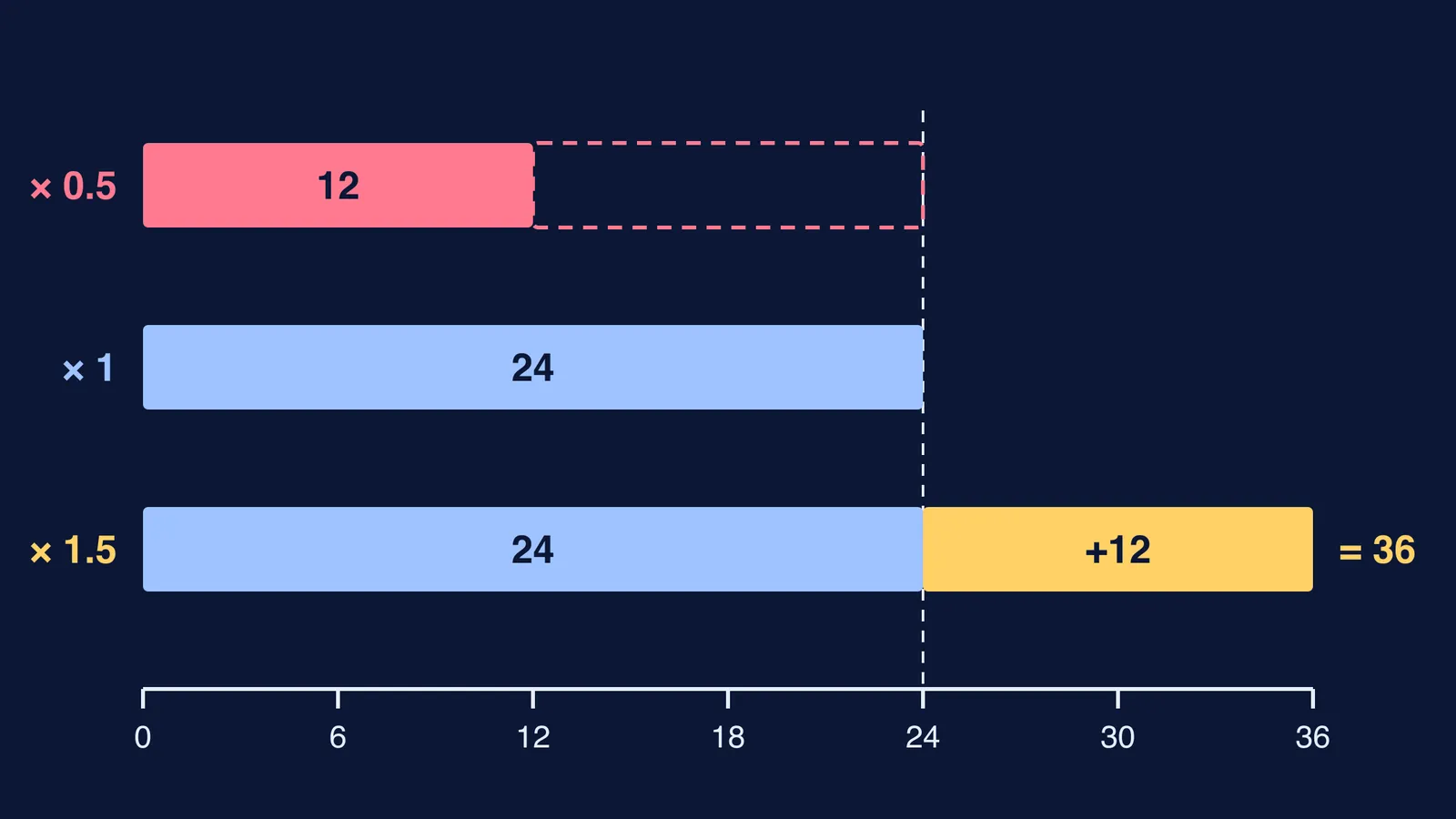
Try this with a 24 cm paper strip and a ruler, or any interactive simulation with a length you can stretch by a factor:
Draw or set a line 24 units long. This is "× 1".
Mark where you think "× 0.5" will end, then scale it. The line stops at 12, halfway.
Mark your guess for "× 1.5", then scale. The line reaches 36: the full 24 plus one more half.
Slide the factor slowly from 0 to 2 and watch the moment the line passes its starting length. That moment is exactly × 1.
The Fermi Simulation Lab has interactive simulations for ideas that are easier to see than to read, and a length that visibly shrinks at × 0.5 is one of those ideas. The same scaling idea runs through the ×10 ladder for converting km, m, cm and mm, and how a scale factor changes area and volume shows what happens in two and three dimensions.
What to say when a child insists "multiplying makes it bigger"
"It does when you multiply by more than one. Is 0.5 more than one?"
"What is half of ₹24? So what should 24 × 0.5 be?"
"Let's both guess first, then check on the strip."
If the wrong method keeps coming back in longer sums, the Fermi Problem Library has worked problems with a step-by-step solver that explains the reasoning rather than printing an answer.