

On this page
It is 10 pm, the NCERT Biology book is open at the same chapter for the third time this month, and your child says they remember nothing. Many NEET-UG aspirants hit this wall. The fix is not more hours but a different arrangement of them: fewer rereads, more recall, spread over weeks.
Why does memorising NCERT biology feel so overwhelming?
Rereading feels productive because the page looks familiar. Familiar is not the same as remembered. In a 2006 study by Henry Roediger and Jeffrey Karpicke, students who restudied a passage felt more confident, but students who tested themselves on it retained substantially more when tested 2 days or 1 week later (Psychological Science, 2006). Restudying came out ahead only when the final test came 5 minutes later.
Rereading can carry you through tomorrow's class test and still fail you in an exam months away. If your child is trying to hold every line equally, our guide to reading NCERT biology lines for NEET helps decide where to look closely.
What does research say about spacing and active recall?
Two techniques keep coming up. A 2013 review by John Dunlosky and colleagues assessed 10 learning techniques and gave a high utility rating to only two: practice testing and distributed practice (Psychological Science in the Public Interest, 2013). The same review rated rereading and highlighting as low utility and suggested practice testing in place of rereading.
Active recall (practice testing) means pulling an answer out of memory, by writing or saying it, before checking the book.
Spaced practice (distributed practice) means returning to the same material after a gap instead of covering it in one long sitting.
How long should the gap be? A meta-analysis led by Nicholas Cepeda pooled 839 assessments from 317 experiments and found that the best gap grows as the test gets further away (Psychological Bulletin, 2006). In a later study by the same team with more than 1,350 people, the best gap for a test one year away was about 5 to 10% of that delay, roughly 18 to 36 days (Psychological Science, 2008). For a NEET aspirant, that means coming back to a chapter after weeks, not hours.
How do you spread NCERT biology revision across weeks?
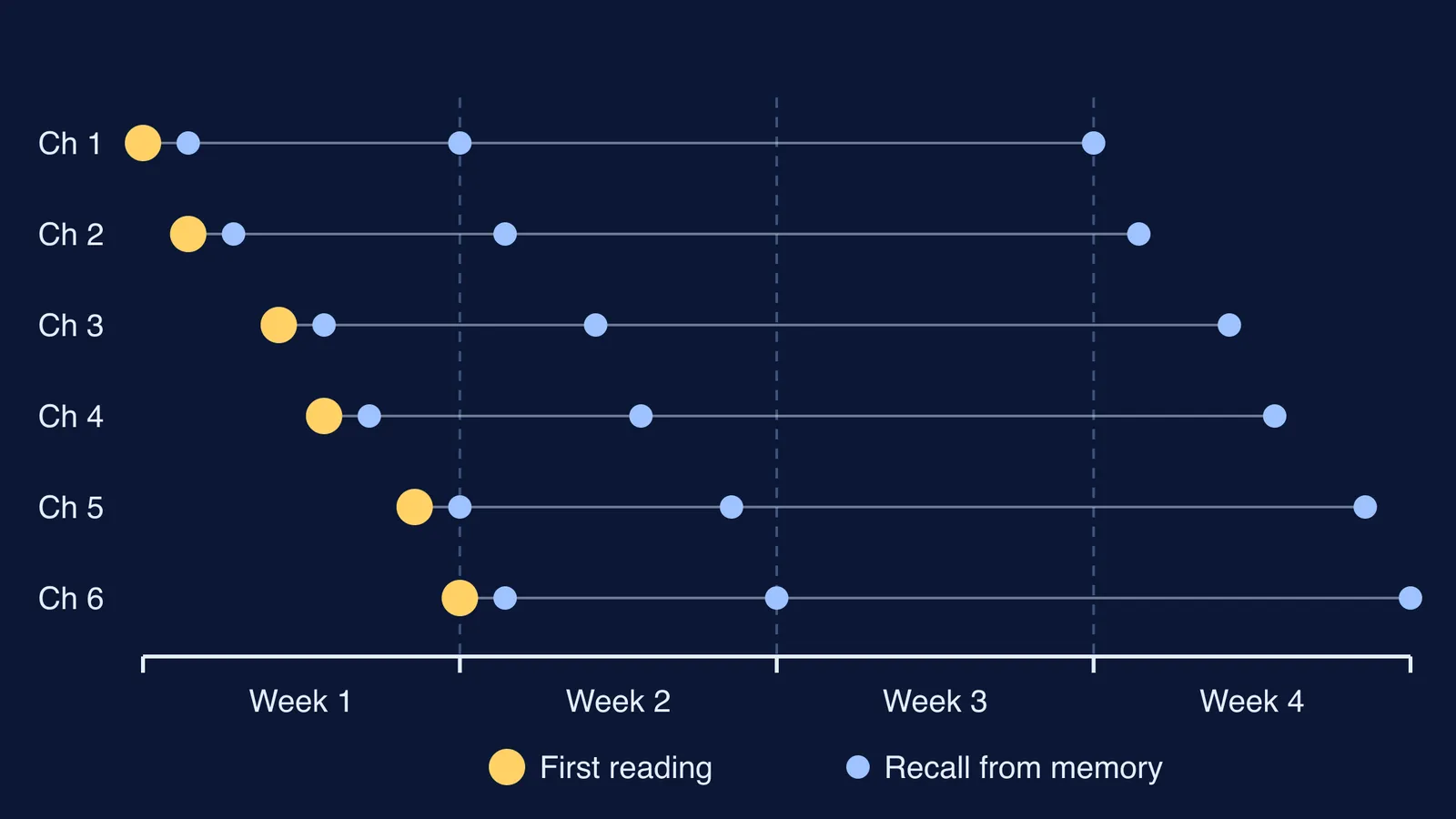
Here is a four-week plan for six chapters. The shape matters more than the count.
Day of first reading: read one chapter section by section. After each section, close the book, write three to five points from memory, then check.
Next day (10 minutes): turn the chapter's headings into questions ("What are the steps of...?", "Give two examples of...") and answer them without the book.
One week later (15 minutes): recall the chapter cold, then open NCERT only to fix what you missed. Mark those lines.
Three weeks later (15 minutes): recall again, starting with the marked lines.
Keep a simple log: one row per chapter with its four dates. On a day with three or more recall sessions due, start no new chapter.
The six chapters are first read within eight days; weeks 2 to 4 are mostly short recall sessions, as the diagram above shows. For a whole-syllabus version, see our spaced revision schedule.
If you are not sure which chapter to begin with, Fermi's AI tutor can work out what you already know and build a plan for the session. When recall exposes a gap in understanding rather than a forgotten word, relearn the idea instead of rereading the line; the Fermi Concept Library has a lesson for every concept in biology, each placed in a map of related ideas.
How can parents help with active recall at home?
You do not need to know biology. You need the book open on your side and closed on theirs. A 10-minute script:
"Pick any heading from yesterday's chapter. Tell me everything you remember about it."
While they talk, tick the lines in the book they cover. Stay quiet.
"You got these. Here are two you missed. Read them once, then tell me again."
"Good. Same chapter next week."
Avoid "Why don't you know this?" Missing lines is the point of the exercise: every gap found at home is one less surprise in the exam hall.
What are realistic expectations for a NEET biology student?
Expect your child to forget, especially in the first recall session; finding those gaps is what the method is for. Progress looks like recalling more of a chapter in week 3 than in week 1, not more hours at the desk. Keep the conversation about the plan, not the rank; our piece on the difference between expectations and pressure has more.
If your child is not sleeping, has stopped eating properly or talks about feeling hopeless, look past the study plan. Talk to a doctor or counsellor, or call Tele MANAS, the free, 24x7 national mental-health helpline set up by the Ministry of Health and Family Welfare, on 14416 or 1800-891-4416 (details via IIT Kanpur's counselling service).
Start tonight with one chapter: close the book, write what you remember, then check.


