

On this page
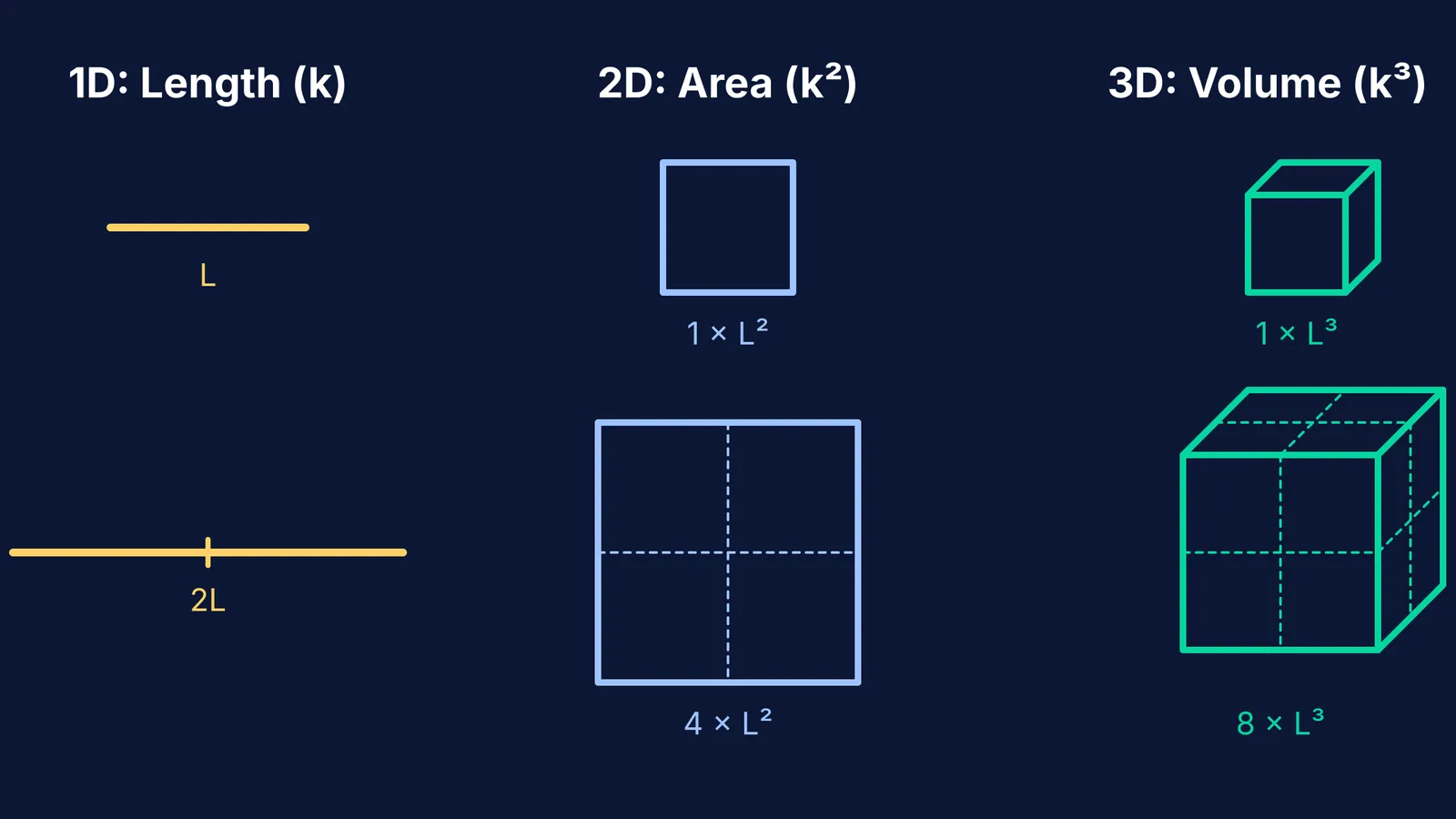
If you double the length of a box, do you double its volume? No. You increase it by a factor of eight.
The relationship between lengths, areas and volumes when scaling an object is one of the most common pitfalls in maths and physics. Whether you are building a model car, estimating the size of a forest on a map, or answering a geometry question, the rule remains the same: scaling affects each dimension differently.
Here is how scale factors work across one, two and three dimensions.
How does scale factor affect length?
The linear scale factor (often written as *k*) is the ratio of corresponding lengths between two similar shapes (Similarity (geometry))). If you enlarge a photograph by a factor of 2, every length—the width, the height, the perimeter—is multiplied by 2.
**New Length = *k* × Original Length**
If a toy train is built to a 1:40 scale, its linear scale factor *k* is 1/40. A 20-metre real carriage becomes a 0.5-metre toy carriage.
How does scale factor affect area?
Because area is a two-dimensional measurement (length × width), scaling an object affects both dimensions. When you multiply the length by *k* and the width by *k*, the overall area is multiplied by *k* × *k*, or *k²*).
**New Area = *k²* × Original Area**
This is crucial when reading maps. On a standard 1:50,000 map, the linear scale factor is 1/50,000.
1 cm on the map represents 50,000 cm (0.5 km) on the ground.
But 1 cm² on the map does *not* represent 50,000 cm². It represents 50,000² cm², which is 2,500,000,000 cm² (or 0.25 km²).
If you are struggling to picture why squaring happens, the Fermi Concept Library contains every concept in physics, chemistry, biology, mathematics and computing, each with its own lesson and its place in the map. For more on metric area changes, see our guide on why 1 square metre is 10,000 cm².
How does scale factor affect volume?
Volume measures three-dimensional space (length × width × height). If you scale all three dimensions by *k*, the total volume is multiplied by *k* × *k* × *k*, or *k³*).
**New Volume = *k³* × Original Volume**
This *k³* rule, sometimes known as Galileo's square–cube law, explains why scale models are surprisingly light.
If you have a 1:24 scale model car, its linear scale factor is 1/24.
The model is 1/24th the length of the real car.
However, its volume (and roughly its weight, if made of similar materials) scales by (1/24)³, which is 1/13,824.
A real car weighing 1,382 kg would weigh just 0.1 kg as a 1:24 scale model. A 1:18 scale model is only 33% longer than a 1:24 model, but because (1/18)³ is 1/5,832, the 1:18 model takes up over twice the volume. For related volume calculations, see Converting Cubic Centimetres to Litres for Tank Problems.
Working backwards from area or volume?
Sometimes an exam question gives you the areas or volumes and asks for the length. You just have to reverse the process:
If you know the Area Scale Factor, take the square root to find the Linear Scale Factor *k*.
If you know the Volume Scale Factor, take the cube root to find *k*.
For example, if two similar water tanks hold 8 litres and 27 litres, the volume ratio is 8:27. Taking the cube root gives a linear scale factor of 2:3. If you want to find the ratio of their surface areas, you then square that linear ratio to get 4:9). You can see similar relationships at play in the area ratio of similar triangles.
If you get stuck on multi-step ratio problems like this, the Fermi Problem Library offers worked problems with a step-by-step solver that explains the reasoning rather than printing an answer, helping you spot the *k²* and *k³* traps before the exam.


