

On this page
You learn the binomial theorem in Class 11 for whole-number powers. NCERT's Class 11 mathematics chapter says plainly that it studies the theorem "for positive integral indices only". Yet physics keeps handing you √1.02 or 1/(1 + h/R)². Each is (1 + x)^n with n = 1/2 or −2, and the tool that handles them is one Isaac Newton worked out in 1665.
What did Newton discover in 1665?
Historian D. T. Whiteside's 1961 paper in The Mathematical Gazette, Newton's discovery of the general binomial theorem, quotes Newton's own recollection: "In the beginning of the year 1665 I found the method of approximating series". Another note he quotes places Newton's reading of Schooten and John Wallis in the winter of 1664–65, before the plague forced him from Cambridge that summer.
Mathematician David Goss's history, The ongoing binomial revolution, explains the step Newton took. Wallis had found the areas under the curves (1 − x²)^n for whole numbers n. Newton tried fractional exponents and noticed that each coefficient follows from the one before by the same rule as in the whole-number case. He used it to expand (1 − x²)^(1/2), (1 − x²)^(3/2) and (1 − x²)^(1/3) as endless series.
Goss notes that Newton discussed the result in a 1676 letter to Henry Oldenburg. A copy of that Latin letter, dated 13 June 1676, is held at Cambridge University Library as MS Add. 3977.2 (Newton Project catalogue). Its transcription states the rule for any index, whole or fractional, positive or negative.
How does the binomial theorem work for fractional powers?
For any real n and |x| < 1:
(1 + x)^n = 1 + nx + n(n − 1)x²/2! + n(n − 1)(n − 2)x³/3! + …
Newton's rule, as Goss describes it, is that each new coefficient is the previous one multiplied by (n − k + 1)/k, where k is the number of the term you are building. Here it is for n = 1/2, starting from 1:
k = 1: 1 × (1/2) ÷ 1 = 1/2
k = 2: (1/2) × (−1/2) ÷ 2 = −1/8
k = 3: (−1/8) × (−3/2) ÷ 3 = 1/16
k = 4: (1/16) × (−5/2) ÷ 4 = −5/128
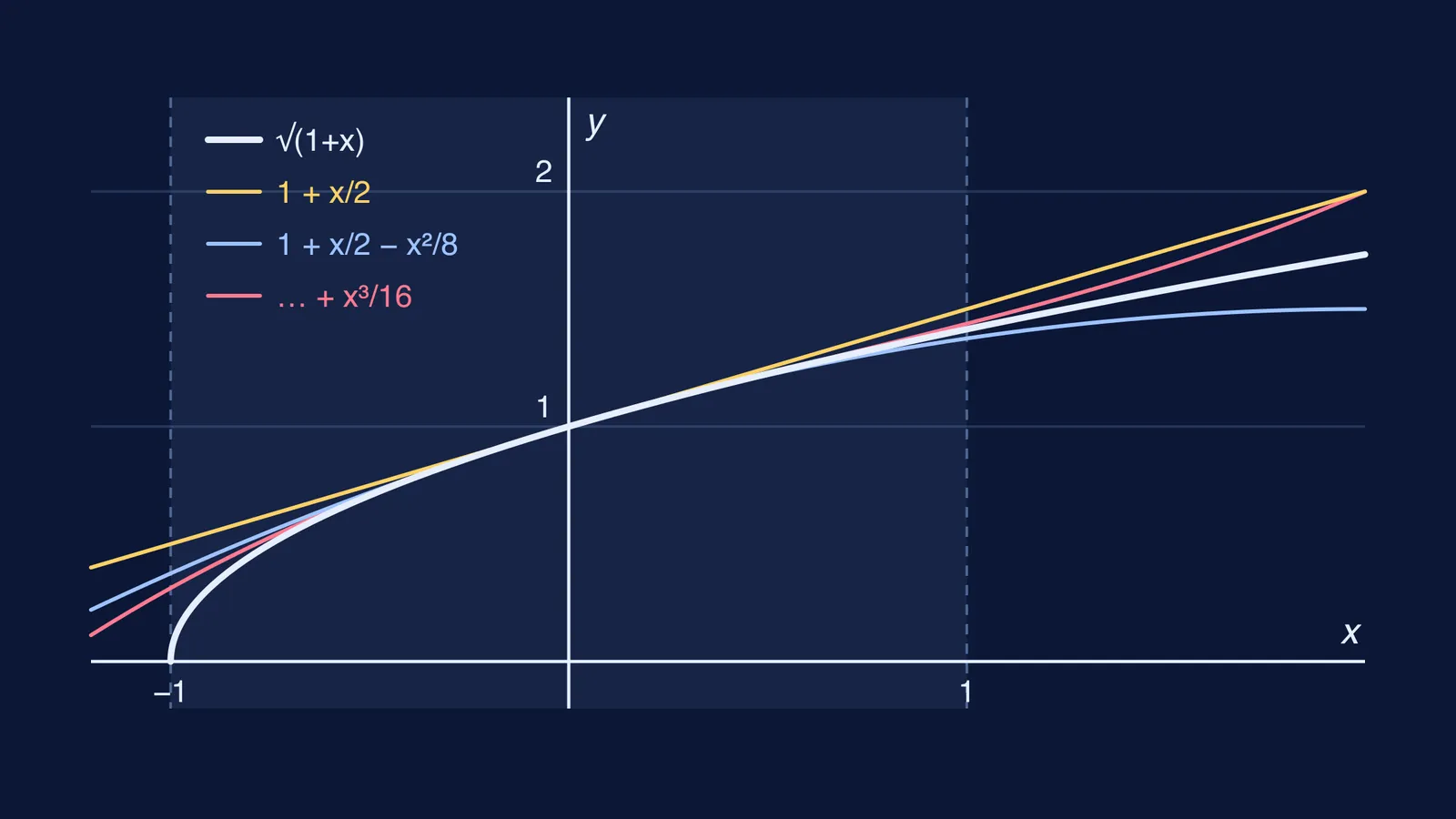
So √(1 + x) = 1 + x/2 − x²/8 + x³/16 − 5x⁴/128 + …
This also shows why the Class 11 version stops. When n is a positive whole number, the factor (n − k + 1) becomes zero at k = n + 1, and every later coefficient is zero too. For a fraction or a negative number it never reaches zero, so the series runs on forever. Check with n = −1: the coefficients come out 1, −1, 1, −1, giving 1/(1 + x) = 1 − x + x² − x³ + …, the geometric series you already know.
More drills: the binomial theorem for negative and fractional index.
Why must |x| be less than 1?
Newton, Goss notes, did not consider when the series converges. Euler, Abel and Gauss took up that question later, and Gauss gave the first satisfactory proof of convergence in 1812. The series equals (1 + x)^n whenever |x| < 1.
Put x = 3 into the √(1 + x) series, where the true answer is 2. The running totals go 1, 2.5, 1.375, 3.06, −0.10, swinging further apart each time. The fix is to rewrite first: √10 = 3√(1 + 1/9), and now x = 1/9 is small.
How do you use it for JEE-style approximations?
When x is small, (1 + x)^n ≈ 1 + nx, and the error is roughly the next term, n(n − 1)x²/2. Two worked examples:
Cube root of 1001. Write it as 10(1 + 0.001)^(1/3). Two terms give 10(1 + 0.000333) = 10.00333. The third coefficient is (1/3)(−2/3)/2 = −1/9, which changes the answer by only about 0.0000011.
Gravity at height h = R/100. Since g_h = g(1 + h/R)^(−2), the approximation gives g(1 − 2 × 0.01) = 0.98g. The exact value is g/1.0201 ≈ 0.9803g, and the gap of 0.0003g is the next term, 3x².
A four-step exam checklist:
Factor out the big part so the bracket reads (1 + x) with |x| well below 1.
Get the sign of x right: (1 − 0.01) means x = −0.01.
Keep 1 + nx, then estimate the next term. If the answer options are closer together than that, keep one more term.
Multiply back by whatever you factored out.
Our guide to small-angle and binomial approximations for JEE physics collects more of these shortcuts, and the binomial approximation visualised shows the same idea as a picture.
If the expansion itself feels shaky, the Fermi Concept Library gives each mathematics concept its own lesson and its place in the map. If you follow the idea but keep slipping on a step, the Fermi Problem Library has worked problems with a step-by-step solver that explains the reasoning rather than printing an answer.
Try it tonight: expand (1 + x)^(−1/2) to three terms with the coefficient rule, estimate 1/√0.98, and check it on a calculator.


