

On this page
In physics and engineering, the binomial approximation is the tool you reach for to clear up messy algebra. It turns powers, square roots, and complex denominators into simple addition. But because it swaps a steep curve for a straight line, it only works if you stay close to the starting point.
What is the binomial approximation for 1+x power n?
The binomial approximation is a first-order Taylor series expansion which states that (1 + x)ⁿ ≈ 1 + nx when the absolute value of x is much less than 1 Wikipedia.
Instead of expanding the full binomial series, you simply bring the power n down to multiply with x, dropping all the squared and cubed terms.
For example, to estimate (1.02)³, you let x = 0.02 and n = 3.
The approximation gives 1 + 3(0.02) = 1.06.
The true value is 1.061208. The answer is practically identical because x is tiny.
When does the binomial approximation fail?
The approximation breaks down rapidly as x gets larger. Because you are dropping terms like x², x³, and beyond, the straight line of 1 + nx stops tracking the true curve of (1 + x)ⁿ.
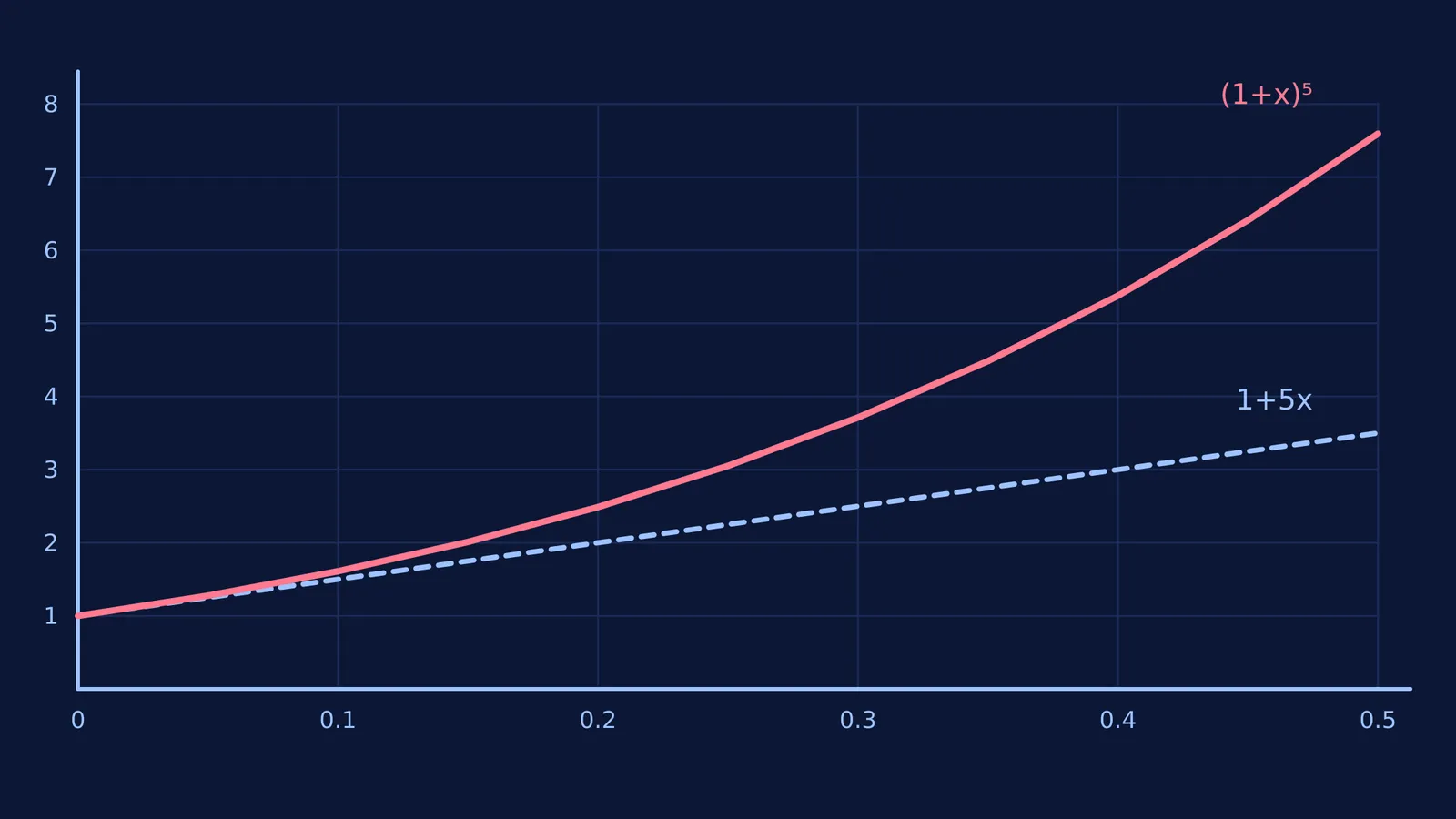
Let us test it for n = 5 at two different points:
When x = 0.1, the approximation guesses 1 + 5(0.1) = 1.5. The true value is (1.1)⁵ = 1.61, giving an error of 0.11.
When x = 0.5, the approximation guesses 1 + 5(0.5) = 3.5. The true value is (1.5)⁵ = 7.59, giving an error of 4.09.
At x = 0.5, the linear estimate is not even half of the true value. When you look at the graph, the reason is obvious. The true equation curves upward exponentially, while the approximation carries on in a straight line. If you need to picture how non-linear terms pull away from linear estimates, the Fermi Simulation Lab has interactive simulations for the ideas that are easier to see than to read.
What happens with negative powers or fractions?
The binomial approximation also works when n is negative or a fraction. This is particularly useful in physics when dealing with denominators or square roots.
For example, consider the expression 1 / (1 + x). This can be rewritten as (1 + x)⁻¹. Using the binomial approximation with n = -1, this becomes approximately 1 - x when x is very small. If you have x = 0.05, the approximation gives 1 - 0.05 = 0.95. The true value is 1 / 1.05 = 0.95238. The approximation is very close.
Similarly, square roots can be approximated using fractional powers. The square root of (1 + x) is (1 + x)^(1/2). Applying the approximation with n = 1/2 gives 1 + x/2. If x = 0.04, the approximation gives 1 + 0.04/2 = 1.02. The exact square root of 1.04 is 1.0198, showing that the rule holds perfectly for fractional powers as long as you stay close to the starting point.
When dealing with gravity, the distance to an orbiting satellite is often written as r = R + h, where R is the radius of the Earth and h is the height above the surface. The force of gravity depends on 1 / r², which is 1 / (R + h)². By factoring out R², you get a term of 1 / (1 + h/R)². Since h is much smaller than R, you can rewrite this as (1 + h/R)⁻² and apply the binomial approximation to get 1 - 2h/R. This transforms a complex denominator into a simple subtraction, making it much easier to estimate the gravitational pull without heavy computation.
Why use the binomial approximation in physics?
Physicists use this trick because the real world rarely deals with large x when looking at changes. If a metal rod heats up and expands by a tiny amount, x might be 0.001. In thermodynamics, gas expansions often involve small fractional changes in volume.
By reducing (1 + x)ⁿ to 1 + nx, you can solve equations without needing a calculator. If you are practising for an exam and get stuck on how these approximations fit into larger derivations, the Fermi Problem Library has worked problems with a step-by-step solver that explains the reasoning.
For more mathematical foundations, see our guide on the Binomial theorem: general term, middle term and coefficients, or explore how historical mathematicians like Al-Karaji, the binomial table and an early form of induction first understood these expansions.


