

On this page
Sign mistakes with powers are some of the cheapest marks to lose: you know the method, write −16 where the answer is 16, and the substitution falls apart. The fix is two short ideas: count the negative factors, and check what the bracket is holding.
Why is a negative number raised to an even power positive?
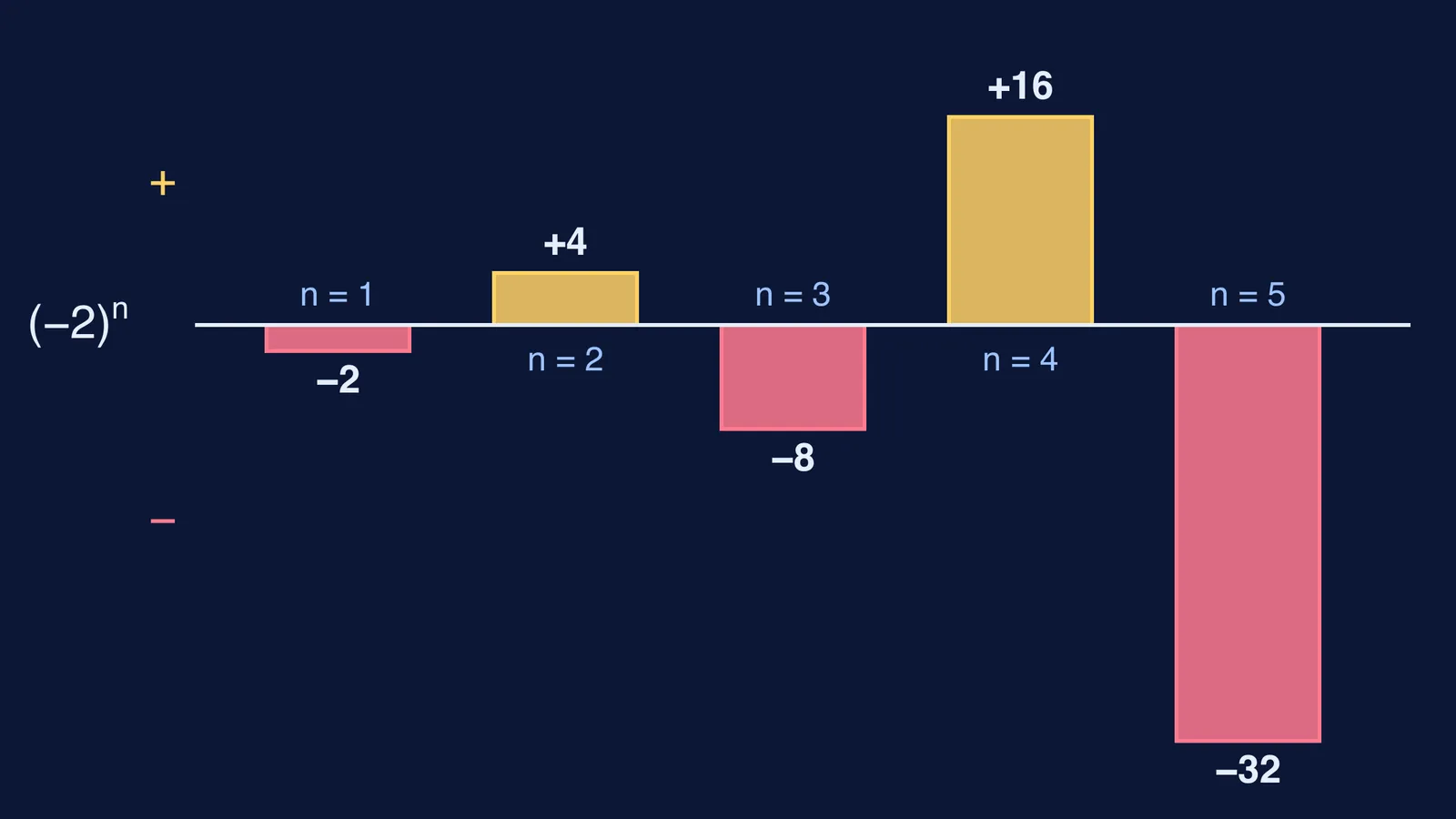
A power is repeated multiplication, so (−2)⁴ means (−2) × (−2) × (−2) × (−2). The sign rule for multiplication does the rest: in OpenStax Prealgebra 2e, section 3.4, the product of two numbers with the same sign is positive, and the product of two numbers with different signs is negative.
Group the four factors in pairs: (−2 × −2) × (−2 × −2) = 4 × 4 = 16. Each pair of negatives turns positive, and with an even exponent every factor has a partner. Nothing negative is left over, so the answer is positive.
What happens when you raise a negative number to an odd power?
With (−2)⁵ you get the same two pairs plus one extra factor: 4 × 4 × (−2) = −32. An odd exponent always leaves one negative factor without a partner, and that single factor makes the whole product negative.
That gives a rule you can say in one line: a negative base to an even power is positive, and a negative base to an odd power is negative. The size of the answer is the same as for the positive base; only the sign changes.
The tidiest way to remember it is (−1)ⁿ. Since (−a)ⁿ = (−1)ⁿ × aⁿ, you only need to know that (−1)ⁿ is 1 when n is even and −1 when n is odd. So (−1)¹⁰⁰ = 1, (−1)¹⁰¹ = −1, and (−3)³ = −27. If the basic laws of exponents are still shaky, our guide to exponents and powers for Class 8 covers them from the start.
What is the difference between −2⁴ and (−2)⁴?
This is the easiest place to slip. The exponent applies only to the thing directly in front of it. In (−2)⁴ the bracket makes −2 the base. In −2⁴ the base is just 2, and the minus sign is applied after the power is worked out.
OpenStax Prealgebra 2e uses exactly this pair in its Example 3.52: (−2)⁴ = (−2)(−2)(−2)(−2) = 16, while −2⁴ = −(2 · 2 · 2 · 2) = −16. In its section on multiplication properties of exponents it does the same with 3, getting (−3)⁴ = 81 and −3⁴ = −81, and explains that without the bracket you raise only the 3 to the power and then find the opposite.
Read −2⁴ aloud as "the negative of two to the fourth". The order is the same idea as in our post on BODMAS order of operations mistakes: powers are worked out before the minus sign in front is applied.
Do calculators and code read −2^4 the same way?
Not always. Python follows the textbook convention: its language reference states that the power operator binds more tightly than a unary minus on its left, so -1**2 gives -1.
Excel does the opposite. Microsoft's operator precedence table for Excel puts negation above exponentiation, so a formula like =-2^4 is read as (−2)⁴ and gives 16. On any tool, type the brackets yourself and you never have to remember which convention it uses.
A worked example: substituting a negative value
Substitution is where the bracket rule matters most, because x becomes a negative number. Find −x² + x³ + (−x)⁴ when x = −2.
Put brackets around every substituted value: −(−2)² + (−2)³ + (−(−2))⁴.
−(−2)²: the square is (−2)² = 4 (even power), then the minus in front gives −4.
(−2)³: odd power, so −8.
(−(−2))⁴: the inside is +2, and 2⁴ = 16.
Add: −4 − 8 + 16 = 4.
If you treat −x² as (−2)² = +4, you get 4 − 8 + 16 = 12 instead, which is why the minus in front needs its own step. If substitution slips are a pattern for you, our post on evaluating expressions with negative values has more practice.
A 30-second sign check before you move on
Did you put brackets around every negative number you substituted?
For each power, is the minus inside the bracket or outside it?
If it is inside, is the exponent even (positive answer) or odd (negative answer)?
Does the size of the answer match the same power of the positive number?
If the idea of a base and an exponent still feels unclear, the Fermi Concept Library covers every concept in mathematics, each with its own lesson. If you keep getting the sign wrong partway through longer problems, the Fermi Problem Library has worked problems with a step-by-step solver that explains the reasoning, so you can follow each line and spot where a minus sign went missing.


