
On this page
Most Class 12 students meet matrices as boxes of numbers to add, multiply and invert. The CBSE Class 12 mathematics curriculum for 2026-27 covers matrix operations, inverses and determinants, including applications of determinants in finding the area of a triangle. It does not describe a matrix as a movement of the plane, though, and that picture is what makes the rules make sense. Grab some graph paper and predict six transformations before checking any of them.
How do you read a 2x2 matrix as a transformation?
Draw a grid and mark two arrows from the origin: i = (1, 0) along the x-axis and j = (0, 1) up the y-axis. We will write a matrix row by row, so (a b; c d) has first row a, b and second row c, d. Its first column is (a, c) and its second column is (b, d).
The Wikipedia reference on transformation matrices builds a matrix exactly this way: transform each basis vector and write the results into the columns. So the matrix sends i to (a, c) and j to (b, d).
The origin stays put, and grid lines stay straight, parallel and evenly spaced (unless the matrix squashes the plane flat). So the point (x, y) lands at x times the first column plus y times the second.
Can you predict rotations, reflections, shears and stretches before seeing them?
Use this routine for each matrix below, covering the explanation first.
Draw where i lands (first column) and where j lands (second column).
Complete the parallelogram on those two arrows. That is where the unit square goes.
Name the move, then guess the new area and whether the square has been flipped over.
Now predict:
(0 −1; 1 0): i goes to (0, 1) and j to (−1, 0). Both turn a quarter-turn anticlockwise: a 90° rotation. It is the rotation matrix (cos θ −sin θ; sin θ cos θ) from the same transformation matrix reference, with θ = 90°.
(1 0; 0 −1): i stays put and j points down. A reflection in the x-axis.
(1 1; 0 1): j leans over to (1, 1). The square slides into a parallelogram with the same base and height: a horizontal shear.
(2 0; 0 3): i doubles and j triples. A stretch into a 2 by 3 rectangle.
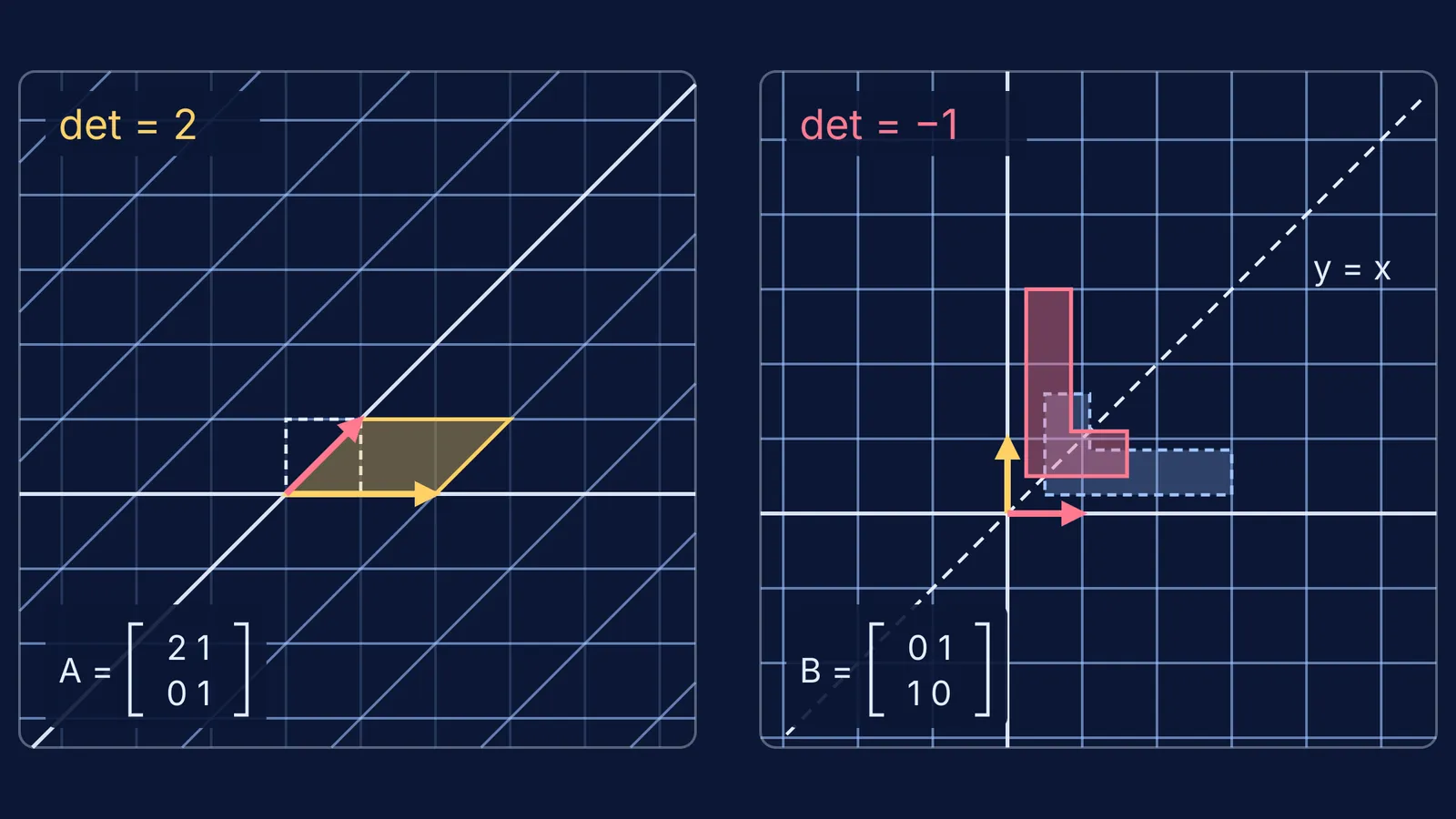
(2 1; 0 1): a stretch and a shear together, shown on the left of the diagram above.
(1 2; 2 4): i and j land on the same line, so the whole plane collapses onto y = 2x.
What does the determinant tell you about area and flips?
For the matrix (a b; c d), the determinant is ad − bc. The absolute value of the determinant is the factor by which the transformation scales every area, and its sign records orientation, according to the Wikipedia article on determinants. A negative determinant means the plane has been flipped, like turning a page over.
Now check your predictions:
Rotation: 0 × 0 − (−1) × 1 = 1. Same area, no flip.
Reflection: −1. Same area, flipped.
Shear: 1, matching the parallelogram's base times height.
Stretch: 6, matching the 2 by 3 rectangle.
Stretch plus shear: 2.
Collapse: 4 − 4 = 0. The square is squashed flat, which is why this matrix has no inverse.
A quick flip test needs no arithmetic. Turning from i to j is anticlockwise. If the turn from the first column to the second is clockwise, the determinant is negative. In the right half of the diagram, i and j swap places and the determinant is −1.
This is where the textbook's triangle-area formula comes from. The triangle with corners (0, 0), (a, c) and (b, d) is half of the parallelogram built on the two columns, so its area is ½|ad − bc|.
Why predict first instead of just watching?
In a study of physics lecture demonstrations, Crouch, Fagen, Callan and Mazur (2004) found that students who only watched understood the ideas no better than students who did not see the demonstration at all. Students who predicted the outcome first showed significantly greater understanding. They studied physics demonstrations, not matrices, but the habit carries over: commit to a sketch, then check.
The same habit works with the interactive simulations in the Fermi Simulation Lab, built for ideas that are easier to see than to read. Write your prediction down before you press play. If a step in the algebra feels shaky, the Fermi Concept Library has its own lesson for each concept in mathematics.
What should you try next?
Here is a short practice plan:
Draw the six predictions above on graph paper.
Compute each determinant and compare it with your drawn areas.
Write matrices for a reflection in the y-axis and a 180° rotation, then check them.
Multiply two reflection matrices, name the single move you get, and compare with why two reflections make a rotation.
When these feel easy, see how an inverse matrix undoes a transformation, then take the area idea into three dimensions with determinants as area and volume.