

On this page
When you reflect an object across a line, its orientation flips. A left hand becomes a right hand, and clockwise turns into counter-clockwise. But what happens if you take that flipped image and reflect it again across a second, crossing line? Because you have flipped the orientation twice, the object returns to its original handedness. The combination of these two moves results in a perfect rotation.
Why do two reflections in intersecting lines give a rotation?
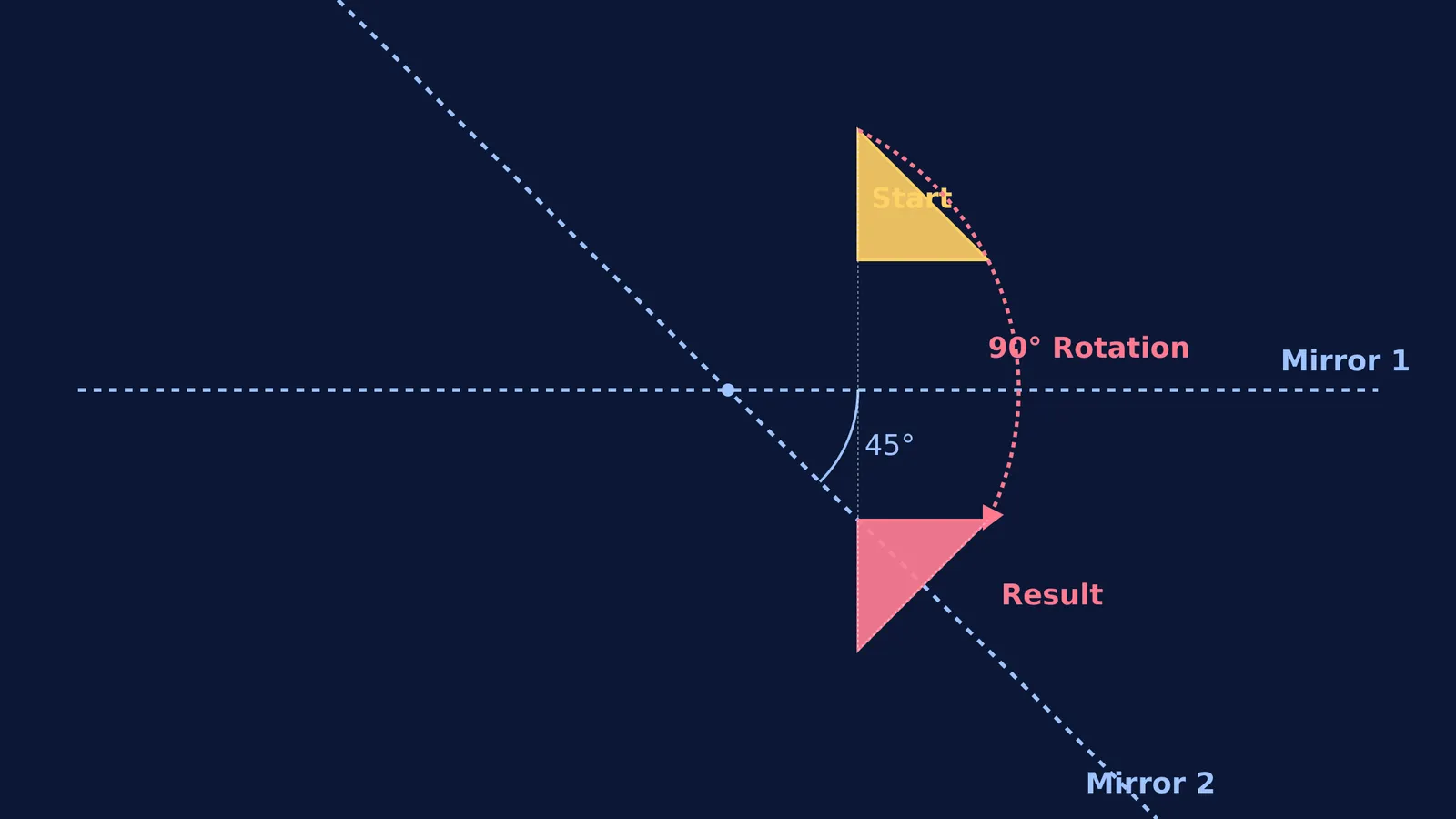
If you place two lines so they meet at a point, reflecting a shape across the first line and then the second causes it to sweep along a circular path. The rule that two reflections in intersecting lines yield a rotation by twice the angle is a standard theorem in transformation geometry (Wikipedia).
To understand why the angle doubles, picture a single point on your shape. Draw a line from the intersection of the mirrors to that point. When you reflect the point across the first mirror, the mirror sits exactly halfway between the original point and the new reflection. The angle from the point to the mirror is equal to the angle from the mirror to the reflection.
When you reflect that new image across the second mirror, the second mirror sits exactly halfway between the first reflection and the final point. The total rotation angle is the sum of these parts. Because the mirrors sit perfectly in the middle of each geometric jump, the total angle the point travels is exactly twice the angle between the two mirrors. This simple principle is exactly why rotating a plane mirror by θ makes the reflected ray turn by 2θ.
How do you find the angle of rotation?
Finding the final position of the shape without calculating algebraic coordinates involves just two steps:
Find the center: Mark the point where the two lines cross. Every point on your shape will rotate around this single central axis.
Double the angle: Measure the angle from the first mirror to the second mirror. Multiply that angle by two to get your rotation angle.
For example, if the angle between the two intersecting lines is 45°, the final shape will be rotated by 90° from its starting position. If the lines are perpendicular and meet at a 90° angle, the rotation is 180°. A 180° rotation is also known as a point reflection through the intersection (Wikipedia).
If drawing this out on paper gets tricky to picture, you can set up the mirrors and shapes in the Fermi Simulation Lab to see the rotation happen instantly. Interactive simulations are built for the ideas that are easier to see than to read, allowing you to drag the mirrors and watch the final image rotate in real time.
Where does this geometry show up in practice?
This double-reflection principle is not just an abstract theorem; it has very real optical applications. When you look into a kaleidoscope, you are looking at two mirrors set at an angle. If the mirrors are set at 60°, the two reflections produce a 120° rotation, creating a beautiful repeating pattern that wraps into a perfect hexagon (Wikipedia).
Similarly, corner reflectors in physics use mirrors set at exactly 90°. Because the mirrors are perpendicular, any light ray that bounces off both mirrors undergoes a 180° rotation. This means the light ray is sent directly back to where it came from, regardless of the angle it entered. This is how bicycle reflectors and the laser reflectors left on the Moon work (Wikipedia).
What happens if you reflect across parallel lines instead?
If the two lines never intersect, the center of rotation effectively moves infinitely far away. In this case, the shape does not rotate at all. Instead, it slides straight forward. Reflecting an object across two parallel lines results in a translation where the distance moved is exactly twice the distance between the lines (Wikipedia)).
Just like with intersecting lines, the order matters. The object moves in the direction from the first parallel line toward the second.
Whether it is finding the minimum mirror height to see your full image or combining transformations on a coordinate plane, geometric rules save you from grinding through complex algebra. By remembering that intersecting mirrors create a rotation and parallel mirrors create a translation, you can instantly predict where any shape will land.


