

On this page
Many Class 12 students learn the determinant as a recipe: multiply across, subtract, move on. A picture lets you check the answer. See a 2×2 determinant as an area with a sign, and you can predict whether it is zero, negative or scaled before any arithmetic.
What does a determinant mean geometrically?
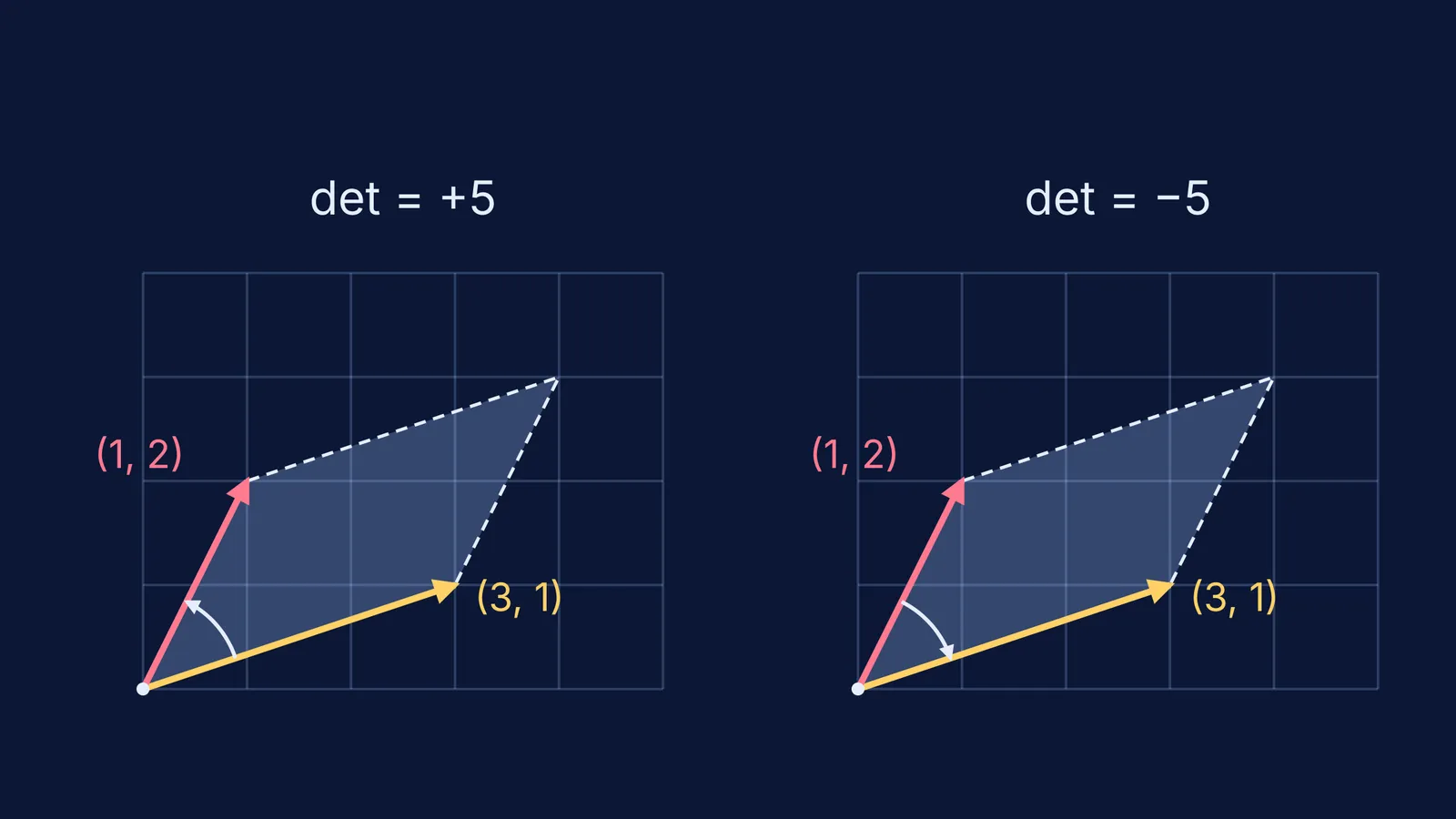
Take a matrix with rows (a, b) and (c, d), and draw each row as an arrow from the origin. The two arrows are adjacent sides of a parallelogram.
The NCERT Class 12 vector algebra chapter states that a parallelogram with adjacent sides a and b has area |a × b|. For two flat vectors a₁i + a₂j and b₁i + b₂j, the chapter's determinant form of the cross product leaves only a k part, a₁b₂ − a₂b₁. That is the 2×2 determinant as defined in the NCERT Class 12 determinants chapter.
The absolute value of a 2×2 determinant is the area of the parallelogram formed by its two rows.
The sign records direction. Grant Sanderson's 3Blue1Brown lesson on the determinant defines it as the factor by which a linear transformation changes areas, negative when the transformation flips orientation; in three dimensions it is the volume of the parallelepiped the unit cube turns into. In row terms: an anticlockwise turn from row 1 to row 2 gives a positive determinant, a clockwise turn a negative one.
When is a determinant zero, negative or doubled?
Sketch the two rows first and ask:
Zero? If both rows lie on one line through the origin (one is a multiple of the other), the parallelogram is flat and has no area.
Negative? If the turn from row 1 to row 2 is clockwise. Swapping the rows reverses the turn, and the algebra agrees: cb − da = −(ad − bc).
One row doubled? One side doubles, so the area doubles.
Whole matrix doubled? Both sides double, so the area becomes four times as large. The NCERT determinants chapter gives the general rule: if A = kB for square matrices of order n, then |A| = kⁿ|B|.
Worked example 1: why does the triangle formula have a half?
Example 6 in the NCERT determinants chapter finds the area of the triangle with vertices (3, 8), (−4, 2) and (5, 1), and gets 61/2.
From (3, 8), the edges to the other two vertices are the vectors (−7, −6) and (2, −7). Their determinant is (−7)(−7) − (−6)(2) = 61, the parallelogram's area, and the triangle is half of it: 61/2. NCERT says take the absolute value; the sign only reports whether you listed the vertices anticlockwise (+) or clockwise (−). More in the area of a triangle using determinants and the collinearity test.
Worked example 2: how can a determinant be negative?
A remark in the same NCERT determinants chapter takes A with rows (2, 2) and (4, 0), and B with rows (1, 1) and (2, 0), and shows |A| = −8 and |B| = −2.
Picture B. Row 1 points up at 45 degrees, row 2 along the x-axis: a clockwise turn, so predict a minus sign. The parallelogram has base 2 and height 1, so area 2. Prediction: −2, which matches.
Now A = 2B. Both arrows double, so the area grows four times and the turn is unchanged: −8. Exercise 4.1 in that chapter asks you to show |3A| = 27|A| for a 3×3 matrix: a box stretched three times in each of three directions has 3³ = 27 times the volume.
Worked example 3: what does a zero determinant tell you?
Example 7 in the NCERT determinants chapter finds the line through A(1, 3) and B(0, 0). For any point P(x, y) on AB, triangle ABP has zero area, so (y − 3x)/2 = 0, giving y = 3x. In pictures: the arrows from the origin to A and to P lie on one line, so the parallelogram is flat.
The second part wants D(k, 0) with triangle area 3. NCERT sets −3k/2 equal to ±3 and gets k = ∓2. In pictures, the rows (1, 3) and (k, 0) have determinant −3k: k = 2 turns clockwise, k = −2 anticlockwise, same area.
The same flatness explains equations: the NCERT chapter opens by noting that two linear equations have a unique solution when a₁b₂ − a₂b₁ ≠ 0. For what happens when it is zero, see consistency of linear equations by the matrix method and adjoint and inverse of a matrix: the properties JEE tests.
How do you practise this so it sticks?
For every determinant question in your NCERT exercises:
Sketch the rows as arrows from the origin.
Write your prediction in the margin: zero or not, the sign, a rough size.
Calculate, then compare. A mismatch is a slip worth finding.
If static sketches are not enough, the Fermi Simulation Lab has interactive simulations for ideas that are easier to see than to read. When you cannot see why answer and prediction disagree, the Fermi Problem Library has worked problems with a step-by-step solver that explains the reasoning rather than printing an answer.


