On this page
Line up three same-size cans on one ramp: empty, full of water, and packed with solid food. The winner is set by how much of each can's mass has to spin, not by weight.
Which rolls faster, a full can or an empty can?
The can full of water normally wins and the empty can comes last. In the University of Maryland's lecture demonstration with an empty can and a can nearly full of water, the water-filled can reaches the bottom first, because water's low viscosity limits how much it rotates, so that can behaves much like a body sliding down without friction.
A solid filling lands in between. In the University of North Texas "racing soup" demonstration, a can of beef broth beats a can of cream of mushroom soup of similar mass (337 g and 351 g), because the thick soup turns with the can "as if it was a solid rod". The same page suggests a check: shake both cans, and only the broth sloshes.
Why does how much mass spins decide the race?
For a round object rolling without slipping, the acceleration down a slope is a = mg sin θ / (m + I/r²), where I is the moment of inertia about the axle. Write I = k m r² and this becomes a = g sin θ / (1 + k). The number k is a shape score: it grows with how much of the mass spins and how far from the axle it sits.
Two shapes set the limits. A thin hoop or cylindrical shell has I = MR² about its axis, so k = 1. A uniform disc or solid cylinder has I = ½MR², so k = ½.
Empty can: nearly all the mass is in the thin wall, so k is close to 1 (slightly less, because the ends sit nearer the axle).
Solid food: the filling spins with the can, so k falls between ½ and 1.
Water: the can turns around water that mostly does not, so k can fall well below ½.
It is the same idea as the ring, disc and sphere race, except the filling chooses the shape.
Worked example: three cans on a 10° ramp
Take illustrative numbers, not measurements: a 50 g tin wall, 300 g of filling, a 1.0 m ramp at 10°, g = 9.8 m/s². Then g sin θ ≈ 1.70 m/s², the rolling acceleration is a = g sin θ / (1 + k), and each time is t = √(2L/a).
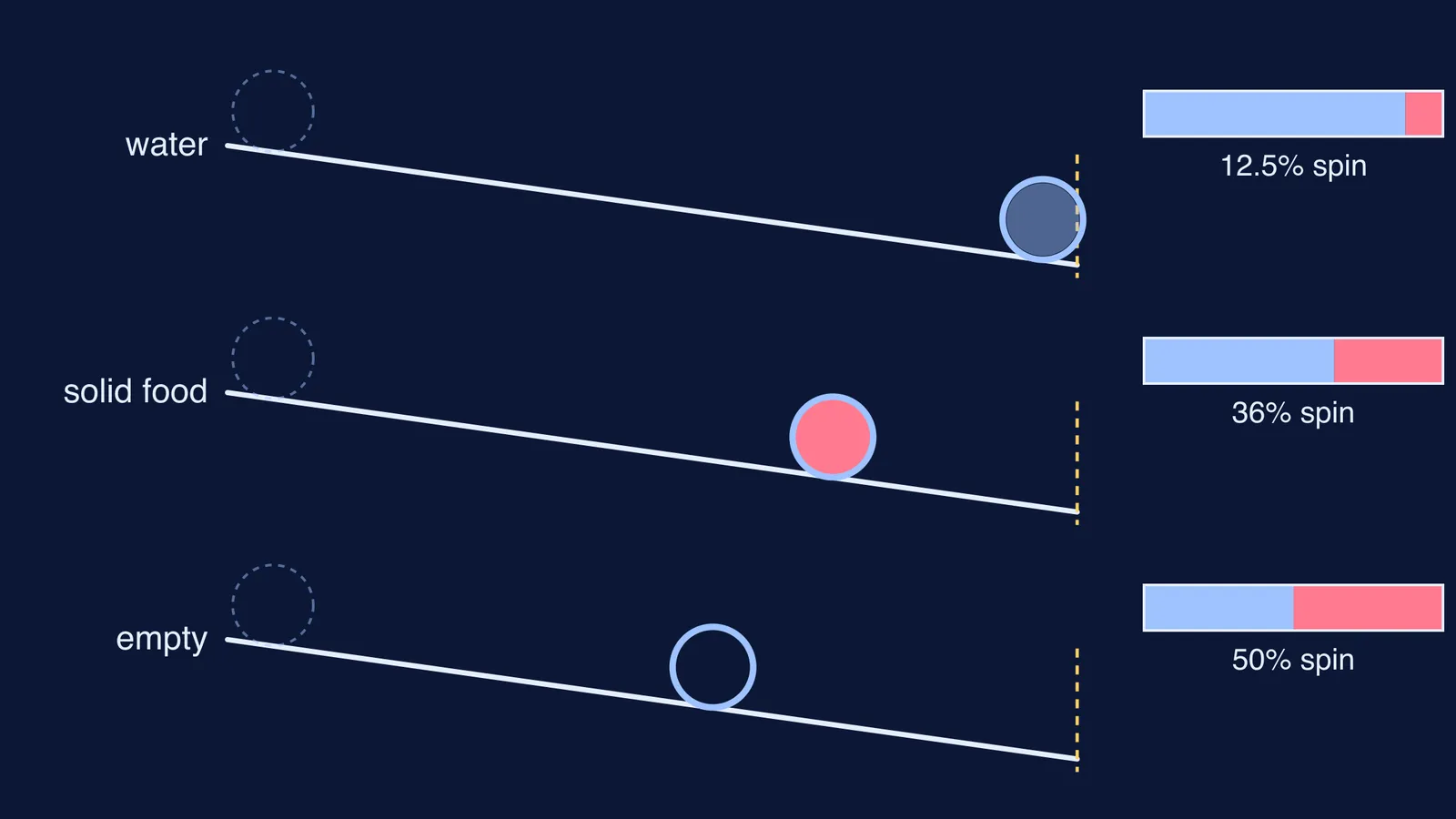
Water can, water not spinning: k = 0.050/0.350 ≈ 0.14, a ≈ 1.49 m/s², t ≈ 1.16 s.
Solid-food can: I = (0.050 + ½ × 0.300) r² = 0.200 r², so k ≈ 0.57, a ≈ 1.08 m/s², t ≈ 1.36 s.
Empty can as a thin shell: k = 1, a ≈ 0.85 m/s², t ≈ 1.53 s.
The water can finishes about 0.2 s ahead of the solid one and nearly 0.4 s ahead of the empty one, gaps a phone's slow-motion video can show.
How does energy sharing between motion and rotation check the order?
Rolling without slipping conserves mechanical energy: the contact point is momentarily at rest, so static friction does no work. Each can turns the same drop into kinetic energy:
mgh = ½mv² + ½Iω² = ½mv²(1 + k), using ω = v/r.
So the share of the energy that goes into spinning is k/(1 + k). In the worked example that is 12.5% for the water can, about 36% for the solid can and 50% for the empty can. Energy spent on spin is not available for speed, so the speed at the bottom, v = √(2gh/(1 + k)), follows the same order: about 1.73, 1.47 and 1.30 m/s for the drop of h ≈ 0.17 m. Forces and energy agree. For other shapes, see how much of a rolling body's kinetic energy is rotational.
How do you run the can race at home?
Pick three same-size tins: one empty, one filled to the brim with water and taped shut, one packed with something that does not slosh when shaken.
Prop a board at a shallow angle so the cans roll rather than skid.
Write down your predicted order.
Race two at a time, releasing them together from behind a ruler.
Repeat each pair three times on video.
Real water turns a little with the wall, so expect a smaller lead than the worked example.
Rolling is easier to see than to read, and the Fermi Simulation Lab has interactive simulations for ideas like this; our rotational motion simulation with three predictions to test pairs well with this race. If moment of inertia still feels shaky, the Fermi Concept Library gives each physics concept its own lesson.
Write your prediction first, then let the cans settle it.