On this page
How does a concentration gradient drive urea removal?
When healthy kidneys function, nephrons filter metabolic wastes while conserving essential nutrients like glucose. In renal failure, urea accumulates in blood to toxic levels—a condition called uremia. Hemodialysis acts as an artificial kidney, using passive diffusion across a semipermeable membrane rather than active transport.
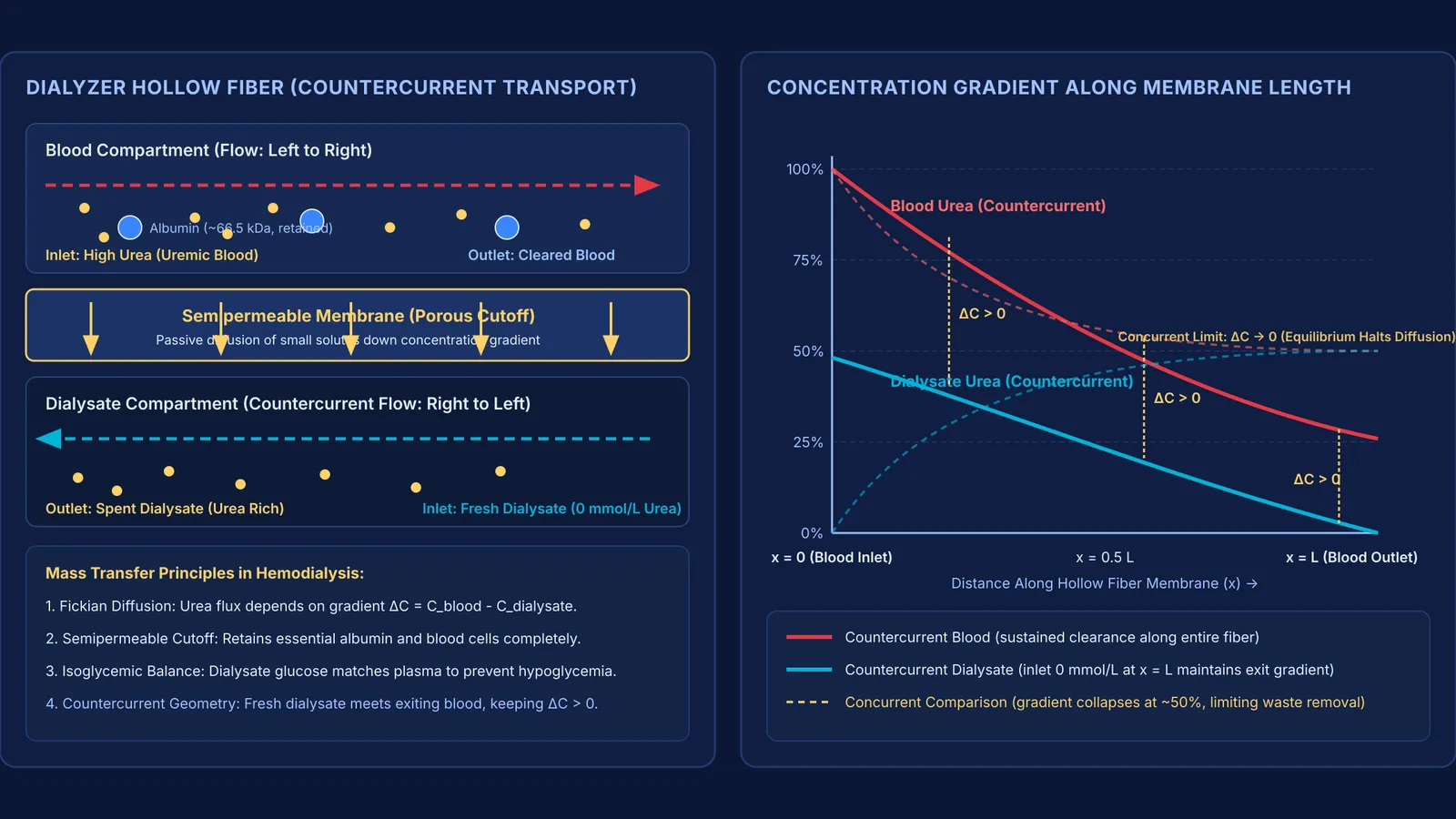
Solute diffusion follows Fick's first law: flux across a barrier is proportional to the concentration difference ΔC between fluid compartments. In a clinical dialyzer, blood flows through microscopic hollow fibers surrounded by dialysate fluid. As outlined in Class 11 NCERT Biology and the KDOQI Clinical Practice Guideline for Hemodialysis Adequacy: 2015 Update, fresh dialysate contains 0 mmol/L urea. Because uremic blood entering the dialyzer carries an elevated urea concentration, a steep concentration gradient forms across the thin fiber membrane.
Small urea molecules (molecular weight 60 Daltons) slip easily through membrane pores down this gradient into the dialysate. Blood cells and serum albumin (molecular weight ~66,500 Daltons) are too large to pass and stay in circulation. KDOQI clinical standards set a target single-pool Kt/V clearance of 1.4 per session, removing 65% to 70% of total blood urea.
Why does dialysate need glucose if the goal is removing waste?
A frequent misconception among NEET biology students is that dialysate should be pure water to maximize waste extraction. In pure water, water would rush into red blood cells via osmosis, while essential blood solutes would rapidly leak out.
Dialysate must match normal plasma tonicity and nutrient levels. A clinical review by Stuard et al. (2024) in the *Journal of Clinical Medicine* notes that standard dialysate maintains physiological sodium (typically 138–140 mEq/L), bicarbonate (30–32 mEq/L), and glucose at 100 mg/dL (5.5 mmol/L).
When dialysate glucose matches blood glucose (~100 mg/dL), the concentration gradient across the membrane is zero (ΔC = 0). Glucose molecules still cross the pores in both directions at equal rates, resulting in zero net flux. If clinics used glucose-free dialysate, glucose would diffuse down this steep gradient out of the blood, exposing patients to severe intradialytic hypoglycemia.
This reliance on concentration gradients connects directly to broader transport concepts, including why pickles do not spoil and reverse osmosis pressure requirements.
How does countercurrent flow keep the gradient alive?
Pore size alone does not determine dialyzer efficiency; fluid flow direction is equally vital. If blood and dialysate flowed in the same direction (concurrent flow), the urea concentration gradient would start high but collapse toward equilibrium halfway down the cartridge, halting diffusion.
Modern dialyzers route fluids in opposite directions: countercurrent flow. Blood enters at one end while fresh, urea-free dialysate enters from the opposite end. Leaving blood with low urea meets fresh dialysate, sustaining a positive concentration gradient (ΔC > 0) across the entire fiber length.
A clinical study by Baldwin et al. (2016) in *Blood Purification* showed that countercurrent flow increases small solute clearance by approximately 20% over concurrent flow. At 4 hours, the diafiltrate-to-plasma urea ratio reached 0.99 in countercurrent flow versus 0.82 in concurrent flow (p < 0.001). This mechanism mirrors the passive gas exchange seen across alveolar diffusion membrane layers.
How should you predict solute flow before running a simulation?
Passive reading rarely builds lasting intuition for transport systems. Research on active learning by Deslauriers, Schelew, and Wieman (2011) in *Science* shows that making predictions before observing physical demonstrations nearly doubles conceptual test performance over traditional lectures. Harvard data published by Crouch and Mazur (2001) in the *American Journal of Physics* likewise found that committing to a prediction forces students to confront their mental models.
To master membrane transport for exams like NEET-UG, test this 3-step prediction method:
Determine the gradient: Calculate the concentration difference ΔC = C_blood - C_dialysate. If ΔC > 0, net diffusive flux is outward into the dialysate; if ΔC < 0, net flux is inward; if ΔC = 0, net flux ceases.
Check permeability: Confirm the molecule can pass through the semipermeable membrane pores. Small solutes like urea and glucose diffuse readily down their gradients, while blood cells and large plasma proteins like albumin cannot pass.
Test a perturbation: Predict what happens when dialysate fluid changes. If dialysate glucose exceeds patient blood glucose, the resulting inward gradient (ΔC < 0) drives glucose into the bloodstream.
To explore these dynamics interactively, the Fermi Simulation Lab provides interactive simulations for the ideas that are easier to see than to read, letting you alter fluid concentrations and watch solute flux change in real time. For broader revision across transport physiology, the Fermi Concept Library maps every concept with dedicated lessons. When numerical clearance problems feel difficult, Fermi's AI tutor notices where you are stuck and holds a line of reasoning across the session to build your confidence.
Before adjusting any fluid parameters in your next practice session, write down your predicted net flux. Testing your prediction against the concentration gradient turns rote memory into genuine conceptual understanding.