

On this page
Have you ever wondered how ships, arid countries and coastal cities turn the salty ocean into fresh drinking water? The answer lies in squeezing the water through a microscopic filter, but doing so takes a massive amount of mechanical effort. To understand why, we have to start with the natural tendency of water to do the exact opposite.
What is natural osmosis?
If you place pure water and seawater side by side, separated only by a semipermeable membrane, the water will naturally begin to move. This membrane is a highly engineered barrier with microscopic pores that let tiny water molecules pass through, but physically block larger, hydrated salt ions like sodium and chloride.
Because nature seeks balance, the water flows from the pure side into the salty side, trying to dilute the seawater until the concentration on both sides is equal. This natural, spontaneous flow is called osmosis. It is the same foundational biological process that plant roots use to draw water from the soil and that Wilhelm Pfeffer measured in the nineteenth century.
What is osmotic pressure?
As pure water flows into the salty side, the volume of liquid on that side rises. This extra fluid creates a downward hydrostatic pressure. Eventually, this physical pressure becomes strong enough to push back and completely stop the net flow of incoming water. The exact pressure required to halt the natural flow of osmosis is known as the osmotic pressure.
In 1901, Jacobus van 't Hoff won the first Nobel Prize in Chemistry for proving that osmotic pressure behaves much like gas pressure, governed by the formula Π = icRT (Wikipedia: Osmotic pressure). According to this law, the saltier a solution is, the higher its osmotic pressure. Because seawater is packed with dissolved ions, its natural osmotic pressure is incredibly high: about 27 bar, or roughly 390 psi (Wikipedia: Reverse osmosis).
If you find the physical chemistry behind such formulas hard to picture, the Fermi Concept Library holds every concept in physics, chemistry, biology, mathematics and computing, each with its own lesson and its place in the map.
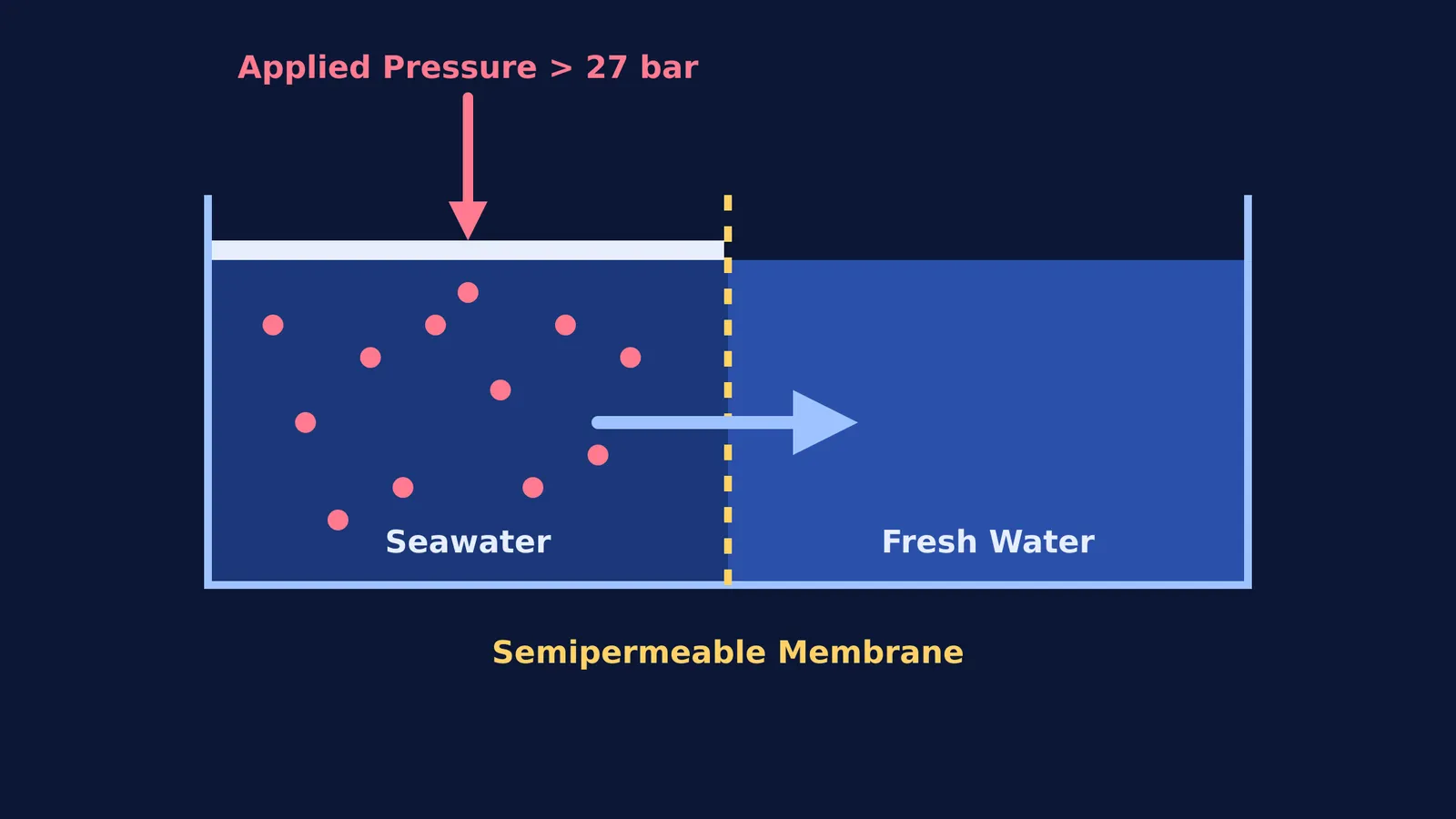
What is reverse osmosis and why is pressure greater than osmotic?
Stopping the flow of water is not enough for a thirsty city; we need to extract fresh water from the brine.
To run the process backwards, we must apply an external mechanical force to the seawater. Pushing down with 27 bar of pressure would only bring the system to a standstill, balancing out the natural osmotic pull (Wikipedia: Reverse osmosis). To actually squeeze fresh water through the membrane and leave the concentrated salt behind, the applied pressure must be strictly greater than the natural osmotic pressure.
How desalination plants operate in the real world
Because of this steep physical requirement, seawater desalination plants cannot use standard plumbing pumps, which might only deliver a few bar of pressure. Instead, they use massive industrial pumps to reach an operating pressure typically between 40 and 82 bar, or 600 to 1,200 psi (Wikipedia: Reverse osmosis).
This enormous pressure requirement makes reverse osmosis an extremely energy-intensive process. A large portion of the financial and environmental cost of running a desalination plant goes directly into the electricity needed to overcome the ocean's natural osmotic pressure. Modern plants recover some of this energy by routing the highly pressurised waste brine through a turbine before it returns to the sea, helping to power the incoming pumps. By contrast, purifying brackish water (which is much less salty than the sea) requires significantly lower operating pressures of just 2 to 17 bar, or 30 to 250 psi (Wikipedia: Reverse osmosis).
A framework for calculating pressure needs
If you are finding molar mass from osmotic pressure or trying to design a basic filtration setup, you can estimate the required pressure using three steps:
Identify the total concentration of all dissolved particles in your feed water (remembering that a salt like NaCl splits into two distinct ions, doubling the effect).
Multiply this total concentration by the ideal gas constant (R) and the absolute temperature in Kelvin (T) to find the resting osmotic pressure.
Add a generous operating margin on top of this baseline pressure to ensure a practical, continuous flow rate of purified water across the membrane.


